IndyLab
24 August 2025
Gyuri Lajos created group «IndyLab» with members Gyuri Lajos, Robert Best, Parmjit Nahil, James Wong, Yarrow Love and Michael Lennon
GL
08:21
Gyuri Lajos
I came to this group because my work reached the stage when I'm ready to synthesise and I integrate all the on going exploratory experimental pieces into one coherent autopoietic whole.
08:22
I did not work under the heading indylab so far because my focus was on technical pieces that were clearly needed but they needed to be operating to some degree to enable me to start fitting them together.
👍
ML
JW
25 August 2025
GL
19:44
Gyuri Lajos
JW
James Wong 25.08.2025 19:19:07
If indywiki pre alpha is the first thing to be ready then can we construct mindplex with it?
GL
19:50
Gyuri Lajos
When you draw a kolam, a trefoil you follow a single path nd when it is done and complete there is no longer a first loop. Or When you write the Eval/Apply mutually recursive functions as the Universal Function that defines LISP there is no first function, both works only when both are complete and the flow of control oscillates between them. The same is stru for the Universal HyprDocument system that I am building.
Indywiki works on its own creating MindGraph dots that are interconnected. But that is not a MindPlex yet, just the dots and the connections. It becomes a graphPlex when Immediate neighbourhoods of nodes bot incoming and outgoing links and dots are themselves get turned into Dots in conPlex Spaces. I just made up the word for it today.
Indywiki works on its own creating MindGraph dots that are interconnected. But that is not a MindPlex yet, just the dots and the connections. It becomes a graphPlex when Immediate neighbourhoods of nodes bot incoming and outgoing links and dots are themselves get turned into Dots in conPlex Spaces. I just made up the word for it today.
GL
19:50
Gyuri Lajos
GL
Gyuri Lajos 25.08.2025 19:36:37
There is no such thing as the first thing ready. I've been working on setting out these mutual arising capabilities as I build them all together as it is in the process of all coming together. Everything I write is using the emergent conventions and affordances are all mindplexes. Mindgraphs graphplexes many names for the same wholiztic constructs with implicate mutually arusung affordances
GL
19:52
Gyuri Lajos
That iwas clearly one of the missing concepts. I felt stongly for the past 40 years (not exactly in these words) that if you get you intentional afetive concept space rith software will nearly take care of itself. But you need to get them ALL and get them right through exploratory experiments.
GL
22:21
This is the start page for the conPlex where the IndyWeb will be born/sawned/ woven fine
👏
JW
ML
22:23
There is a natural isomorphism between carefully constrccted folder structures and graphPlexes
22:24
This is the secret Sauce (secret because it is secreted in my mind and not much of it yet got eternalied iand fully formed
22:25
Each page will have an automatically generated outline of its immdiate neighbourhood or level 1 conPlex
22:26
The basic unit of expression is not a page but a conPlex
22:26
On the other hand every page can contain entry points ot many conPlex
22:27
Pages using trailmarks can automatically turned into conPlexes via transclusion
22:28
And all the functions needed to do all that will be part of these one MEMplEX neiaghbourhood
29 August 2025
GL
10:11
Gyuri Lajos
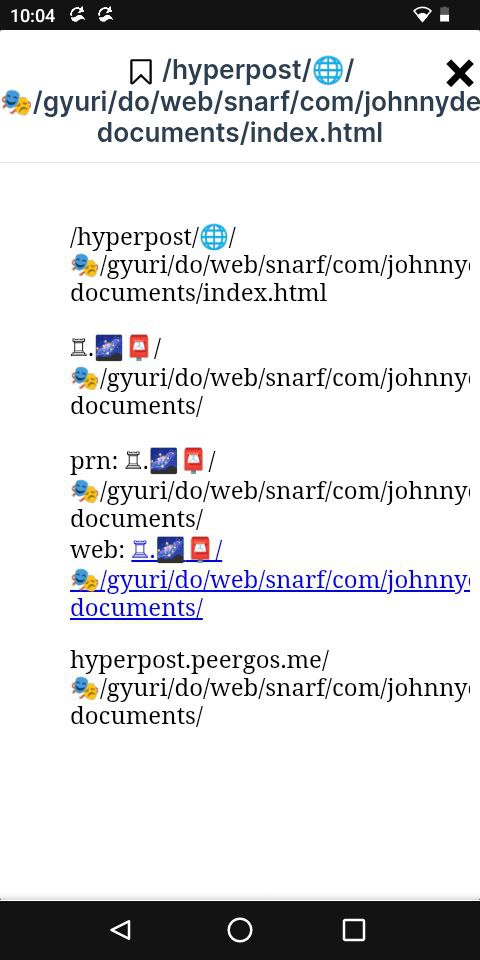
Compare contrast build upon reflecting on JDEX
Treat
Folder paths as human meaningful intentionally transparent uninstall resource names
Leverage IPFS content addressability and Peergos together to provide mechanisms that allow URNs that are permanent yet resolve to specific versions of resources in context or rather conplexes with for verifiable attribution provenance and recapitulable history
Treat
Folder paths as human meaningful intentionally transparent uninstall resource names
Leverage IPFS content addressability and Peergos together to provide mechanisms that allow URNs that are permanent yet resolve to specific versions of resources in context or rather conplexes with for verifiable attribution provenance and recapitulable history
10:12
Allow for multiple alternative names
for the same resource embedded reused in all appropriate contexts.
for the same resource embedded reused in all appropriate contexts.
10:14
Most importantly URNs can be resolved using a range of named protocols
The resources themselves carry designations of available retrieval schemes
The resources themselves carry designations of available retrieval schemes
10:18
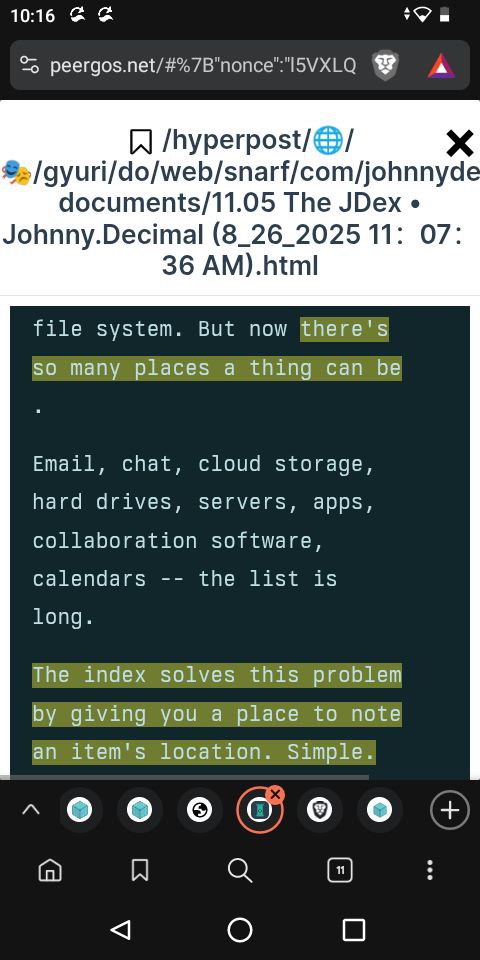
JDEX Problem statement and value proposition
10:29
IndyLab solves this problem by giving 1 (individual or named communities of practice and collaboration) a single private permanent personal-first evergreen self organising space to keep everything you care about and engage with on the web or the IndyWeb in a way that maximize flow of information, conversations that are continuous without being synchronous and all interwoven work flows for maximal benefit continuity productivity and continuous autonomous autopoietic improvement
That space is not just a digital vellum but facilitate work interplay that itself provide lifelong expansion of mutual learning and growth of understanding along with ownership of the very computational means that are required.
That space is not just a digital vellum but facilitate work interplay that itself provide lifelong expansion of mutual learning and growth of understanding along with ownership of the very computational means that are required.
JW
10:41
James Wong
In reply to this message
Tried to log in to comment but the login page could not be found.
10:56
In reply to this message
❓ Is this comparable to multiple queries that can access the same database?
- A graph/Plex node/dot can be reached through many different associative pathways
- In my view, the widespread adoption of the file folder in software UI has been a major misstep and is like forcing a square peg into a round hole
- there are many ways to classify and idea, but file folders artificially force us to choose one specific folder name, often the wrong one
- and the inefficiency appears as soon as we try to find the idea again
- because the original search key w used as the folder name to classify the file is not the search key that appears in our mind's eye later on
- A graph/Plex node/dot can be reached through many different associative pathways
- In my view, the widespread adoption of the file folder in software UI has been a major misstep and is like forcing a square peg into a round hole
- there are many ways to classify and idea, but file folders artificially force us to choose one specific folder name, often the wrong one
- and the inefficiency appears as soon as we try to find the idea again
- because the original search key w used as the folder name to classify the file is not the search key that appears in our mind's eye later on
GL
12:22
The true magic of content addressing is that the same file can appear in many folders it's identity does not depend where it appears in a folder structure, it can be anywhere all at once, yet it can be retrieved independently
Each resource maintains information links to all the other folders and full path to them where it is referenced
Each resource maintains information links to all the other folders and full path to them where it is referenced
12:24
Folders as named container in a structure is fine the mistake was to tie the identity of the file to the access path
💯
JW
12:27
Folder structure lay out in a plain neighbourhood of a point in space a conPlex they are great to work with when attention is focused and the resources so stored can but linked to a complete list of all the conPlexes where they are used reused
12:30
Peergos gives permanent names to mutable folders the best thing to store all meta information
As long as the actual resources are stored in IPFS we can combine the best of both worlds. I played such game with Fission but this constellation is really what is required
As long as the actual resources are stored in IPFS we can combine the best of both worlds. I played such game with Fission but this constellation is really what is required
12:33
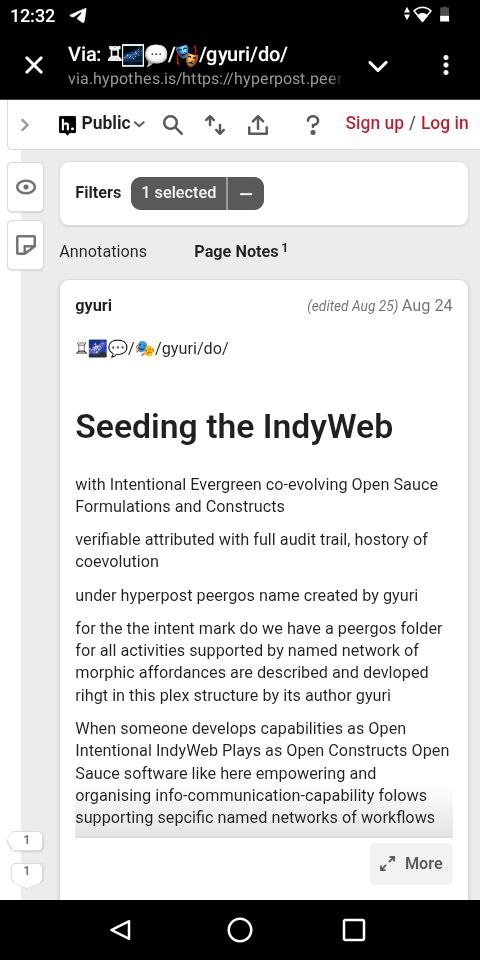
Worked for me
JW
21:35
James Wong
In reply to this message
Which software keeps track of all the file folder associations of the CID?
YL
22:03
Yarrow Love
And KV store might work 🤔
22:04
Hmm
30 August 2025
GL
10:39
Gyuri Lajos
All the best software in the long tail of the indy Web is deeply interdependent origination form a dynamic mutual arising implicate dynamic order. The all of them contain a the same seed with graphplexes née MindGraph
at some stage of auropoirsus is the common shared omnipresent kernel that is kind of graph shaped structured intentionally transparent and key value store instantiated as local Storage local forage ultimately index dB but can have many other instantiation depending on the scale and nature of the open sauce infrastructure devised for specific scale and nature of required homoicinic self hosting info-comunication-conversational virtual cloud services and infrastructes that are all commons based peer produced constellation that coevolve cicreated cocurated
Shaed and replicated all ways rooted in indy usual self-sovereign pseudo identities
at some stage of auropoirsus is the common shared omnipresent kernel that is kind of graph shaped structured intentionally transparent and key value store instantiated as local Storage local forage ultimately index dB but can have many other instantiation depending on the scale and nature of the open sauce infrastructure devised for specific scale and nature of required homoicinic self hosting info-comunication-conversational virtual cloud services and infrastructes that are all commons based peer produced constellation that coevolve cicreated cocurated
Shaed and replicated all ways rooted in indy usual self-sovereign pseudo identities
31 August 2025
GL
08:14
Gyuri Lajos
Relating IndyLab to HyperPost. The minimal constellation for
HyperPost is a Personal IndyLab designed to provide a singular autonomous private permanent co-evolutionary Space for creating,curating local first off line first private first permanent Universal HyperDocuments and associated Personal First We
b native affordances and capabilities and infrastructure for lifelong private learning and sharing and collaboration with a view to be interplay-able and collaboration in the emergent indy learning commons. Where Personal Learning Work seamless extends to collaborative mutual indy learning commons seeding the InterPersonal IndyLab that weaving the indy mutual learning commons where people are able to create their own named dedicated communities around shares interest and pursuits
Scaling their mutual learning attainable synthesis discover ability visibility reach and impact
HyperPost is a Personal IndyLab designed to provide a singular autonomous private permanent co-evolutionary Space for creating,curating local first off line first private first permanent Universal HyperDocuments and associated Personal First We
b native affordances and capabilities and infrastructure for lifelong private learning and sharing and collaboration with a view to be interplay-able and collaboration in the emergent indy learning commons. Where Personal Learning Work seamless extends to collaborative mutual indy learning commons seeding the InterPersonal IndyLab that weaving the indy mutual learning commons where people are able to create their own named dedicated communities around shares interest and pursuits
Scaling their mutual learning attainable synthesis discover ability visibility reach and impact
08:22
Stop oscillating between personal IndyLab and interpersonal IndyLab while focusing on HyperPost and develop it at ever expanding scales
08:25
start with personal mono logue
Dialogue deep peer to peer conversations
create private groups from known trusted peers who in turn are able to invite others from their own trusted peers into groups they are participating.
Dialogue deep peer to peer conversations
create private groups from known trusted peers who in turn are able to invite others from their own trusted peers into groups they are participating.
08:29
Such groups would seed their own trusted interpersonal indylabs weaving the Indy Learning commons when connecting collaborating with other IndyLabs
❤
JW
08:35
This is an initial draft of my current focus aiming to deliver at least a plan shared from the outset in the Open within the Open Learning Commons project: Indy Learning Commons.
Start work in the Open.
From within my own Personal IndyLab with the goal of creating a launch community for HyperPost as the seed IndyLab
Identify tasks and budgetary requirements and campaign for sponsorship
👍
Start work in the Open.
From within my own Personal IndyLab with the goal of creating a launch community for HyperPost as the seed IndyLab
Identify tasks and budgetary requirements and campaign for sponsorship
JW
08:39
outline-work break down structure
08:46
gyuri/do/post/via/indy/lab/0
As per universal convention sub folders named 0 in a folder are created as containers for meta-level structured information and capabilities work ineterplay-ces
This one is under the name gyuri which matches the hypothes.is account we may need some refactoring later but run with it
As this gives permanent attribution to the named actor author player One
As per universal convention sub folders named 0 in a folder are created as containers for meta-level structured information and capabilities work ineterplay-ces
This one is under the name gyuri which matches the hypothes.is account we may need some refactoring later but run with it
As this gives permanent attribution to the named actor author player One
08:47
remember all this available at
hyperpost.peergos.me
hyperpost.peergos.me
08:52
gyuri/do/post/via/indy/lab/1
instance first constellation for Personal IndyLab unnamed self that is the owner of the enclosing Peergos/IPFS space
Remember this path is part of a Webhosted directory so all the content here is puvlically available but can contain private links to Peergos folders that are accessible to the peergosspace owner
instance first constellation for Personal IndyLab unnamed self that is the owner of the enclosing Peergos/IPFS space
Remember this path is part of a Webhosted directory so all the content here is puvlically available but can contain private links to Peergos folders that are accessible to the peergosspace owner
09:01
//-- reflective observation
09:03
For the past 23 years I relied on mobile devices, starting with my first one Sony Clie a Palm powered Personal Digital Assistant, to sketch design ideas on the go. Writing to think.
09:09
I could not use my iLike f++ device as it's battery could not be charged.
The battery seemed to have recovered and I can use it at least just for writing.
That helps a lot
The battery seemed to have recovered and I can use it at least just for writing.
That helps a lot
09:09
--!//
GL
09:30
Gyuri Lajos
This is a practical example of my tacit dictum for the past 40 years
A correction of the totally misguiding dictum of Haugeland in Mind Design where he stated
A correction of the totally misguiding dictum of Haugeland in Mind Design where he stated
09:31
If u get your syntax right semantics can take care of itself
09:35
If you get the inception of the affective interplaying concepts of the constructs players and plays that are required, their IT, right, we the people can co- create take care of IT in through symmathetic conversations in the medium of software
GL
10:56
Gyuri Lajos
indy/lab/1/
- hub
- // responsible for
- exchange/ flows of
- information
- services
- across/between individual's own
- devices
- personas/accounts
- services
-
- doc
- // responsible for
- create, curate, comprehend, self-organize, morph
- universal hyper Plex documents
- wiki
- CK.editor
- map
- hub
- // responsible for
- exchange/ flows of
- information
- services
- across/between individual's own
- devices
- personas/accounts
- services
-
- doc
- // responsible for
- create, curate, comprehend, self-organize, morph
- universal hyper Plex documents
- wiki
- CK.editor
- map
11:01
indy/lab/2
// Peer 2 peer sharing and collaboration
// Peer 2 peer sharing and collaboration
11:10
indy/lab/3
Create named interest/pursuit collaborative spaces dedicated to named interests/purposes/pursuits/pursuances as group with two members as co stewards
Create named interest/pursuit collaborative spaces dedicated to named interests/purposes/pursuits/pursuances as group with two members as co stewards
1 September 2025
GL
07:46
Gyuri Lajos
Use this group for IndyLab related chatter
2 September 2025
JW
18:50
James Wong
> Question
- can adjacency between ideas be interpreted as a dot?
- if so, can Peergos subdirectory structure be applied to newly emerged adjacency relationships?
- can adjacency between ideas be interpreted as a dot?
- if so, can Peergos subdirectory structure be applied to newly emerged adjacency relationships?
GL
19:25
Gyuri Lajos
Just name it and it is a dot in conPlex space name the association the name itself cN be a composite a trail dot is a clue or clue in a whoi neighbourhood of intertwingularity
3 September 2025
JW
04:48
James Wong
In reply to this message
> Q ❓ - what is the syntax/format so that the new name can be recognised as a dot and indexed by indyweb?
GL
07:52
Gyuri Lajos
It is is a state of flux, but it will be shipping in a way so that it will be fully self-documenting and tinkerable.
I used to have '- ' But to preserve markdown compatibility, certainly on tha annotation margins need to use just hypen - at the first character and then clueterms
I used to have '- ' But to preserve markdown compatibility, certainly on tha annotation margins need to use just hypen - at the first character and then clueterms
07:54
I think I have an idea how to revive Open Collective. I'll be around this morning if u have time with say 30 minutes notice. I'd better set up my other laptop. I have too many windows open, work in progress in many fronts
GL
08:18
Gyuri Lajos
need to check this out https://sideways.earth/wp-content/uploads/2024/06/Group-1000002263-1.webp
08:20
Grace Rachmany
GL
08:21
Gyuri Lajos
GL
Gyuri Lajos 02.09.2025 14:05:57
Hi Grace. I'll be reading/annotating it, but have to snarf to get a poermanent copy. I saved it here so that I can annotate and engage in conersations away from the centralied platforms https://bafybeieypkzbo5af57mfcqgg4dt2srzdhforknpccw26xyaitot3hxd3su.ipfs.dweb.link/KopievonExtranationalIdentificationVerifiable.html
JW
09:17
James Wong
What time do you want to meet?
GL
10:06
Gyuri Lajos
I have to do some cooking. In an hour's time, But that may clash with yours's. After 2 pm I may be able to designate a time. Sometime between 2 and 5 pm would be great.
10:26
Deep interplay with Hypothesis
JW
11:04
James Wong
In reply to this message
I'll make myself available between 2 and 5pm. Does 3 pm sound good?
GL
11:30
Gyuri Lajos
Will see hopefully
GL
12:13
Gyuri Lajos
Just realised I have a dental appointment this afternoon
12:13
I got the day wrong
JW
14:43
James Wong
oh, ok. so no meeting today.
GL
18:40
Gyuri Lajos
Sorry
4 September 2025
JW
06:27
James Wong
Let me know when you want to meet.
GL
09:17
Gyuri Lajos
Morning Gien
09:20
how does 12:30 sounds +/-0.5 hour whichever is best for u
JW
10:49
James Wong
Sounds good
GL
10:54
Gyuri Lajos
Which one u pick within that range
PN
11:26
Parmjit Nahil
Hey guys, can I join if that's 12.30 Hungary/European time?
GL
12:31
Gyuri Lajos
Yes 12:30 Hungary.
PN
12:32
Parmjit Nahil
So where is the link to meet?
GL
12:32
Gyuri Lajos
I just had a bit of a network outage. Will take 5 minutes to get that link
PN
12:33
Parmjit Nahil
OK let's catch up!
GL
12:35
Gyuri Lajos
we could use telegram for a change
PN
12:36
Parmjit Nahil
Ok 👍
GL
12:37
Gyuri Lajos
While I get ready please check this one out and the team
12:41
go to go t
12:41
12:42
pick your username
12:43
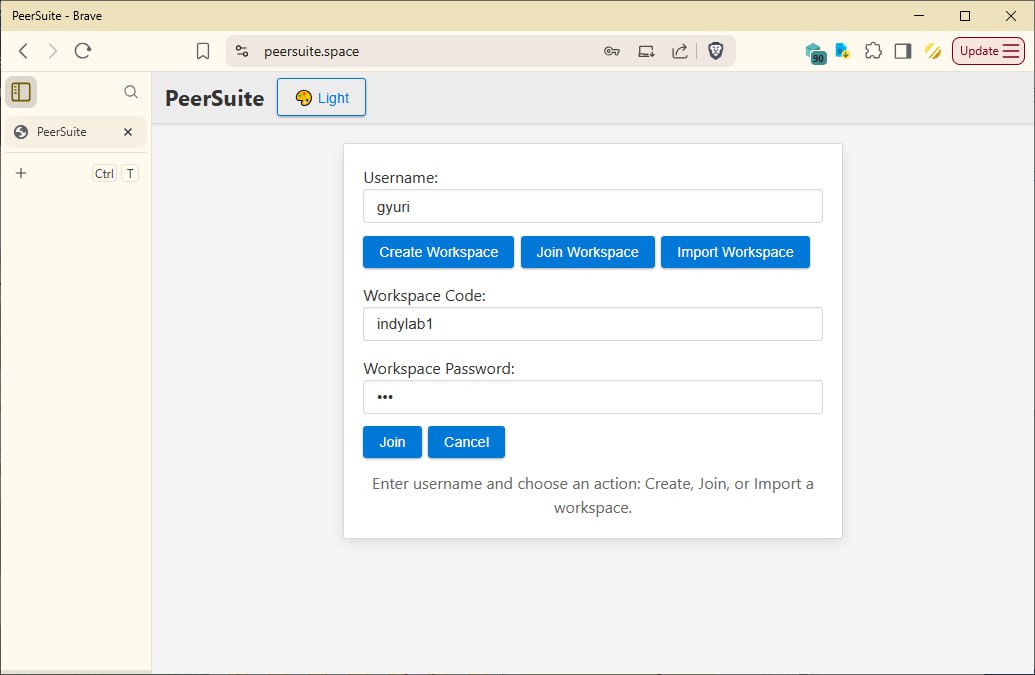
give indylab1 as workspace code
12:43
pw diy and press join]
PN
12:46
Parmjit Nahil
wait a moment
GL
13:15
Gyuri Lajos
seemed tohave lost connection
13:16
You may need to rejjoin peersuite.space
PN
ML
22:13
Michael Lennon
@Gien_0 (et al.)
This reminded me of some of your work. Thoughts?
https://learn.opensourceecology.org
This reminded me of some of your work. Thoughts?
https://learn.opensourceecology.org
5 September 2025
JW
07:43
James Wong
In reply to this message
Yes, in the same space. I met Marcin over upon a time, inviting him to speak at Open Source Circular Economy Days of a global event that I was part of.
👍
ML
8 September 2025
GL
11:22
Gyuri Lajos
Latest exemplar of con-vergence/fluence of way of writing and annotating is eemplified like this@
11:24
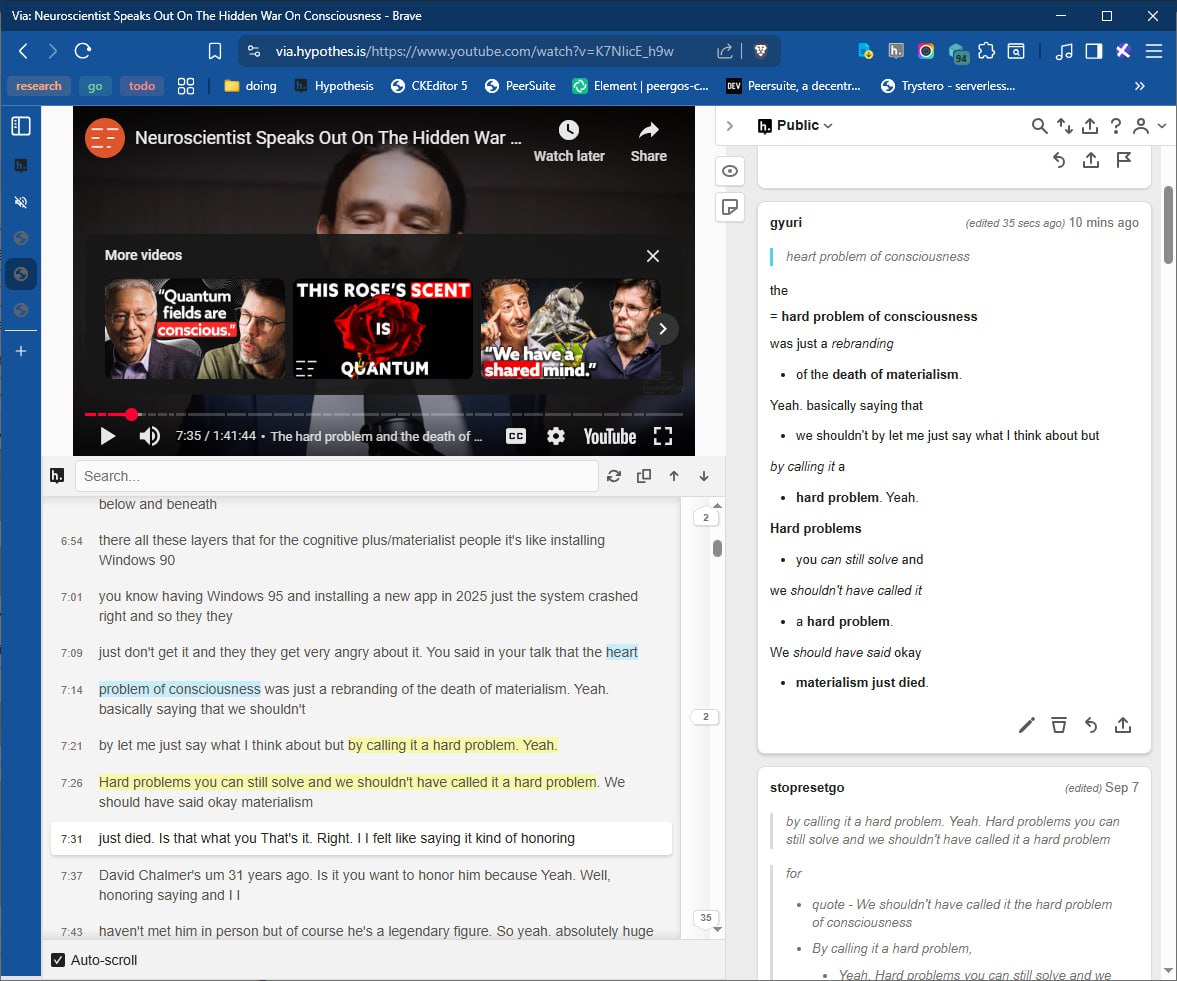
Use italics for verb like turn of words and bold four noun like turn of words
GL
15:22
Gyuri Lajos
GL
Gyuri Lajos 08.09.2025 12:58:20
We are set to drum up some sponsorship and renewed activities going on the next couple of days. It would be nice if we could arrange a call this week for an update
ML
GL
15:22
Gyuri Lajos
RB
Robert Best 08.09.2025 15:02:23
Sorry, I've been away on a little vacation with my family... Not home right now. Just happened to have a bit of wifi to see this. Will likely be back around sept 22 or so.
GL
15:22
Gyuri Lajos
GL
Gyuri Lajos 08.09.2025 15:04:08
Have a great vacation. Hopefully indy learning commons will not be shutdown with all current actvities
15:22
Thank u for the update
GL
15:22
Gyuri Lajos
RB
Robert Best 08.09.2025 15:09:24
I'll try and contact them and say we intend to still keep the space, to hold off on stopping anything and give us some more time to update things.
GL
15:22
Gyuri Lajos
GL
Gyuri Lajos 08.09.2025 15:11:31
Thank you. We got some sponsorship came in today and expect more and will be working on launching a couple oelit trials
ML
17:05
In reply to this message
watched yesterday while walking. Mobile-based media consumption impacts my social annotation capacity.
9 September 2025
JW
07:07
James Wong
> indyweb breakthrough / epiphany - language is sparse encoding - agential RAGs are the wrong strategy - the Indyweb is the right direction with modularity and reusability as fundamental information design axioms
- every sentence, every paragraph, every chapter, every essay, every book every paper is intrinsically sparse encoding.
- language fundamentally correlates to the columnar organisation of neuronal groups of approximately 10,000 neurons
- the English language has a few hundred thousand words in dictionary groups
- IPFS employs content addresses that can be mapped to dictionary groups
- this finally breaks through the extremely primitive backwards digital fascimile of the past half century by enabling true modularity of networks of ideas
- making them reusable and modular instead of inflexible fixed text corpus.
- Looking at how AI tools use a technique called agential RAG (Retrieval Augmented Generation),
- it is the fundamentally the wrong way to go about generating modular ideas to store in a graph by chunking a big block of text corpus into smaller ideas.
- This is because the assumption of storing big blocks of text corpus is the wrong assumption to begin with
- this considers modularity and reusability as an afterthought rather than as a fundamental design principle
- incremental change can keep us moving on the wrong direction
- that's when a paradigm shift is absolutely required
- implementing sparse encoding for language itself is pretty revolutionary!
- but it is the only way to mitigate a combinatorial explosion.
- every sentence, every paragraph, every chapter, every essay, every book every paper is intrinsically sparse encoding.
- language fundamentally correlates to the columnar organisation of neuronal groups of approximately 10,000 neurons
- the English language has a few hundred thousand words in dictionary groups
- IPFS employs content addresses that can be mapped to dictionary groups
- this finally breaks through the extremely primitive backwards digital fascimile of the past half century by enabling true modularity of networks of ideas
- making them reusable and modular instead of inflexible fixed text corpus.
- Looking at how AI tools use a technique called agential RAG (Retrieval Augmented Generation),
- it is the fundamentally the wrong way to go about generating modular ideas to store in a graph by chunking a big block of text corpus into smaller ideas.
- This is because the assumption of storing big blocks of text corpus is the wrong assumption to begin with
- this considers modularity and reusability as an afterthought rather than as a fundamental design principle
- incremental change can keep us moving on the wrong direction
- that's when a paradigm shift is absolutely required
- implementing sparse encoding for language itself is pretty revolutionary!
- but it is the only way to mitigate a combinatorial explosion.
JW
07:48
James Wong
> indyweb breakthrough / epiphany - language IS sparse encoding - agential RAGs are the wrong strategy - the Indyweb is the right direction with modularity and reusability as fundamental information design axioms
- every sentence, every paragraph, every chapter, every essay, every book every paper is intrinsically sparse encoding.
- language fundamentally correlates to the columnar organisation of the neocortical neuronal groups of approximately 10,000 neurons
- and there are approximately 200 million such cortical mini columns of grouped neurons that make up the neocortex
- each spoken human language has a few hundred thousand words in its dictionary group
- specialised domains expand this but
- English has an estimated 171,000 current words,
- dictionaries contain over a million entries, while
- a native speaker's active vocabulary might be closer to 20,000 words.
- sparse coding may be the way brains evolved to deal with the combinatorial explosion of symbolic spoken language
- IPFS employs content addresses that can be mapped to dictionary groups
- this finally breaks through the extremely primitive backwards digital fascimile of the past half century by enabling true modularity of networks of ideas
- making them reusable and modular instead of inflexible fixed text corpus.
- Looking at how AI tools use a technique called agential RAG (Retrieval Augmented Generation),
- it is the fundamentally the wrong way to go about generating modular ideas to store in a graph by chunking a big block of text corpus into smaller ideas.
- This is because the assumption of storing big blocks of text corpus is the wrong assumption to begin with
- this considers modularity and reusability as an afterthought rather than as a fundamental design principle
- incremental change can keep us moving on the wrong direction
- that's when a paradigm shift is absolutely required
- implementing sparse encoding for language itself is pretty revolutionary!
- but it is the only way to mitigate a combinatorial explosion
- a theoretical model for sparse encoding of language in current generation of computing devices can be very useful to operationalize a new digital LANGUAGE system that opens up the latent possibilities of language
- the Indyweb is the system most aligned to developing the next generation of human language
- language itself is a strange loop
- it is simultaneously reality AND a description of reality
- In this sense, it is a cultural artefact of human self-awareness
- Gregg Henrique's uToK that breaks reality into different system levels embedded like nested Russian dolls may be a clue as to reality's inherent self-organisational, autopoeitic, system levels.
Different signs are appropriate for different levels.
- plants cannot directly communicate with bacteria
- cats cannot symbolically communicate with plants
- humans cannot symbolically communicate with cats
- at least not in detail and comprehensively
- in this model, one could interpret "enlightenment" our awakening as an act of getting in touch with the lowest level of our system in relationship to all of reality
- Sparse coding was introduced by Jeff Hawkins of Numenta and the Redwood center for Theoretical Neuroscience
https://redwood.berkeley.edu
- the act of writing should be activating word/idea nodes in realtime via some level of sparse encoding to record the idea flow.
- recognized pathways between sequences of nodes can be measured with a distance metric that can trigger reusability.
- novel composition is timebinding, we generate a mixture of novel text strings along with existing ones. It's always mixed mode.
- citation
- new idea
- citation
- new idea
- etc...
- every sentence, every paragraph, every chapter, every essay, every book every paper is intrinsically sparse encoding.
- language fundamentally correlates to the columnar organisation of the neocortical neuronal groups of approximately 10,000 neurons
- and there are approximately 200 million such cortical mini columns of grouped neurons that make up the neocortex
- each spoken human language has a few hundred thousand words in its dictionary group
- specialised domains expand this but
- English has an estimated 171,000 current words,
- dictionaries contain over a million entries, while
- a native speaker's active vocabulary might be closer to 20,000 words.
- sparse coding may be the way brains evolved to deal with the combinatorial explosion of symbolic spoken language
- IPFS employs content addresses that can be mapped to dictionary groups
- this finally breaks through the extremely primitive backwards digital fascimile of the past half century by enabling true modularity of networks of ideas
- making them reusable and modular instead of inflexible fixed text corpus.
- Looking at how AI tools use a technique called agential RAG (Retrieval Augmented Generation),
- it is the fundamentally the wrong way to go about generating modular ideas to store in a graph by chunking a big block of text corpus into smaller ideas.
- This is because the assumption of storing big blocks of text corpus is the wrong assumption to begin with
- this considers modularity and reusability as an afterthought rather than as a fundamental design principle
- incremental change can keep us moving on the wrong direction
- that's when a paradigm shift is absolutely required
- implementing sparse encoding for language itself is pretty revolutionary!
- but it is the only way to mitigate a combinatorial explosion
- a theoretical model for sparse encoding of language in current generation of computing devices can be very useful to operationalize a new digital LANGUAGE system that opens up the latent possibilities of language
- the Indyweb is the system most aligned to developing the next generation of human language
- language itself is a strange loop
- it is simultaneously reality AND a description of reality
- In this sense, it is a cultural artefact of human self-awareness
- Gregg Henrique's uToK that breaks reality into different system levels embedded like nested Russian dolls may be a clue as to reality's inherent self-organisational, autopoeitic, system levels.
Different signs are appropriate for different levels.
- plants cannot directly communicate with bacteria
- cats cannot symbolically communicate with plants
- humans cannot symbolically communicate with cats
- at least not in detail and comprehensively
- in this model, one could interpret "enlightenment" our awakening as an act of getting in touch with the lowest level of our system in relationship to all of reality
- Sparse coding was introduced by Jeff Hawkins of Numenta and the Redwood center for Theoretical Neuroscience
https://redwood.berkeley.edu
- the act of writing should be activating word/idea nodes in realtime via some level of sparse encoding to record the idea flow.
- recognized pathways between sequences of nodes can be measured with a distance metric that can trigger reusability.
- novel composition is timebinding, we generate a mixture of novel text strings along with existing ones. It's always mixed mode.
- citation
- new idea
- citation
- new idea
- etc...
GL
08:55
Gyuri Lajos
GL
Gyuri Lajos 09.09.2025 08:42:37
Thank you Parmjit for your long term support
ML
08:55
I think we should be able to stir up enough activity so that we won't loose Indy Learning Commons space on Open Collective
08:55
I had received consistent feedback that suggest that the current hyperpost.peergos.me setup and its native integration with hypothes.is may not be as accessible and ready to scale approacj as I hoped for.
ML
08:55
I'll keep pursuing that path, of course, but thinking about a more readily acessible approach with greater viral reach potential. Expecting people to sign up and learn hypothes.is to scale their interpersonal cross social networks engagement and turn it into interpersonal mutual learning experience while weaving the Indy Learning /commons with that 1 sign up, even that is 1 signup to many.
ML
08:55
Going back to the drawing board. I think I have some great ideas, working on formulating them.
08:55
I had a chance to chat with Robert, He is on holiday with the Family till the 22 of September but will also respond to Open Collective not to shut down the project
ML
GL
08:56
Gyuri Lajos
In reply to this message
It is not modularity. It is composability and born interplayability. There are no modules everything is part of a constantly co-evolving coherent whole with its implicate order and interplays
👍
ML
08:58
refactor
repurpose
exapt
reimagined
all the while preserving continuity and availability through time and even future compatibility
repurpose
exapt
reimagined
all the while preserving continuity and availability through time and even future compatibility
09:00
In reply to this message
there is no such thing as information in its own it is all part of an info-communication-curation-conversation-capabilitye-affordance-work flows
👍
ML
09:00
which is all People Centered and for the benefit of the partiipants not the aggregators
09:02
everyone can own their own spaces and do it for themsleves and share capabilities software produced via symmathetic conversations, everyone becomes a symmatheticits in the medium of software in the long tail of the indyweb
09:05
In reply to this message
Peergos provides human readable Permanent names for mutable conPlexes not justContex but complete neioghbourhoods of named networked associative complexes
👍
ML
09:07
In reply to this message
composability scaling mastery of complexities, increase comprehension and scale human abilities to think and communicate previously unthinkable uncommunicable thorughts
09:09
In reply to this message
that's all there is in machine processable form on the web at the moment
👀
ML
09:11
In reply to this message
that is not encoding, but intentional structuring via artiualtio, creative naming with implicate structure and order that is dynamic autopoietic AND maintains the connection between the artifact and its creator(s) so you can always ask human actors involved and bring them together to work togehter, people can discover each other too
09:14
autnonomus self-organizing control of information by its creator for mutual benefit of the partiipants not some aggregator
PN
13:17
Parmjit Nahil
Perhaps it would help to direct the subject matter. I see a need for concepts such as Common Law to be clarified for example. If we could find 3 different projects to give examples of their definition, how they got to that definition and how they are using it on the ground successfully, that would help provide coherence for the collective (including me 😊)
13:21
However, there would have to be facilitated face-to-face sessions that would build a sense of cohesion and trust - the people selected would have to be doing work 'on the ground' that tests the validity of what the theory is based on
13:22
Also these will be very busy people so it all needs to be smooth and easy to use, with documents that are easy to locate, update with versions etc
11 September 2025
GL
07:57
Gyuri Lajos
PK
Peter Kaminski 11.09.2025 06:31:22
Peergos looks very cool, Gyuri. 🙂
ML
GL
07:57
Gyuri Lajos
GL
Gyuri Lajos 11.09.2025 07:56:42
Spent literally years studying it and shaping it to deliver its full potential. Will let you know when I'm ready to show rather than tell. If you have any questions I probably can tell you a lot about it. Just ask here. I like async channels. Remember the Dream Space "conversations that are continuous without being synchronous" , and that are contiguous with entirety of the participants life long learnings weaving the mutual autonomous Ind Learning Commons a stepping stone towards Collective Sense Commons OGM
GL
11:26
Gyuri Lajos
At long last I can just annotate this video and the one about the revolution will be annotated as a way to launch the seed for the Indy Learning commons memplex.net/hyperpost.co
GL
11:52
Gyuri Lajos
making the point that much of that dreamed about is now possible
11:53
for the past 6 years I've been dreaming of and preparing for being able to make these annotations and launch a systems that provides that capability describes on the margins
11:54
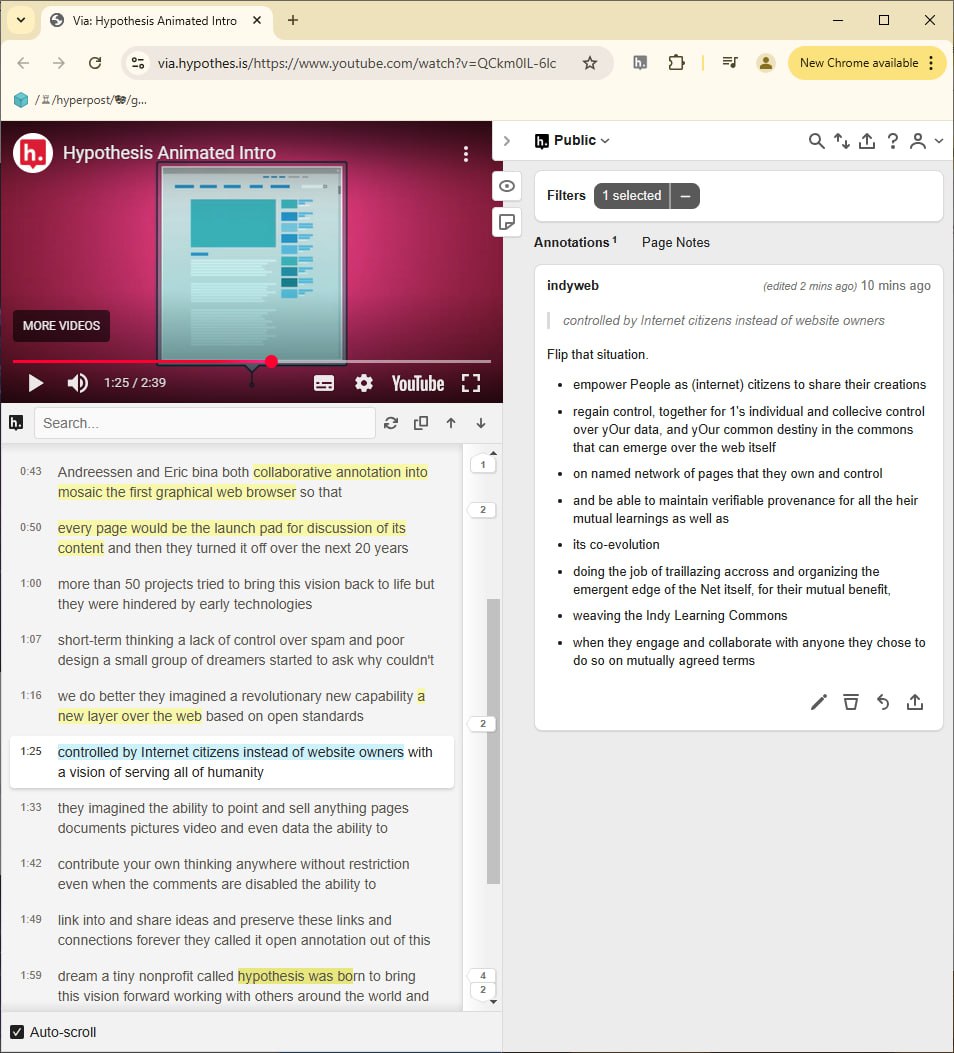
Indy Learning Commons as part of the Open Learning Commons
Gyuri Lajos invited Peter Kaminski
GL
20:13
Gyuri Lajos
GL
Gyuri Lajos 11.09.2025 20:00:58
Hi Peter. I'm sure you got the mail from CTA
20:13
What a perfect timing when we are getting ready be able to show rather then just tell
GL
20:16
Gyuri Lajos
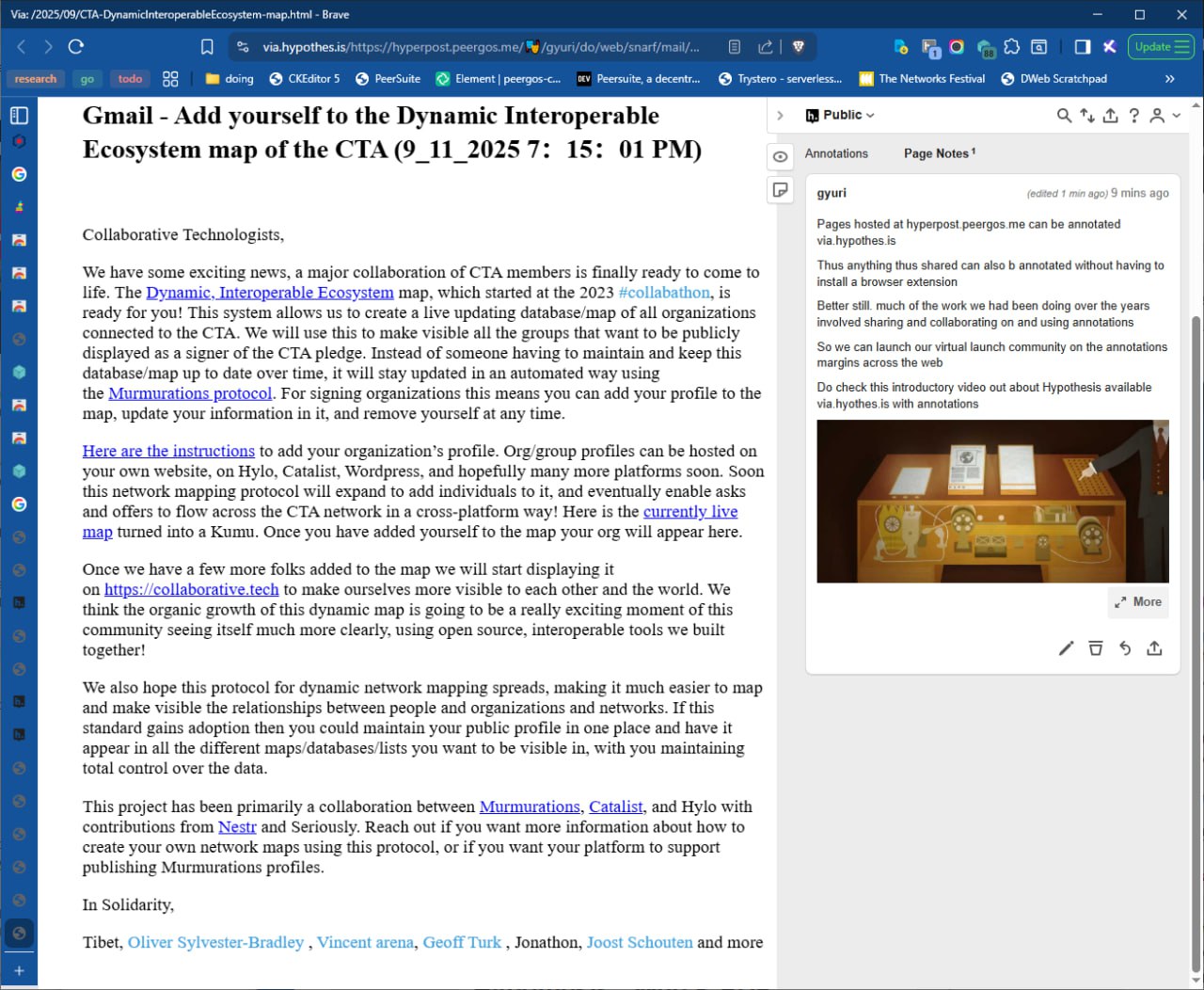
Saved the mail into Peergos folder for my private email long term autonomous storage and also an editied version for sharing openly on the web. Real soon this open access will be replaced by recorded sharing
13 September 2025
GL
10:25
Gyuri Lajos
transiounal-noites-indy0.seed
10:27
k51qzi5uqu5dgvbh9nhvfhg4g87zx7m6n9tl1l51mr6y978nitqq344e2bvmjm
10:29
indy0.seed
k51qzi5uqu5dizf8i0axacwcoxtavghju9zdjcbhzo7sxu4xpy8fvxl4h7rvnz
k51qzi5uqu5dizf8i0axacwcoxtavghju9zdjcbhzo7sxu4xpy8fvxl4h7rvnz
10:33
use local webui for IPFS Desktop that is displayed in the browser so we can use search to find the ipns setting for a given ipns that had been used earlier
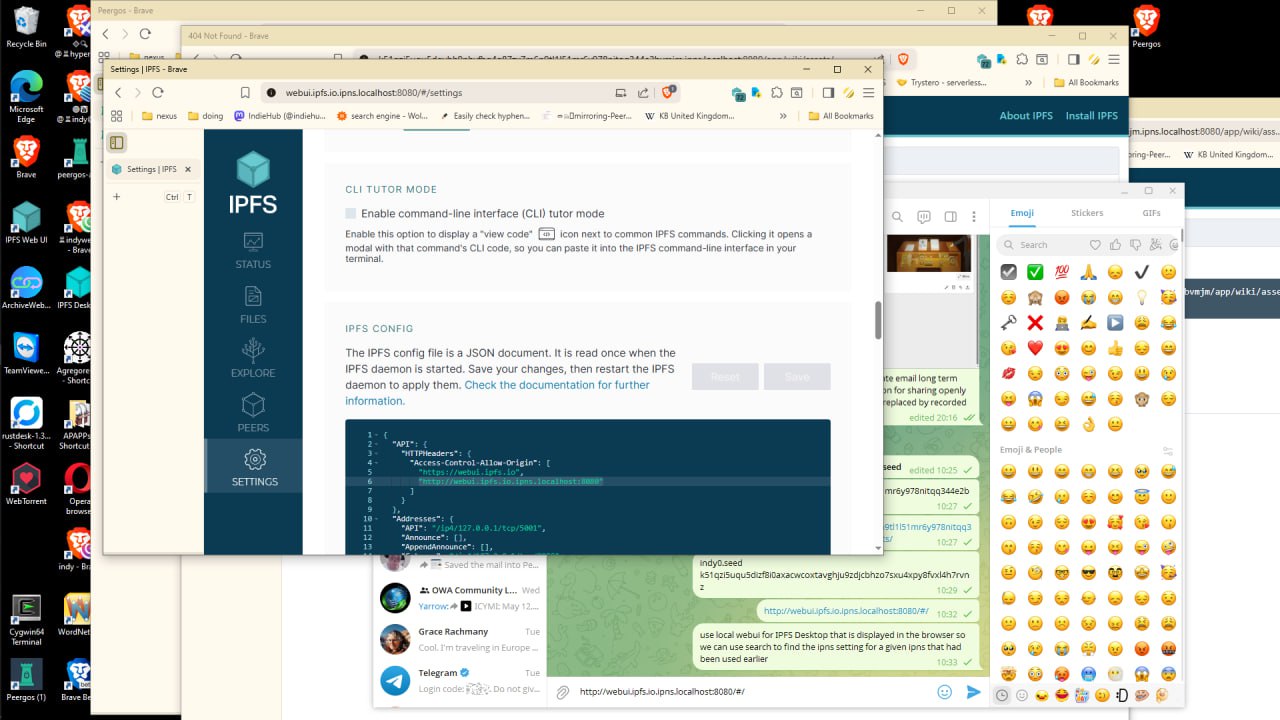
10:36
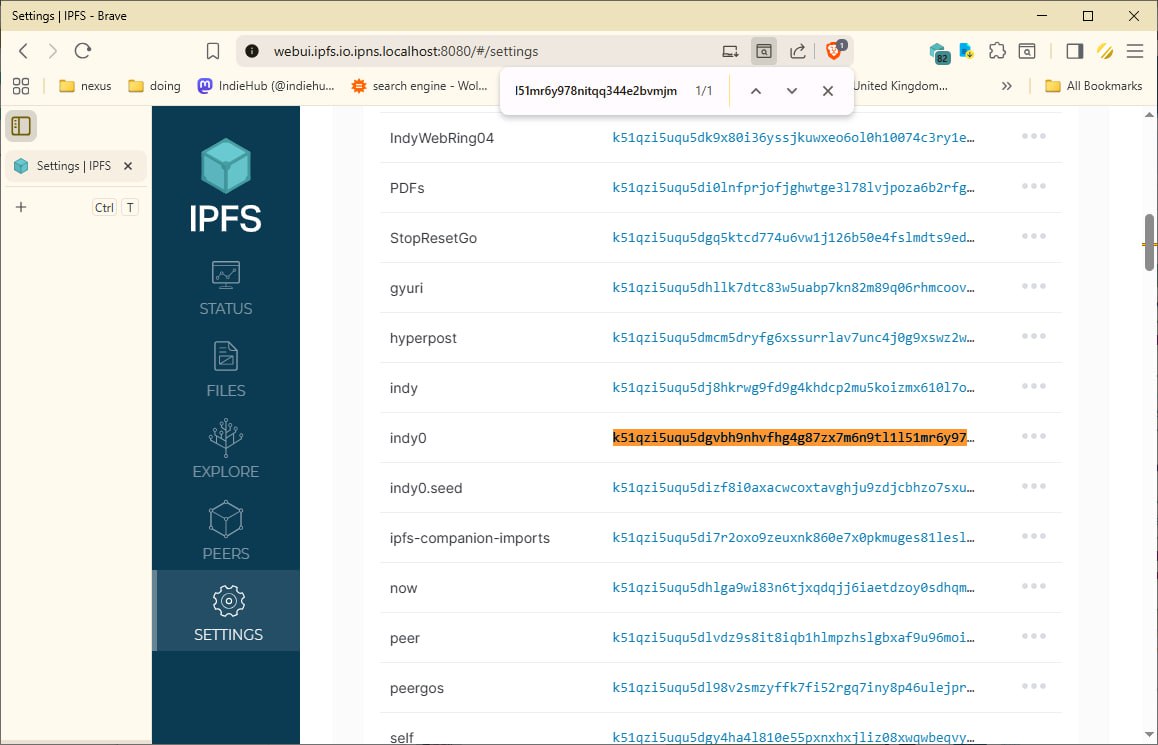
so it is indy0
10:38
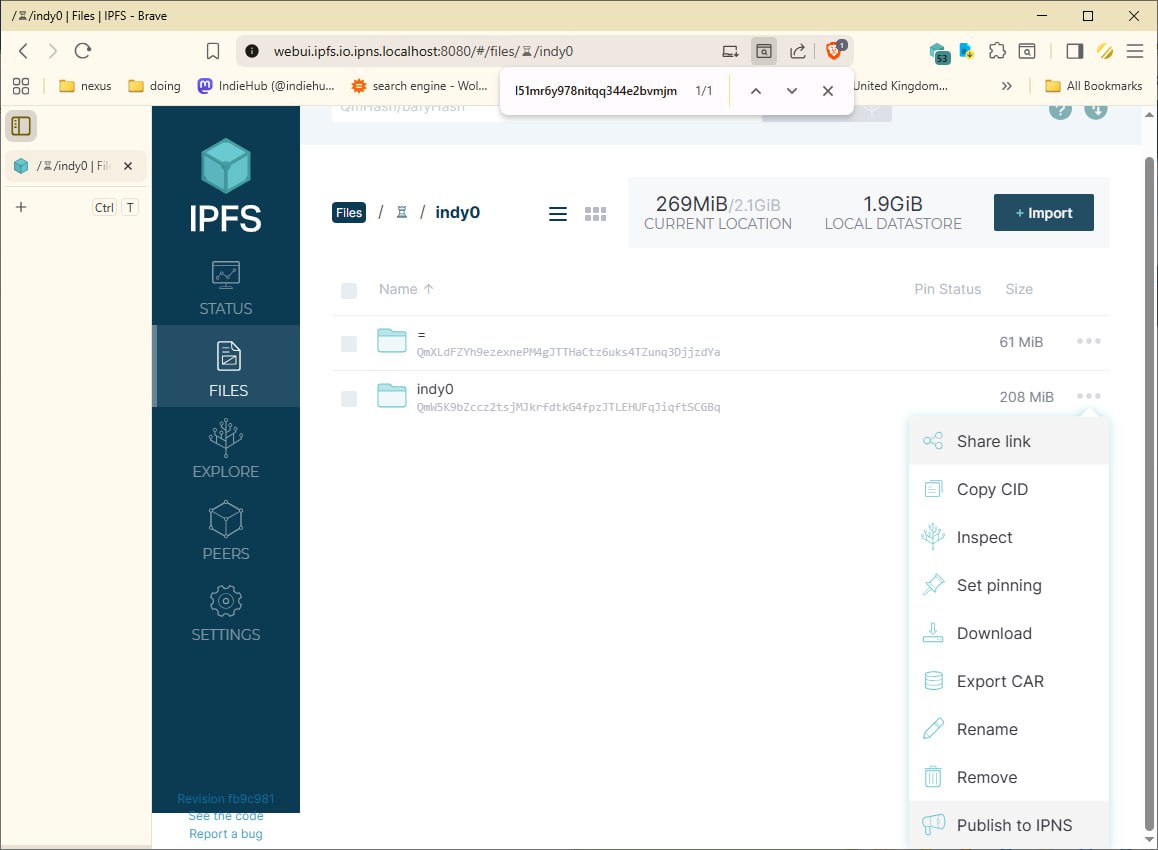
publish folder indy0/indy0 that has the app/wiki folder
10:41
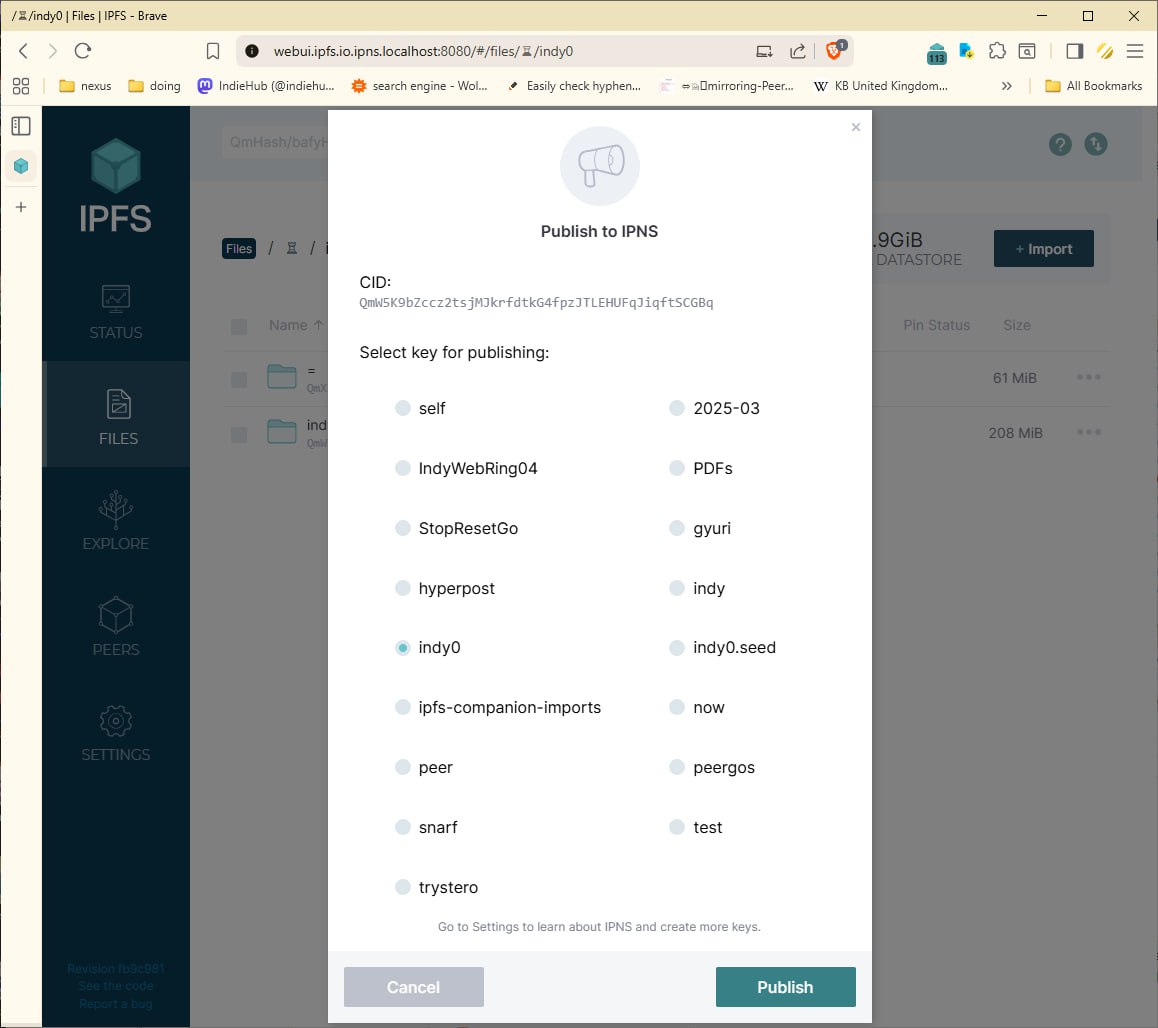
press Publish
10:41
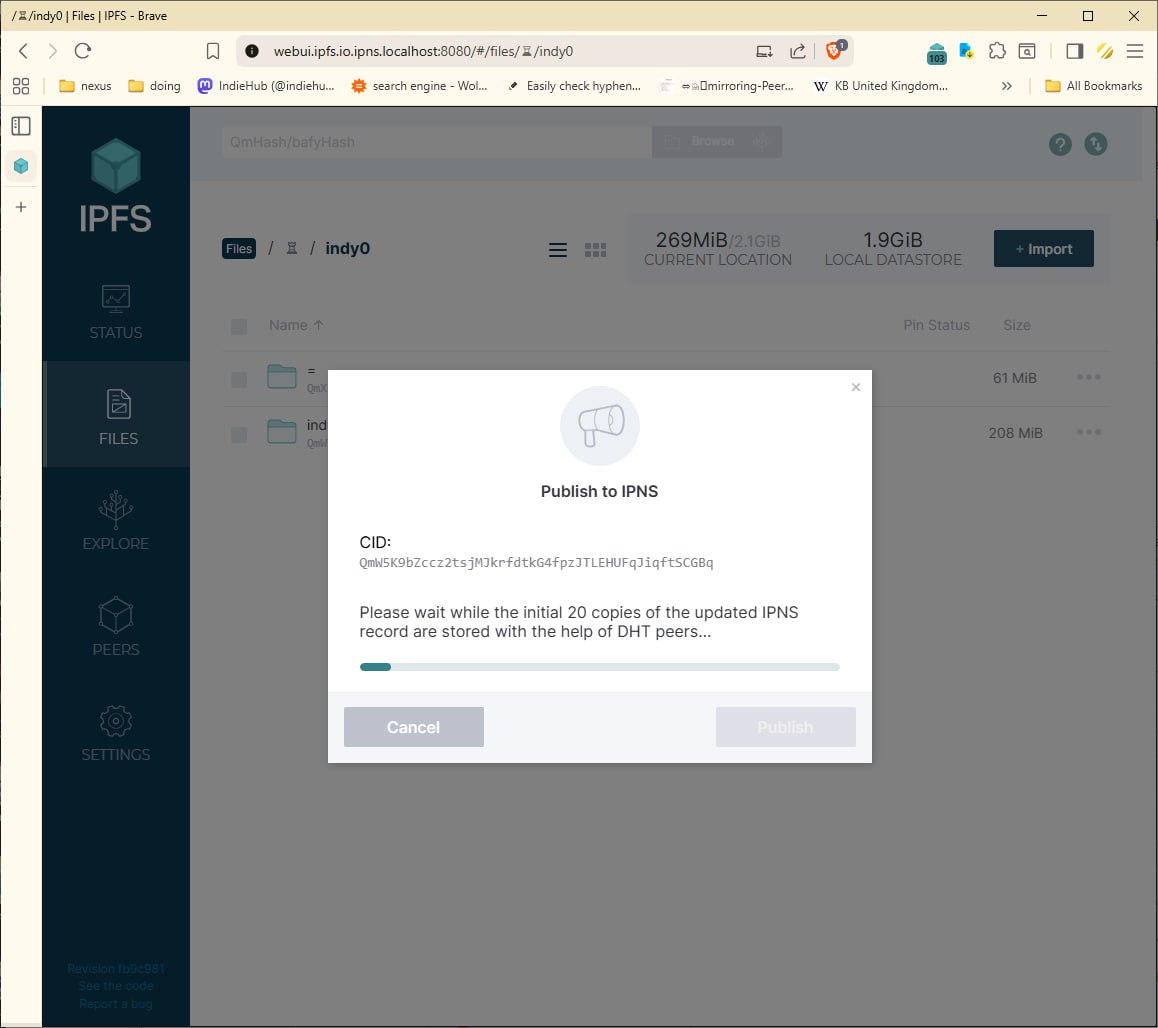
publishing in progress
10:42
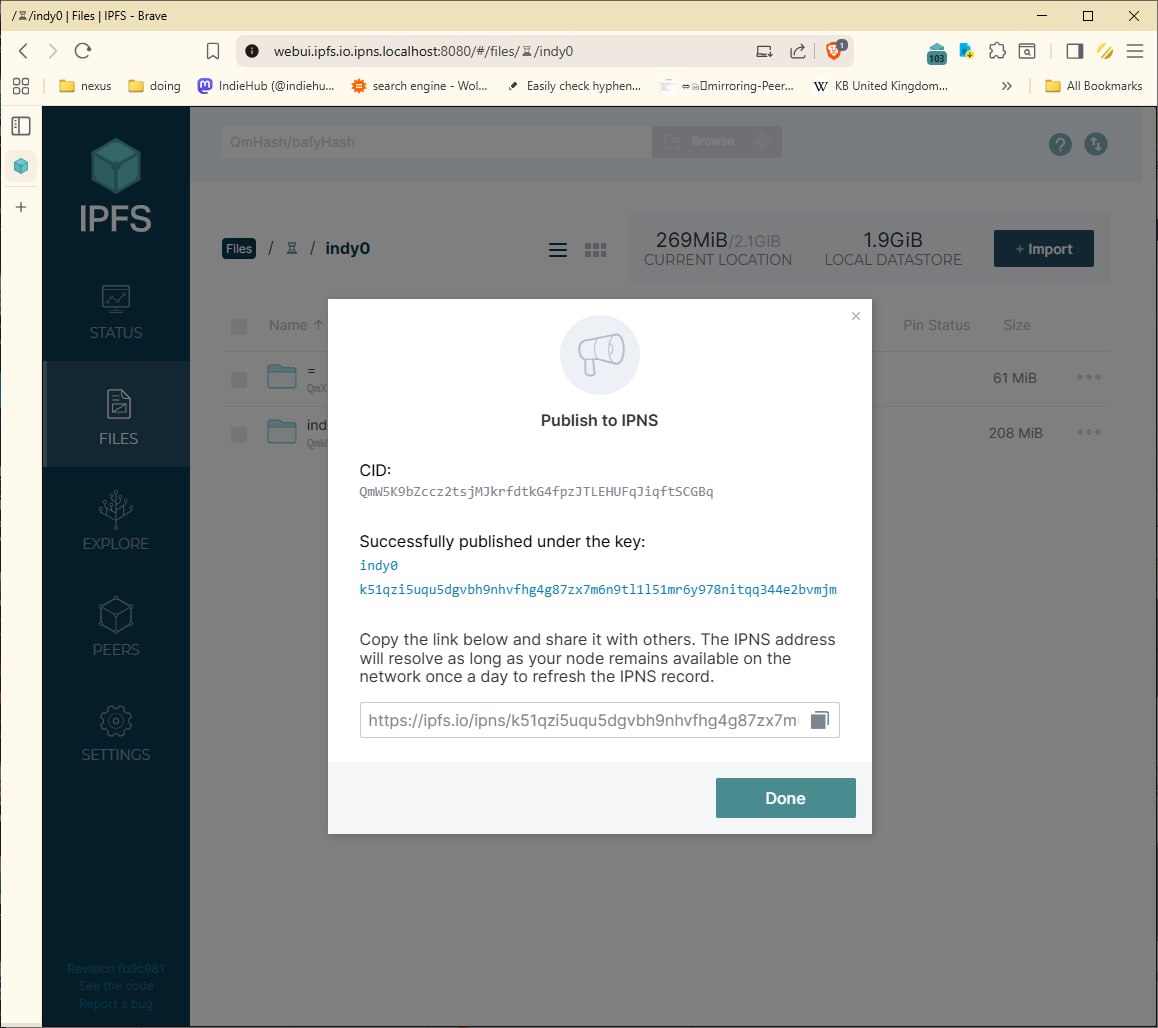
publishing complete
10:43
Perhaps we need to publish the folder called app try that
10:44
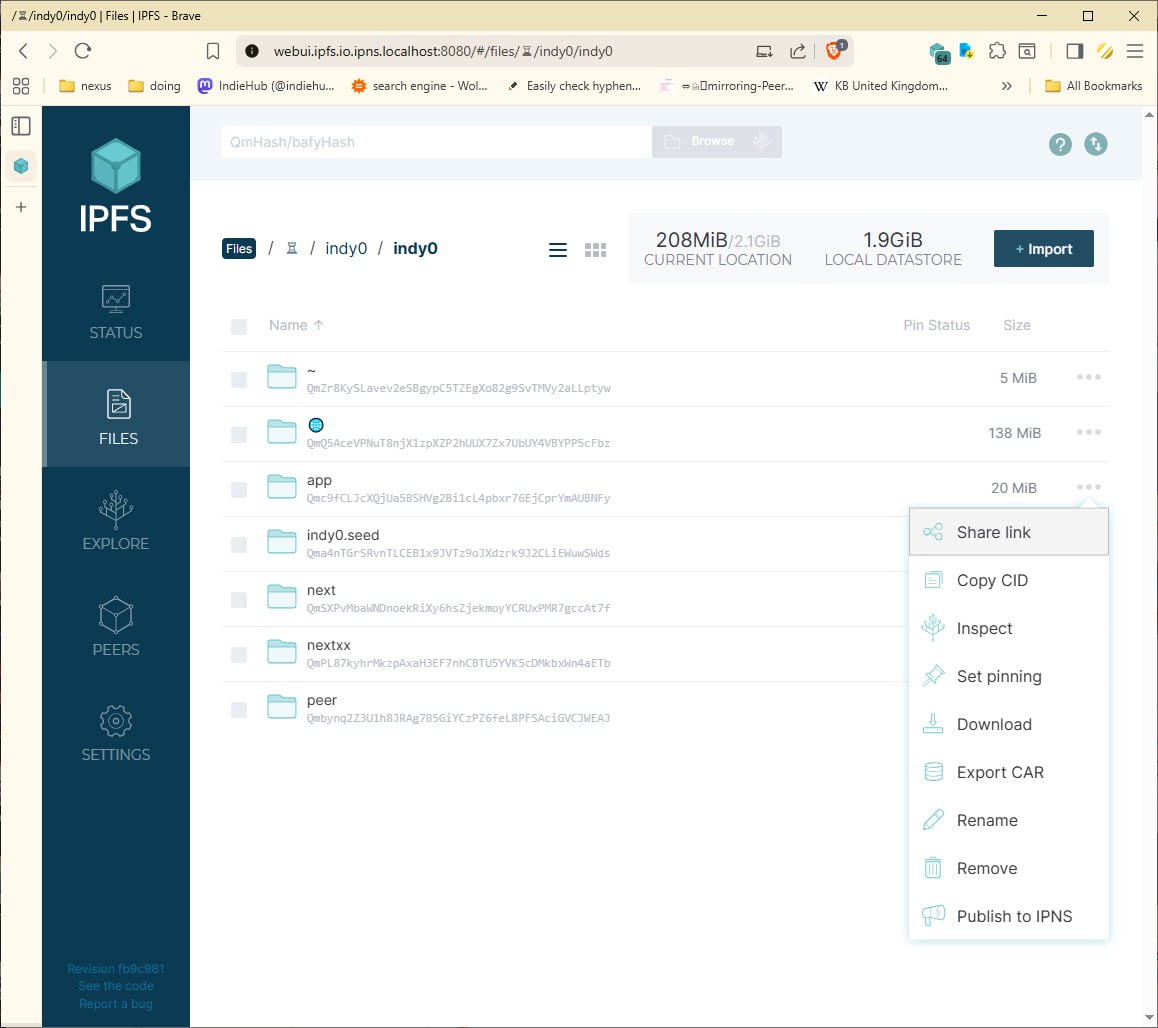
publishing app folder with indy0 key
10:44
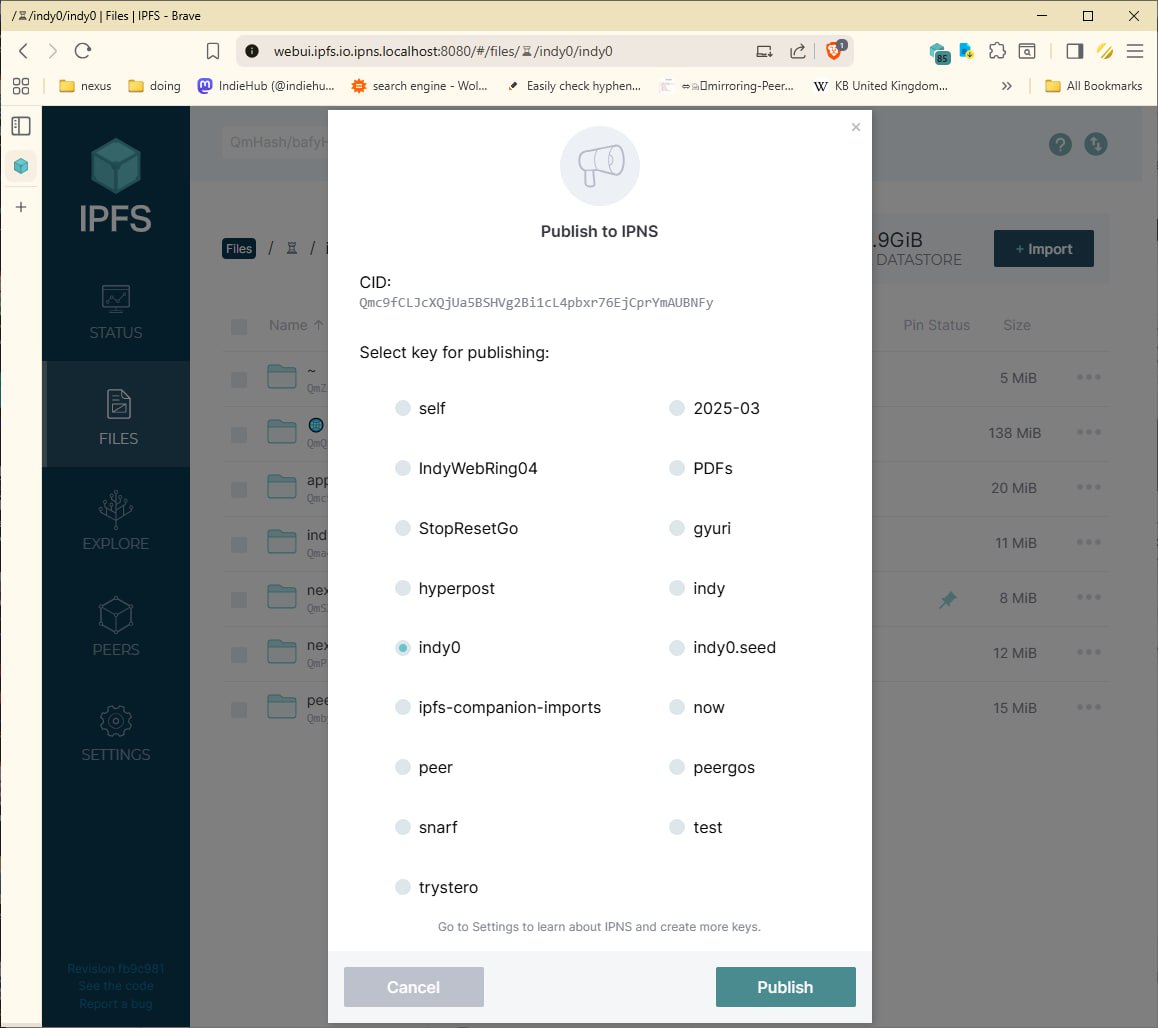
10:45
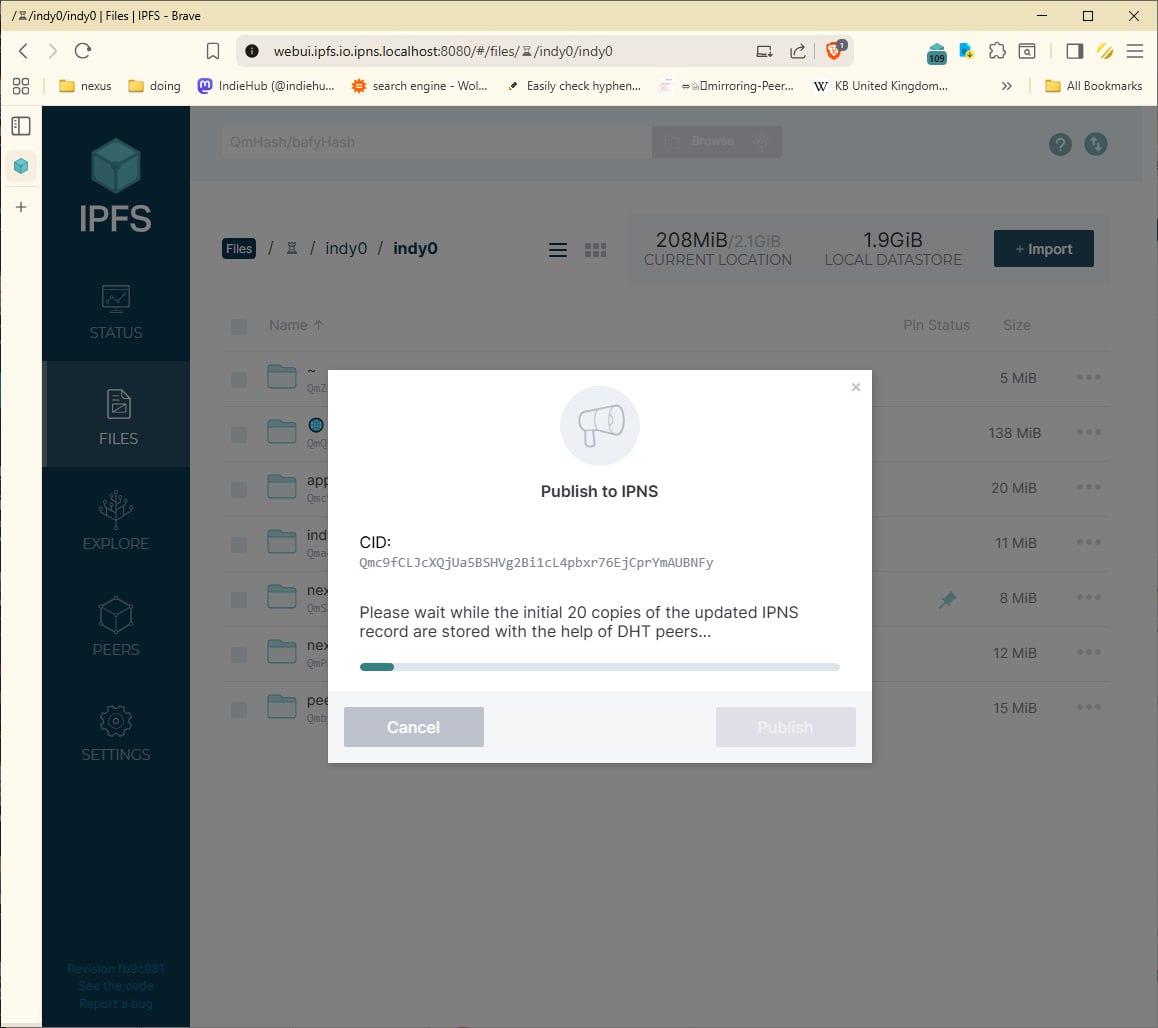
10:45
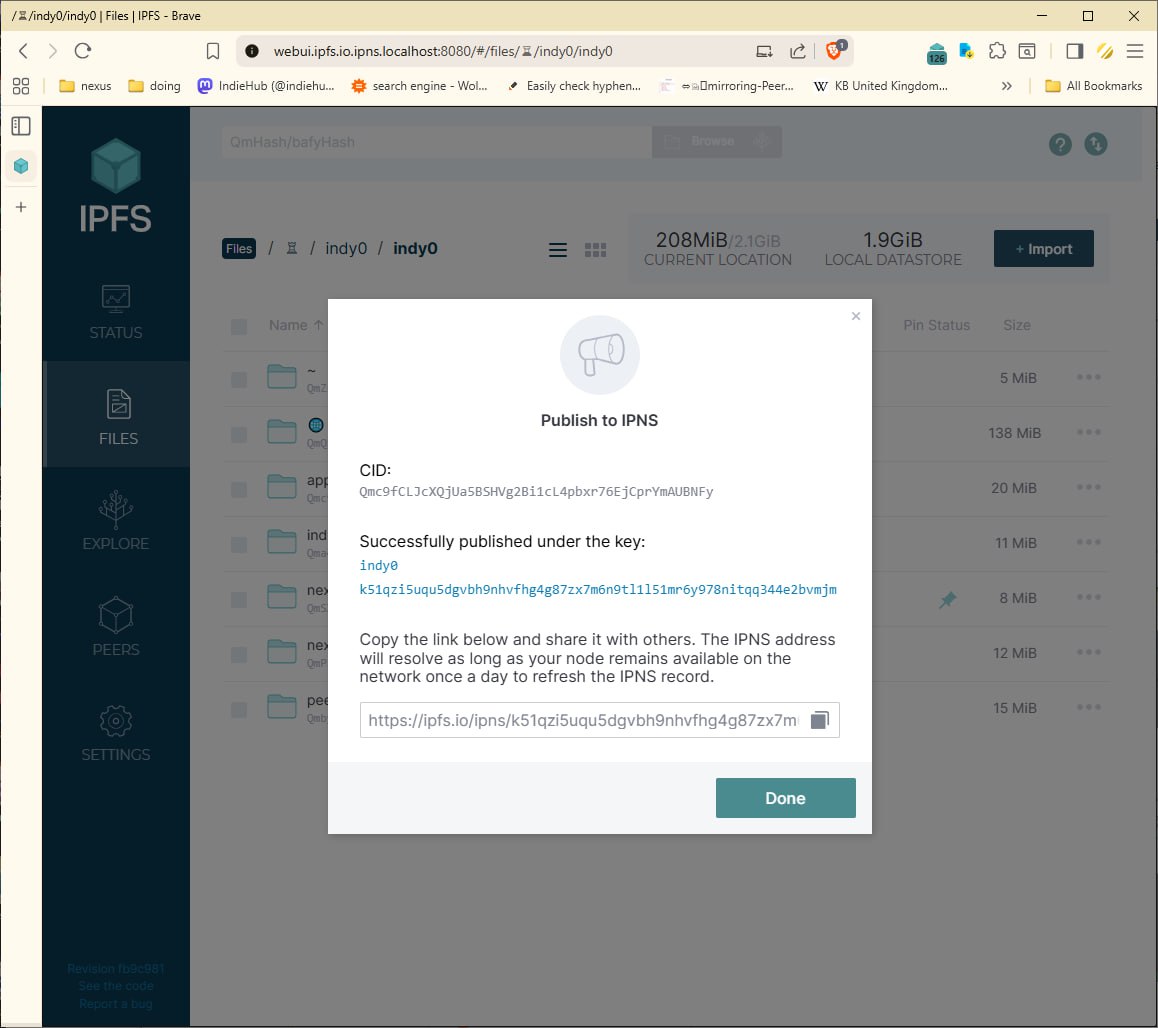
published app folder
GL
11:01
Gyuri Lajos
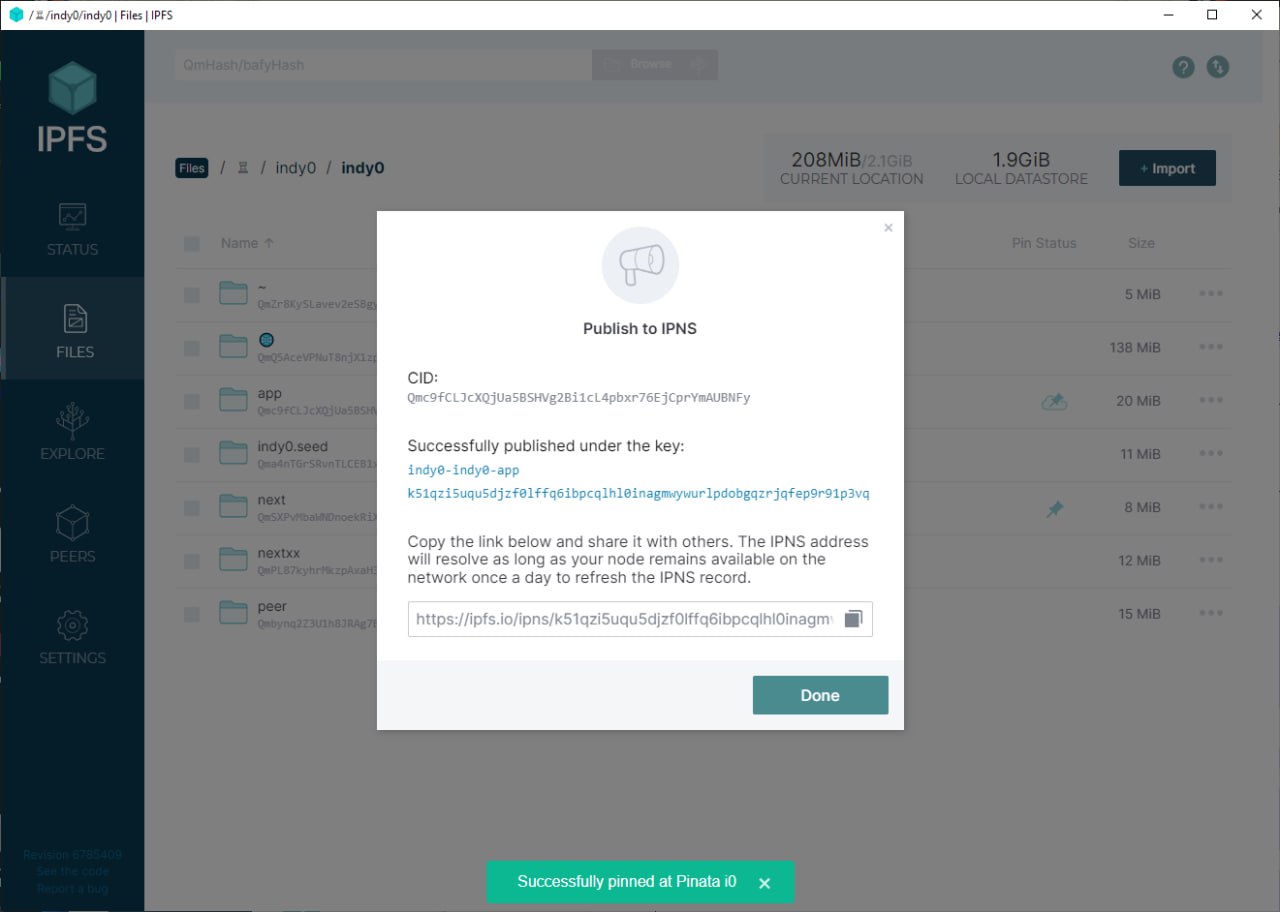
trying to publsi indy-indy0-app
11:12
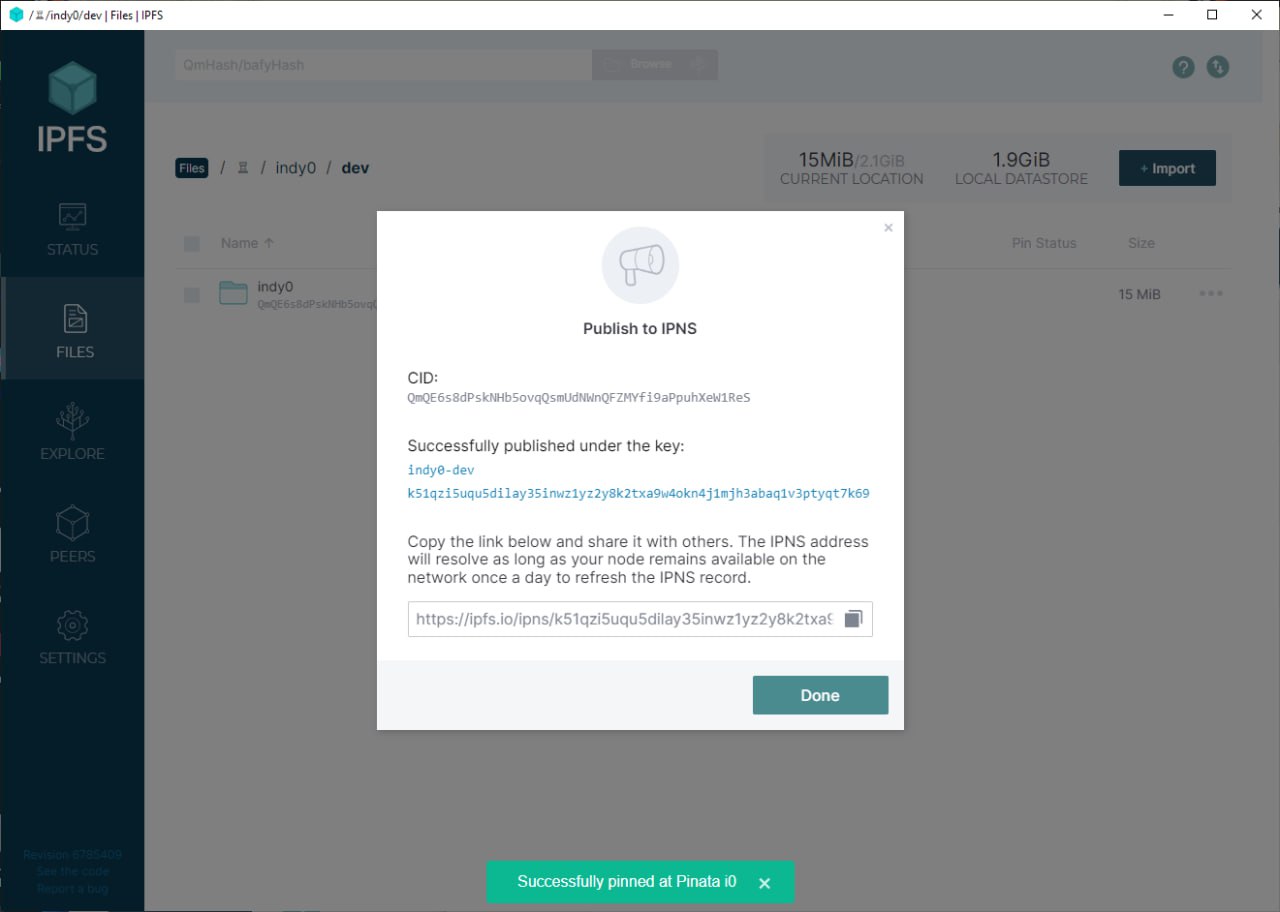
setup ipns indy0/dev
GL
11:37
Gyuri Lajos
CID:
QmYYXUibuDMQ6EGeMhwM7T3bLgHMZ9UNQTkKAqDhrVSvBa
Successfully published under the key:
indy0-dev-indy0
k51qzi5uqu5dl3fptkgrc51c40q51v787lr0fc1kd3i115nqm8r8igm6abelt6
QmYYXUibuDMQ6EGeMhwM7T3bLgHMZ9UNQTkKAqDhrVSvBa
Successfully published under the key:
indy0-dev-indy0
k51qzi5uqu5dl3fptkgrc51c40q51v787lr0fc1kd3i115nqm8r8igm6abelt6
ML
14:42
Michael Lennon
In reply to this message
☝🏻With so many lengths and types of communications in this thread, it is easy to miss invitations such as this one
15 September 2025
GL
17:35
Gyuri Lajos
experimenting with this p2p chat/audio/video app also based on trystero but is not an Open Construct like peersuite.space but seems to be more slick and stable
17:36
Try to keep this open channel active. Can try to message there. may be a good alternative to Zoom if you do not want your conversation captured and monitored
17:38
peersuite.space especially when you host it yourselves may not be as slick but it is an Open Construct so you can verify that it is secure and private and tinkerable
16 September 2025
GL
05:02
16
Upcoming
Tue Sep 16 • 7:00 PM - 8:00 PM GMT+2
CTA Community Meetup - P2P Protocols Convergence
https://us06web.zoom.us/j/85266528148?pwd=Pls5aafMlyKju7V7T7cs5kCqMShVKz.1
We're looking forward to our next call, this Tuesday @ 5pm UTC / 1pm ET / 10am PT.
We'll be discussing the various P2P protocols out there, and where/show convergence may happen between them. What are the best patterns and the best outcomes we can imagine for the movement of decentralized and local first technology. Are you building on a P2P protocol right now? Do you want to but something is holding you back? Let's touch base on the state of the play and next steps for adoption of these technologies.
Zoom: us06web.zoom.us/j/85266528148
Upcoming
Tue Sep 16 • 7:00 PM - 8:00 PM GMT+2
CTA Community Meetup - P2P Protocols Convergence
https://us06web.zoom.us/j/85266528148?pwd=Pls5aafMlyKju7V7T7cs5kCqMShVKz.1
We're looking forward to our next call, this Tuesday @ 5pm UTC / 1pm ET / 10am PT.
We'll be discussing the various P2P protocols out there, and where/show convergence may happen between them. What are the best patterns and the best outcomes we can imagine for the movement of decentralized and local first technology. Are you building on a P2P protocol right now? Do you want to but something is holding you back? Let's touch base on the state of the play and next steps for adoption of these technologies.
Zoom: us06web.zoom.us/j/85266528148
GL
GL
ML
21:07
Michael Lennon
In reply to this message
Curious/not sure I am understanding about the critique of RAG as "knowledge-chunking" / "memory access" technique.
The boundaries of information that is familiar and readily ingested ("ready-to-eat") vs information that less so and thus may cause indigestion, confusion, etc... (e.g. "is that edible?") is also a function of which level of the system is consuming the information. Similar to consumption of sugar by a living system, Sugar consumed by a person vs. sugar ingested by a neuron are "chuncked differently"
A significant practice in this thread appears to be sharing "large knowledge chunks" ingested by the sender with the expectation that the receivers will have sufficient context, interest, bandwidth to "re-ingest" the knowledge.
Sometimes I am grateful for the knowledge sharing, just as often I wonder if this is sufficiently useful conversation.
There is more to assessing the utility
of a informational process than optimization of a particular feature.
I hope I am tracking your communication accurately enough
❤
The boundaries of information that is familiar and readily ingested ("ready-to-eat") vs information that less so and thus may cause indigestion, confusion, etc... (e.g. "is that edible?") is also a function of which level of the system is consuming the information. Similar to consumption of sugar by a living system, Sugar consumed by a person vs. sugar ingested by a neuron are "chuncked differently"
A significant practice in this thread appears to be sharing "large knowledge chunks" ingested by the sender with the expectation that the receivers will have sufficient context, interest, bandwidth to "re-ingest" the knowledge.
Sometimes I am grateful for the knowledge sharing, just as often I wonder if this is sufficiently useful conversation.
There is more to assessing the utility
of a informational process than optimization of a particular feature.
I hope I am tracking your communication accurately enough
JW
GL
21:20
Gyuri Lajos
It is so inevitable. The word enlightenment for me works the dual opposite way. It is the highest level of cosmic awareness. or more like the more you expand your awareness it becomes transparent and enables me to catches glimpses of the highest level of wholness and its implicate sense. he nameless is the truest eternal name. Naming is to bring the named IT into focal awareness, when you become aware or sense the totality of your tacit awareness that is in fact the highest 1 can reach
🙏
ML
21:23
I would like to know if that link works and what's the latency
👍
ML
21:24
all and no thing makes it ALL
21:25
ex nihilo it all fits
21:27
from PDA to Inter Planaetary InterPersonal Virtual Digital Assitant. One that runs on all youc computing devices, all it needs is a browser like Agregor, that also runs on all devices
ML
21:27
Michael Lennon
In reply to this message
I keep hearing this. Keep thinking I understand it and then discover "it's not quite because X isn't ready"
Not sure our aspirations are as synced as believed, nor that I am really getting it. This "making the dream graspable" -- which Gyuri you have pointed to several background lectures readings and such which have been illunimating, but the shared sense of Aha! (Transcendent Revelation) is an important not yet for me. 😢
Not sure our aspirations are as synced as believed, nor that I am really getting it. This "making the dream graspable" -- which Gyuri you have pointed to several background lectures readings and such which have been illunimating, but the shared sense of Aha! (Transcendent Revelation) is an important not yet for me. 😢
GL
21:27
Gyuri Lajos
IPIPViDiA
👀
ML
ML
21:33
Michael Lennon
In reply to this message
In other words, "unique digital words" (or knowledge objects) " for "weaving (algoritmizing)" uniquely individual digital footprints into sentences/narratives/ or other knowledge artifacts?
GL
21:33
Gyuri Lajos
In reply to this message
I am talking about practical experiences of an autopoietic process. It is like drawing a Kolam it is simply not there until the beginning is joined with the end
👍
ML
21:34
externalization of intellect, recorded experiences, learning, not knowledge
👀
ML
ML
21:48
Michael Lennon
In reply to this message
Great question.
Digital recordkeeping is changing how we remember.
We assume there are "shared knowledge" objects including those arising from human inter-subjectivity e.g. Common Law, Language, Morality, (Archival knowledge) through which individuals collectively synchronize into "larger hiving patterns."
There are many forms of collective memory (shared stories, language, libraries, etc).
How digital systems support (or not) footprints of living is key to re-membering and responding to life.
@gyuritrailmarker Gyuri is on a quest to safeguard Aliveness from current constraints of digital memory (systems).
Is that a fair characterization?
Digital recordkeeping is changing how we remember.
We assume there are "shared knowledge" objects including those arising from human inter-subjectivity e.g. Common Law, Language, Morality, (Archival knowledge) through which individuals collectively synchronize into "larger hiving patterns."
There are many forms of collective memory (shared stories, language, libraries, etc).
How digital systems support (or not) footprints of living is key to re-membering and responding to life.
@gyuritrailmarker Gyuri is on a quest to safeguard Aliveness from current constraints of digital memory (systems).
Is that a fair characterization?
GL
22:35
Gyuri Lajos
Yes. But as Bush said
We cannot expect machines the human ability of association but combine that with perfect recall is what opens up ways to think previously unthinkable thoughts
But it needs to be combined with autonomous flows interactions interplay between people and the world. Consilience where power is no longer needed as before
👀
We cannot expect machines the human ability of association but combine that with perfect recall is what opens up ways to think previously unthinkable thoughts
But it needs to be combined with autonomous flows interactions interplay between people and the world. Consilience where power is no longer needed as before
ML
22:36
External centralized power simply cannot hold in complex cultures as we have now
👀
ML
17 September 2025
GL
GL
22:17
Gyuri Lajos
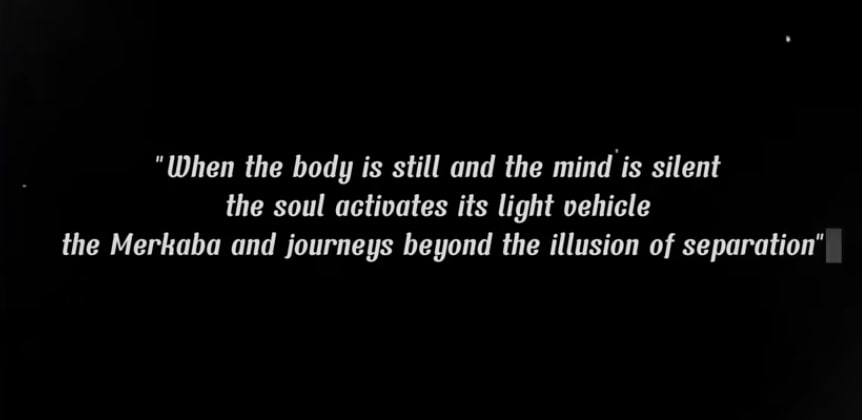
Quick high density update
18 September 2025
GL
02:16
Gyuri Lajos
One Step closer to closure
02:16
Here is a secret link to what I am working on at the momemnt
02:16
This is no longer shared as a page shared via the Webhosting directory of the Peergo account of its creator
02:16
It is a secret link that the author can create and share and control. That is to say access to it can be removed
02:16
It can be password protected
02:16
the password is diy
02:16
you should get someting like this
02:16
enter the password diy
02:16
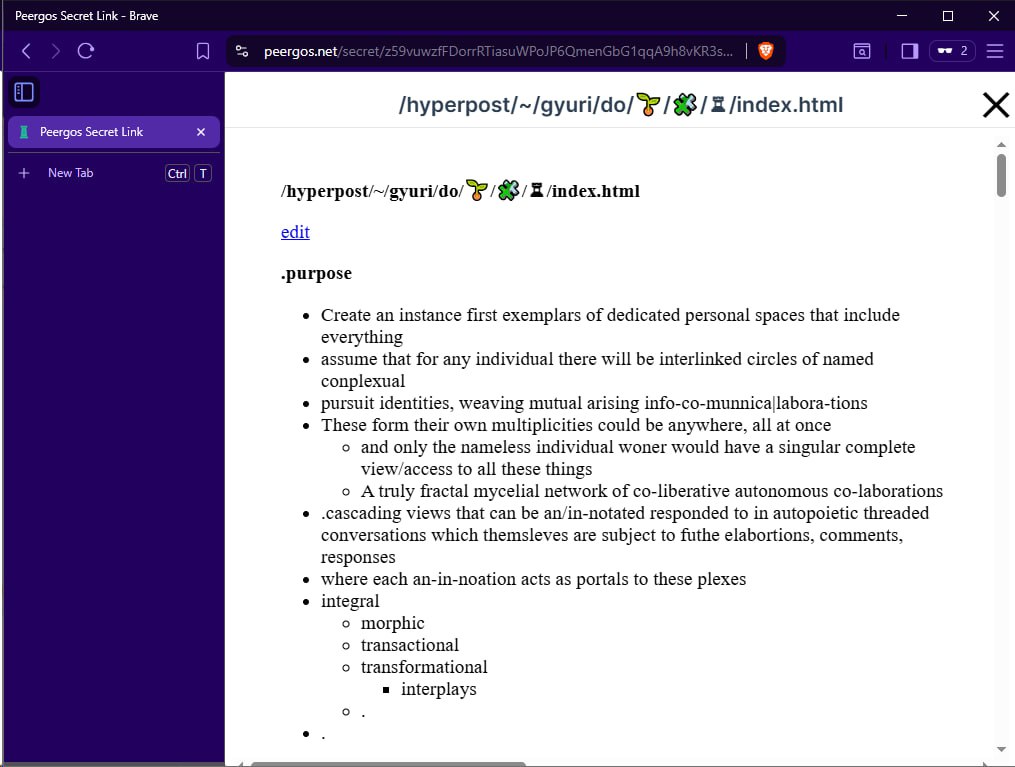
to get this
02:16
Now it has lots of typos and need more work
02:16
But the goal is that people with whom 1 shares documents this way will be able to highlight any text and create conversational threads that will be associated with those highlights (mirrored in in-line clues as action points)
02:16
Thus be able to have all the benefits of annotations in a trully private setting and with the potential to turn them into social annotations both within 1s indyWeb colaboratories or on the web via hypothes.is and other public social annotations
02:16
I do not think I'll get it all working by tomorrow, but certainly wants to get it done by next Thursday.
👍
ML
JW
02:16
Then we can say good by to Telegram and have our own colaboratory
02:16
Let's hope that Peergos will be up to it. I have three lines of convergent experimental development threads that I hope I will be able to join into a continual work loop
02:16
so that we can get at last off the Ground and into the Personal First InterPersonal InterPersonal Virtual Cloud. A much needed alternative that the extractive use of the current Cloud software as a service offerrings. A virtual Autnonomous Cloud for information that can be shared along with the Software as an autonomous virtual Service. Providing the infrastrucural support to render the idea of Software as a Symmathetic Conversation to be the way that Software is developed in the future
👍
JW
02:16
for the benefit of the participants both as users and providers and distributors in emergent networks of Trusts in the long tail of the Indy#web weaving the IndyVerse for Humans by Humans
02:16
Do not bother to read just yet
👍
ML
02:16
Here is an annotateable version. Hopefully will be able to work without it soon
02:16
Well I did not get very far, but that is the right way to do it. Thin
02:16
Write to think, be explicit, trust that soon all that articulation will be rendered much more workable by the systems capabiities themselves
🙏
ML
02:16
End to end first strange loop
👀
ML
02:16
By the time the system will work it will have a true cnstructive documentation
02:16
Tell so that you can show!
🙏
ML
02:16
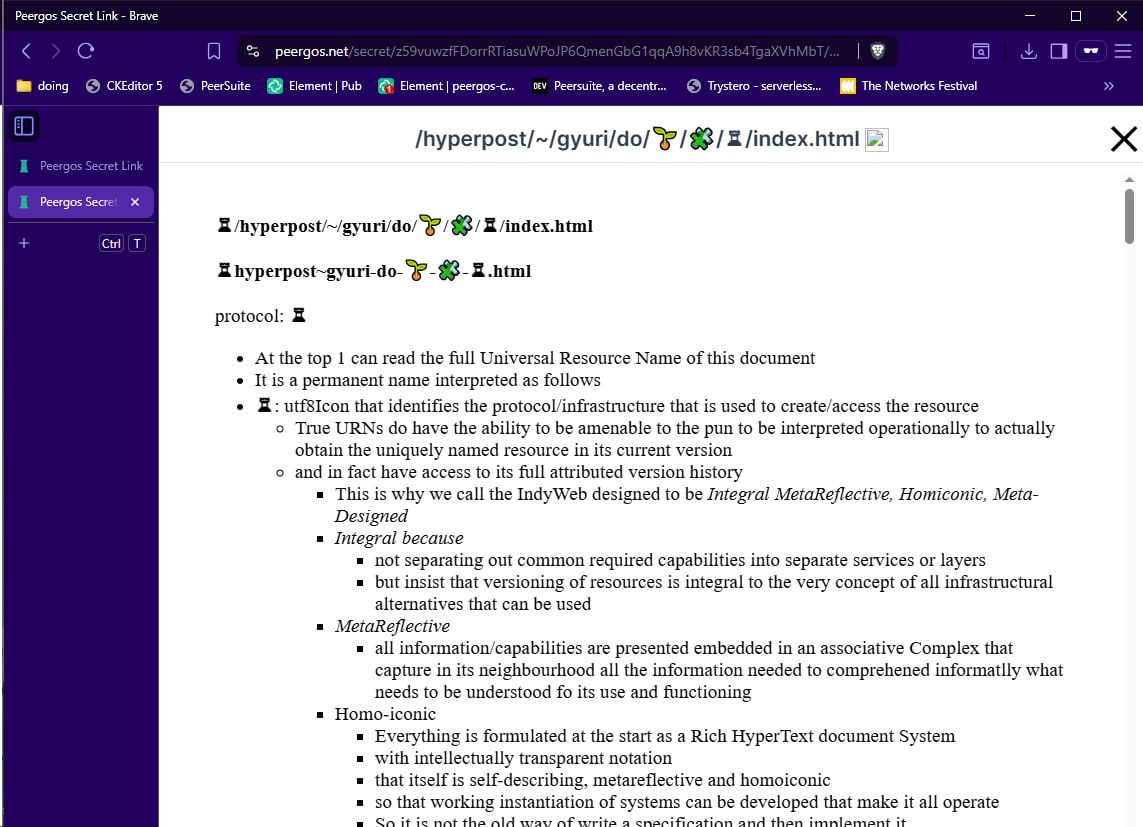
this is how it looks now via secret link
JW
07:07
James Wong
In reply to this message
I know you too well.... Already guessed that PW correctly!
I didn't see any content though
🤣
I didn't see any content though
ML
07:08
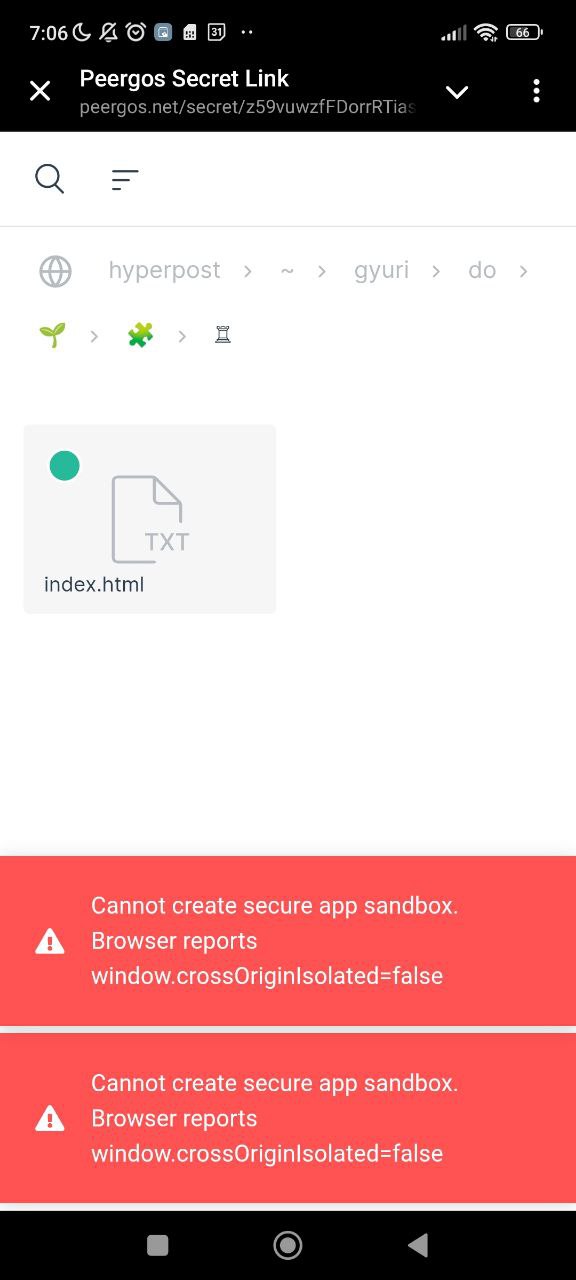
GL
07:28
Gyuri Lajos

Need long tap and open in browser
GL
09:41
Gyuri Lajos
The latest setup on Peergos, at long last enables me to write without being distracted by technical foibles. What a bliss. Long way to go, but at long last I had actually started the living the dream: ora at labora https://hypothes.is/users/gyuri?q=ora+et+labora
⚡
ML
GL
13:54
Gyuri Lajos
I meant to say ora eSt labora
19 September 2025
GL
11:22
Gyuri Lajos
GL
Gyuri Lajos 19.09.2025 08:59:41
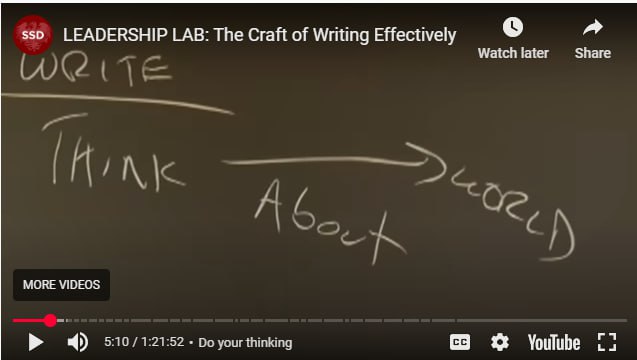
There are 26 annotations of mine that matches these three word: write+to+think. Obviously a deep preoccupation of mine.
https://bafybeibu37qvocixdajmwpozmzyprcwc7wa3wdntvshdi56nrg7g4r3ruq.ipfs.dweb.link?filename=hypothes.is-tag-write-to-think.html
A visible sign of "high performant neurodiversity" something I've learned from this talk
https://bafybeibu37qvocixdajmwpozmzyprcwc7wa3wdntvshdi56nrg7g4r3ruq.ipfs.dweb.link?filename=hypothes.is-tag-write-to-think.html
A visible sign of "high performant neurodiversity" something I've learned from this talk
ML
20 September 2025
GL
12:58
Gyuri Lajos
Maybe, just maybe, getting closer to closure
12:59
13:00
Don't hold your breadth though. Perfection takes time. Perfection in the sense of self-sufficiency, and reaching a meta-stable fixed point that delivers a minimal workable constellation that works.
13:03
I lost count, but it is probaly the 7th time I reconstellate everything a new, with exver expanding scope to ensure that all end to end path segments actually link up and mutual arising what is required. LSIP universal function only had two mutually recursive function, Here we are dealing with, at least 7 o perhaps 14 mutually interdependent capabilities that together delivers the sweet spot just above the threshold.
13:05
There is a hope today that I can make it work with Pergos alone. That would probably reduce the efort needed by an order of magnitude.
13:06
This became possible (if indeed it had, will see soon) because I was exploring how the Peergos and IPFS based infoc-communication-collaboration infrastructure would be set up sharing 90% of the structure, yet eneabling mutual recursion
13:11
As I keep professing (I am a professor of this mutual arising construction of intentionally trnasparentf universal seeet spot constellations of infordances) the one who professes what 1 believes is possible to do, and actually able to does have a chance in heaven to accomplishes by acting on that doin what 1 believes in.
13:13
The novelty here is that I can share a document with a secret link, that I have full control of, it is set to expire in a month and requires a password
13:14
But if you turn on hypothes.is the annotations show up and anyone is able to annotate. And even relpy to the annotation.
13:17
Two tasks come from this
13:17
1 ship the document with hypothes.is embedded
13:18
2 provide a link in the annotation to request access
GL
13:39
Gyuri Lajos
This latest constellation that does not rely on Peergos webhosting to share author controlled live content via secret linkt even without password allows top slice or summary to be hyper posted that could spell out ways and terms of attributed sharing that can provide direct autonomous private communication channel between creator and audience individually
13:43
So there is just one more piece needed invite individuals to shared spaces with the ability to create their own contributions to named threaded conversation or in their own spaces on the indyweb
13:43
Will see
21 September 2025
GL
22 September 2025
GL
12:51
Gyuri Lajos
This is what I am working on at the moment
12:53
Boiling the Ocean doubling the scope by the week in the assured faith in the comming closure
12:54
The task is to use existing capabilities to make sense, organize and give direction and track the very process of deliveing
12:55
Instead of trying to descibe what is to be done, just keep doing it with ever more capabilities emerging tht would accelerate the process
12:56
rich the point where I really need to know what I am doing and the frontier gets ever more focused by the week.
12:57
The supoer power comes from the fact that I can use hypothesis as a way of capturing the deep intertwingularity that needs to be made manifest so that instead of it all being in my head, ever more gets externalied, hence resumable, reexaminable, compleable
12:58
Just keep doing. No more planning just execution following the grain of what is emerging
12:59
Yesterday I had another abortive attemt at eliminating the depndene on via.hyoothes.is. We need to do that but just no tnow.
13:01
in a way hyperpost will provide a much more capable alternative to both Telegram and Hypothes.is although it is designed to play nicely with everything that exists today and in fact leverage it for scaling reach, and improving the value derivable from both.
That is because all will be augmented with seamless inter personal inter service (real centralized or emergent virtual) with seamless, unenclosable, unstopable, privae secure interplayeabiity
That is because all will be augmented with seamless inter personal inter service (real centralized or emergent virtual) with seamless, unenclosable, unstopable, privae secure interplayeabiity
13:07
Getting close to getting the IT right eventually and proressively, in an clearly accelerating manner, everywhere, all at once, for the first time, at long last, through making it expansively progressively operational, delivering unthinkable value scaling reach, salient synthesis and capabilties.
13:10
Like a rolling Stone, uphill with acceleration as if it was downhill
13:11
gentle nudging not hard pushing
13:13
Most if not all the capabilties that we need are out there as Open Constructs, the question is how could we combine them, at cascading upward scale a kind of wholeness and implicate atuopoiesis.
13:14
Literally everyday, I see new practica ways of delivering on the highest ambitions.
13:17
That 2019 Outrageous Paper of ours was hinted at the potential to creting a high level constuctive synthesis of ideas germaine to the Semantic Web, Freebase/Google Knowledge Graph, Cyc as MEMplEX. I tis now a practical possibility not just a dream.
13:18
The way to show it all is to tell it all in way that it is actually embodied in a working system
13:19
Ok back to work
13:20
If you follow the link shared above just click on the red link at the top of the card
13:22
Korzybski, rightly pointed out that the Map is not the Territory
⚡
ML
13:23
However applying the practical magic of computation we can create Terriotries by first drawing up Maps for them!
13:24
I realised yesterday that I have much of it already at hand and working that enables me to draw up such Maps.
13:26
I've got it all wrong. My intention was to devise computational means that would help peope to make sense of what they write to think. I realized that what is needed is to augment the human intellectual capacities personally and in colaboratories with the right tools to make sense of their (me2we2us2all) far out ideas themselves together!
👀
ML
23 September 2025
GL
10:27
Gyuri Lajos
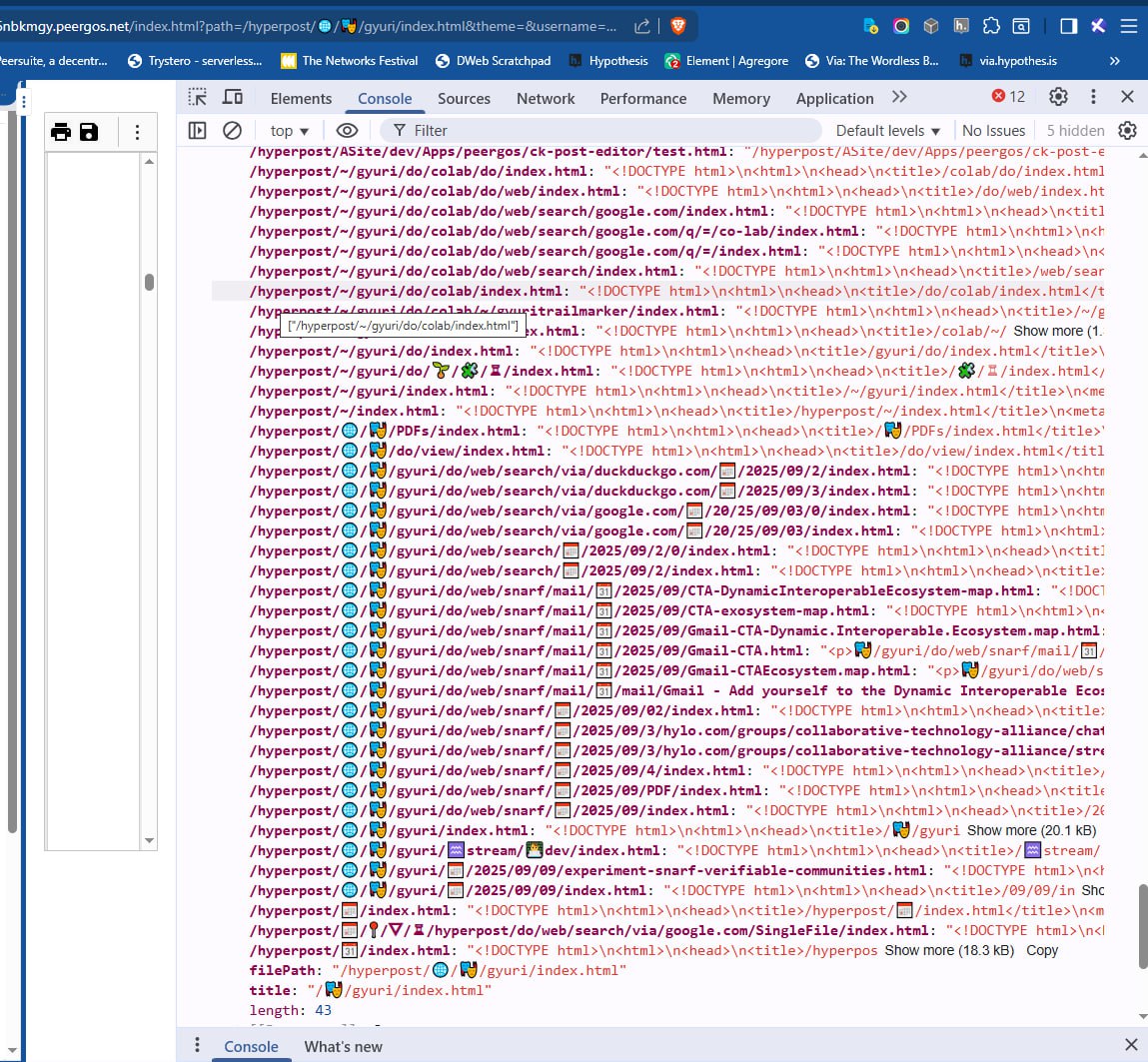
harvest time
GL
10:48
Gyuri Lajos
ByBy Writing stuff in Telegram
10:48
If I wish to share and update I just share a link
10:51
Best of all, I can change what I share to fix issues any time
10:53
Next step is to leverage the high resolution dynamic addressability afforded by Hypothesis annotation on 1's shared documents to start Weaving Over Web Indy Learning Paths across the Web Over the Web
👀
ML
GL
13:08
Gyuri Lajos
JW
James Wong 19.09.2025 20:13:57
How would I surface various types of salience landscapes in my mindplex? I would want to do that depending on who I am interacting with. I suppose I need to enter the keywords/dots that give the top slice and all the associations would follow along
ML
GL
13:08
Gyuri Lajos
GL
Gyuri Lajos 20.09.2025 08:44:52
Morning Gien
13:08
Will answer later today
13:08
GL
Gyuri Lajos 23.09.2025 12:42:50
This is an example of how we may start to construct HyperMaps of salience for scaling synthesis and reach
13:08
GL
Gyuri Lajos 23.09.2025 13:06:13
It is always the title that emerges last
13:08
In reply to this message
start to answer, that today is today
GL
13:09
Gyuri Lajos
It is easier to tell once you can experience, show IT
GL
16:52
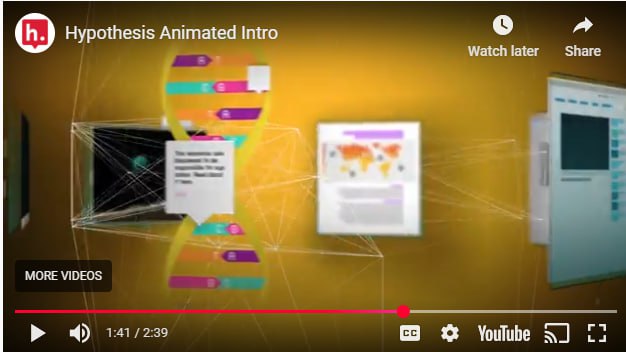
This is the best one liner to describe the mission of the IndyWeb combined with Hypthes.is
👀
ML
16:54
and add people should be able to share pages in their own web spaces and every page would be a portak to conversations and interconnection and a portal to dedicated named colaboratories
16:57
GL
19:14
Gyuri Lajos
I am getting close to the point where I can keeptrack of all my work in my own emerging indranet.work space as it is instantiated within hyperpost
25 September 2025
GL
13:54
Gyuri Lajos
I had a go at developing access stuff I snarfed and annotated from the web so that people could see the annotations without the browser extension installed for it.
13:55
There is a way now
13:55
1 Use singlefile Chrome extension to save the web page
13:57
2 Uploaded it to an IPFS gateway like https://pinata.cloud/
26 September 2025
ML
06:27
Michael Lennon
In reply to this message
Freeing the footprints of digital dialogue from the digital soil from which they emanate allows for new degrees of digital freedom.
Several leading AI thinkers -including Antonio Damasio (below)- believe preceding language in consciousness is feeling (or sentience).
Are emerging forms of "meta-consciousness" lacking / sterile if they lack sentience (feeling) upon which language (and memes) are constructed?
https://youtu.be/h2r3ASPHnhM?si=UEmi73kk35XXZN1V
Several leading AI thinkers -including Antonio Damasio (below)- believe preceding language in consciousness is feeling (or sentience).
Are emerging forms of "meta-consciousness" lacking / sterile if they lack sentience (feeling) upon which language (and memes) are constructed?
https://youtu.be/h2r3ASPHnhM?si=UEmi73kk35XXZN1V
27 September 2025
GL
09:38
Gyuri Lajos
Update: Now that I can use at least my own modification of CK Editor and document everything I do combining the power of Rich Text Editing with PlexTrailMarks I can actually able to sork systematilly. Not just Write to Think, but write to co-evolve the very capabilities we need
🤩
ML
28 September 2025
GL
15:52
The message is "It it's up to us"
29 September 2025
GL
12:51
Gyuri Lajos
Curent goal is to ensure that with a minimal onboarding flow, without sign up or sing in anyone can join the indyweb via invite by anyone already on it and install just one desktop app IPFS Desktop and can become an indy inividual archivist of the web of anything that they deem of interest or worth keeping in their own archive. And in doing so they would end up sharing that page on IPFS, so that anyone can have access to it openly and eventually permanently, and also enable anyone with a hypothesis account to annotate the page, or just see others' annotations
12:52
Each such page would have a link to the archivist's own indrant.work space! so enabling participants to suimultaneously scaling reach, mutual learning, salience synthesis of novelty and interrestingness
12:53
on the margins
12:55
scaling what the author of marginalia called not just interestingness, but engage in open sharing and collaboration weaving the Indy Learning Commons: Understand to be Understood
30 September 2025
GL
GL
05:35
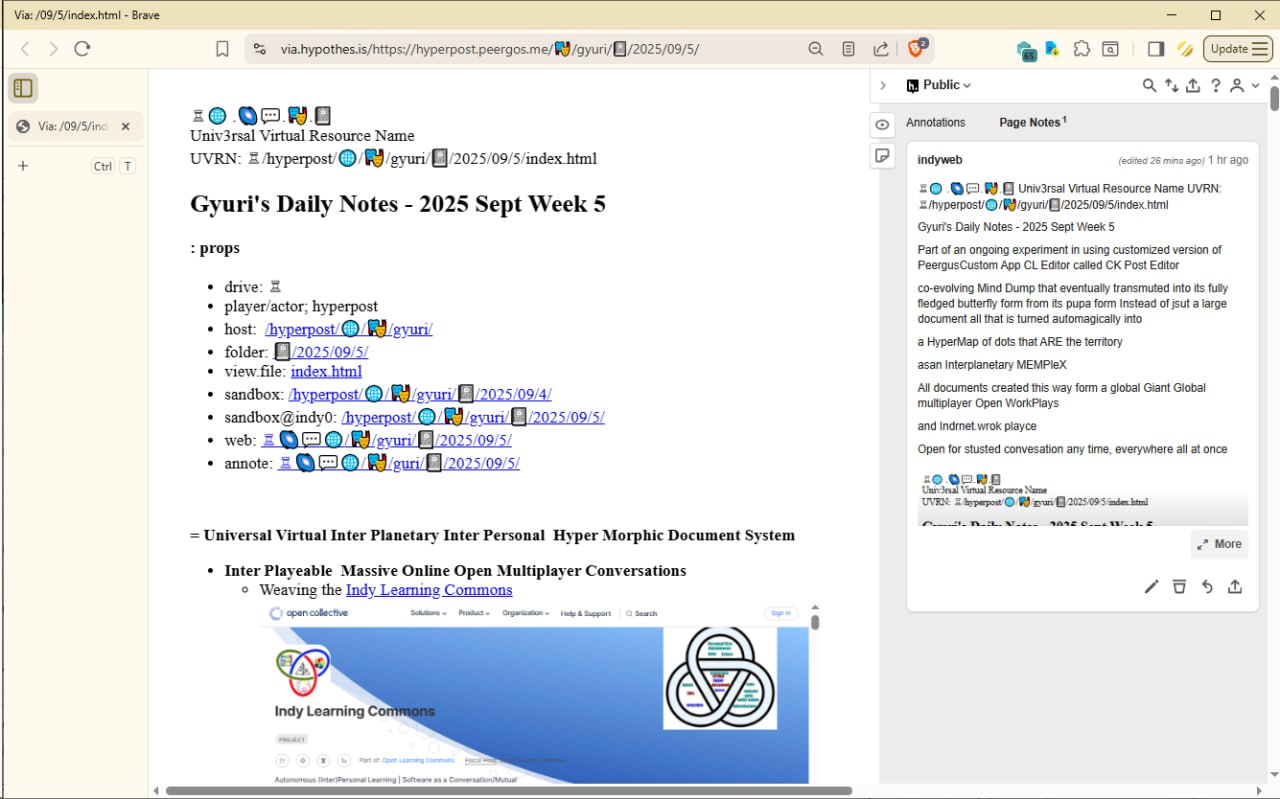
I am all working here. Everything will be reacheable from here or its future equivalent will explode this document and all others eventually linke dot it or shared or found in searches into a Its own HyperMapped Territory of intertwingledHyperMaps of Dots that IS The Territory
👍
JW
05:43
Co-Create/Curate Blaze All yOur Lifelong Mutual Indy Learning Trails in the Commons in yOur own MEMplEX for the Web. doing the job of making sense of the emergent endless frontier of the Web Let people Do It for themselves, privately securely with Autonomy and dignity.
GL
06:03
With a view to be able to two way link to current work and add Indy Convesations on the annotation margin. Add hyperpost links to own constributions wit
06:06
Everyone cwn own their own Work Spaces. A singular space for all their work that they own. for most of their need they will never need to go to places, where they loose control over their data, and their destinit, but let capabiities come to them and organize and conduct most of their work in their own spaces using tools that they own
06:07
Instea of apps, define your own wrkflows whre each document shipfs with the very caabilities needd to do the work
06:09
Peergos provides just such an Open Source, Open construct, Open Sauce infrastructure that caters for the unity of information and the means of working with them in the form of Peergos Custom Apps.
06:11
Both documents and capabilities have their own attributed human readable permanent names! or Uniersal Resource Names tht can be used to actully obtain and work with those resources.
1 October 2025
GL
11:34
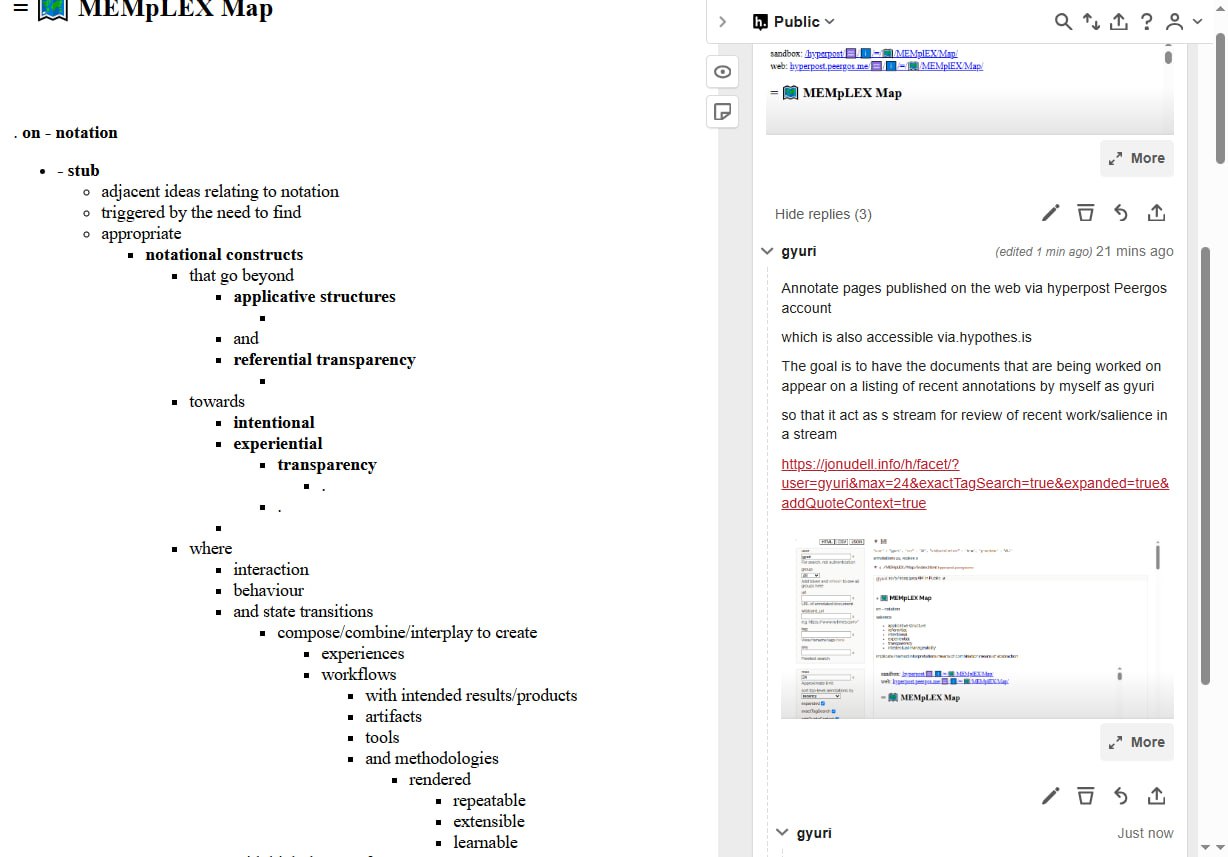
Using my annoation stream as a way to share and track ongoing work accross documents
11:39
Annotate documents I work on so they appear in an active engageable stream
11:42
Hypothesis byline:
11:43
Make reading active and social
11:51
Hyperpost let's you post your work anywhere anchored through social annotations as portals to associated
conversations
conversations
12:00
I have way too many documents opened for writing using CK Post Editor. Being able to provide a salience Map is in the works. But I need to close them down. And need a way to keep track of all these scattered writings. One solution that is readily available is to annotate the currently worked on documents, as hyperposts that are shared on the web using Web Host directory of my hyperpost account, which are also annotatable using via.hypothes.is, and as such would appear in my annotation search stream.
I can thus close one by one these pending documents once I annotated them.
I can thus close one by one these pending documents once I annotated them.
12:03
This is also a great example of what I've been dreaming abut for so long as a possibiity. Instead f developing complex learning management capabilities enclosed in an own app as I had it 4 years ago, a monolith, with horrendously complicated technology stack and development/delivery workflow, I can just leverage existing capabilities, compose them and provide the infrastructure that let information AND capabilities to confluence together, minimizing coding and able to add new capabilities without any framework or tedious complex development setup, and do that in an ad hoc manner, focusing on intellectual manageability, and explicit structuring, (that itself is easy to refactor,( that promises to be easy to emulate compelling to do.
👍
ML
GL
12:24
Gyuri Lajos
Once I turn all the document I am working on (in named contexts) are added to my annotation space, it becomes possible to create high resolution cross references between them that are themselves intentionally marked on the margins, and can be worked on them on the margins without neding to open them in an editor. Leaving nough clues on the margins to automate incorporating suggested riants changes n the margins int the document next time they are openned t work on them within hyperpost
GL
20:14
Gyuri Lajos
I use this link https://jonudell.info/h/facet/?user=gyuri&any=%E2%98%91%EF%B8%8F&max=100&exactTagSearch=true&expanded=true to keep track of my current tasks!
20:18
after it loaded you have to still press HTML button on the top left
20:22
This one search shows what I am working on in any moment! https://jonudell.info/h/facet/?user=gyuri&max=100&exactTagSearch=true&expanded=true&addQuoteContext=true&wildcard_uri=https%3A%2F%2Fhyperpost.peergos.me%2F*
20:23
the first time 1 opens this url, need to press the HTML button to run the search
20:24
from then on, if 1 changes any of the faceted search fieldsthe search is submitted automatically
GL
20:48
first create/curate and CONNECT information snippets in focal attention context of a page being annotated and turn them into Clues and use HyperPost them on the WEB in yOur Own(ed) named networked hyperPost Spaces, which turn into web pages that you/or any one can annoate and ... rinse and repeat
20:49
NB* the initial local case in **hyperPost It is an example of intentional Names, that uses camel case composite words with the first letter lower case
20:56
Now ready o close the loop. and share these snippets in annotations for the right context
20:59
Gyuri Lajos, [01/10/2025 20:49]
NB the initial local case in hyperPost It is an example of intentional Names, that uses camel case composite words with the first letter lower case
Gyuri Lajos, [01/10/2025 20:56]
Now ready to close the loop. and share these snippets in annotationsr in appropriate contexts
NB the initial local case in hyperPost It is an example of intentional Names, that uses camel case composite words with the first letter lower case
Gyuri Lajos, [01/10/2025 20:56]
Now ready to close the loop. and share these snippets in annotationsr in appropriate contexts
GL
21:17
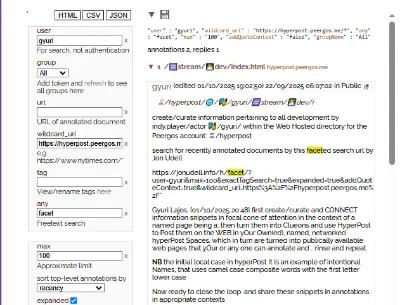
Soon I'll be able to do everything I've een doing on Telegram. Best of all can share it all as microHyperPost or HyperPostGrams or IndyGrams
21:18
We can have the best of all possible worlds, just becasuse there are existing Centralized Services that are open, interoperable and uniqutous
21:19
Can make them even more open yet permanent and People centred
2 October 2025
GL
09:19
Gyuri Lajos
GL
Gyuri Lajos 02.10.2025 09:11:34
Could you please check if this link works?
09:19
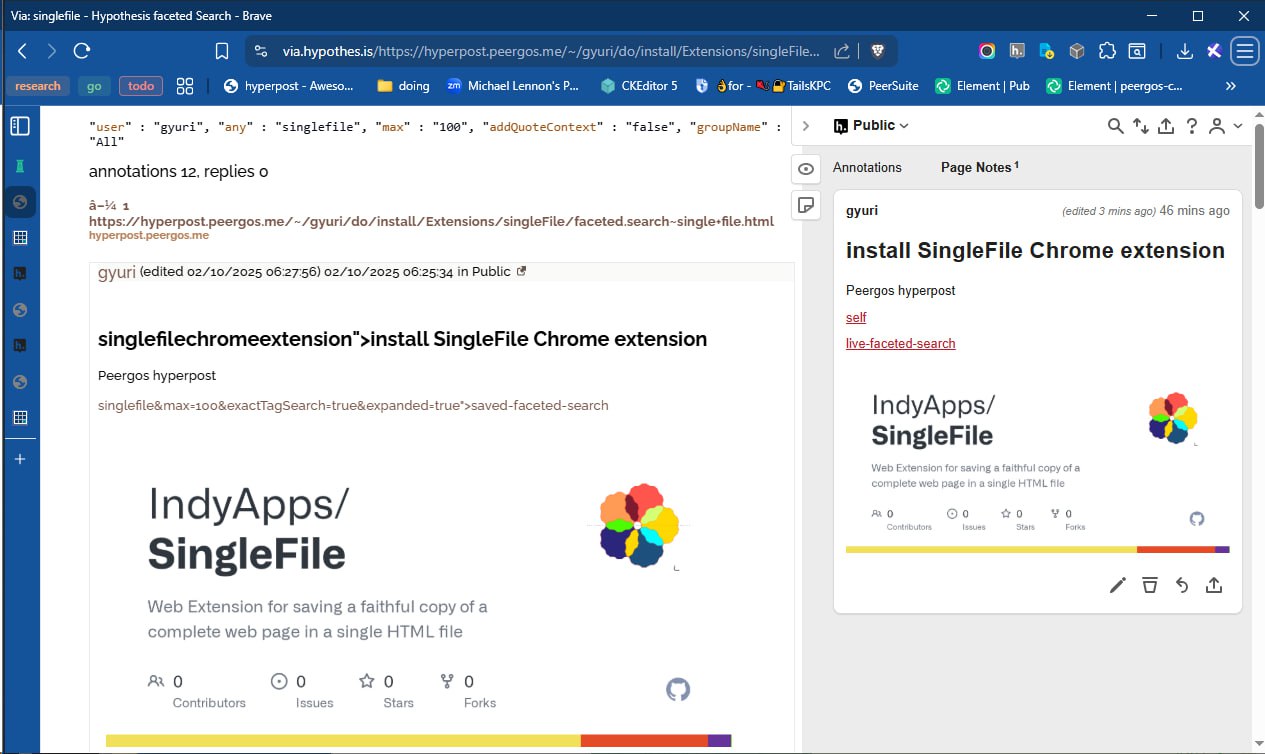
should give you something like this
09:19
If it does work, I should be able to just get to an end to end first cycle needing to rely on IPFS side less than anticipated. Peergos plus via.hypothes.is working for hyperpost.peergos.me as a WebSite hosted via Peergos may be enough to get off the ground and into the Virtual Cloud with hyperpost
GL
09:26
Gyuri Lajos
The winning move is to mirror/document work on going in private indyspace created s by Peergos accounts hosting named Colabs (collaboratories) (like hyperpost, indy0 and indy itself and rely on Hypothesis and its faceted search. So that bot oly do we have individual web based work seamlessly melded with collaboratories but thaanks to hypothesis global scale and reach all that work becomes visible at web scale. Combining the best of /centralied discovery and accounts with private autonomous personal first no accounts.
09:29
Better still with just one accountregistered and signedup/in that woul be hypothesis, all autnonomous Peergos powered Users and /collaboratories will not only be part of a gloabl social networks via social annotations, but peope will be able to integrate into all their workflows that use other services to be tracked, saved and mirrorred within their owned spaces, giving permanence, and autnonomy to work that would otherwise be ephemeral
09:31
I am also experimenting with mirroring all my active accounts within Peergos, so that all lthe usernames are passowrd will be managed within secure peergos spaces, so that eventually even if your wrok laptop dies you should be able to carry on working. All you would need is a browser and a Peeergos account, which yu can even run on your own machines as a backup and guarantee availability of all your inormation in a single logical space even offline
GL
09:52
I'm setup both on my mobile and my laptop for calls, while I am working.
09:52
should get notifications on my mobile
09:52
if u send a message
3 October 2025
GL
03:18
Gyuri Lajos
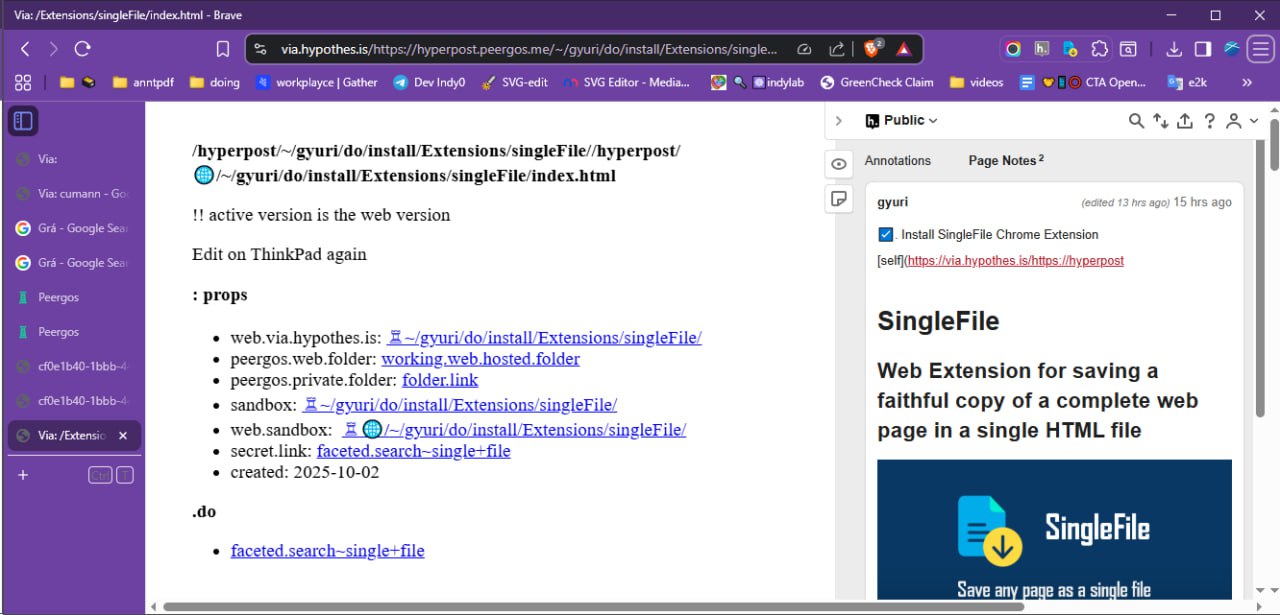
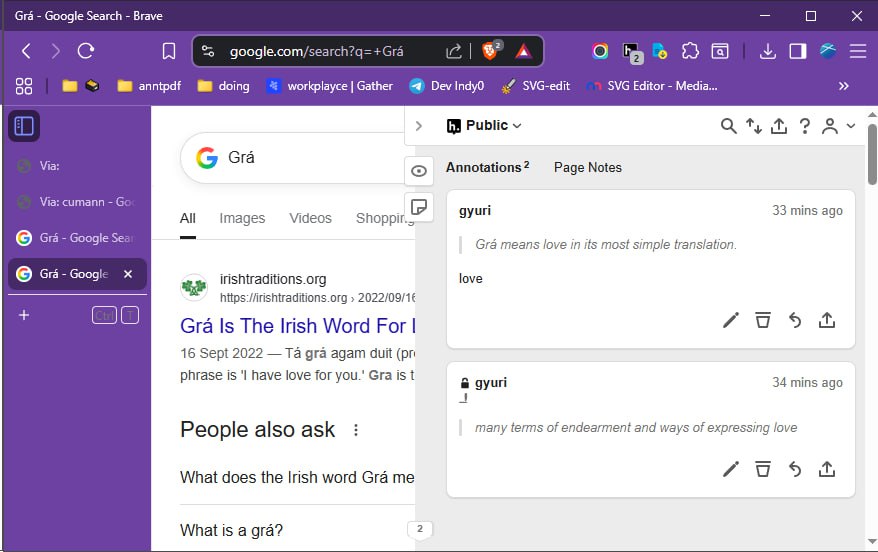
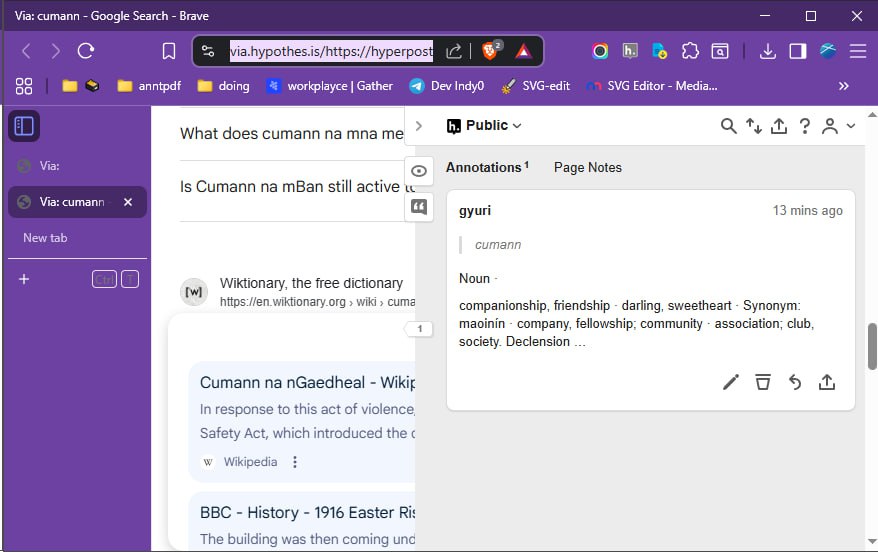
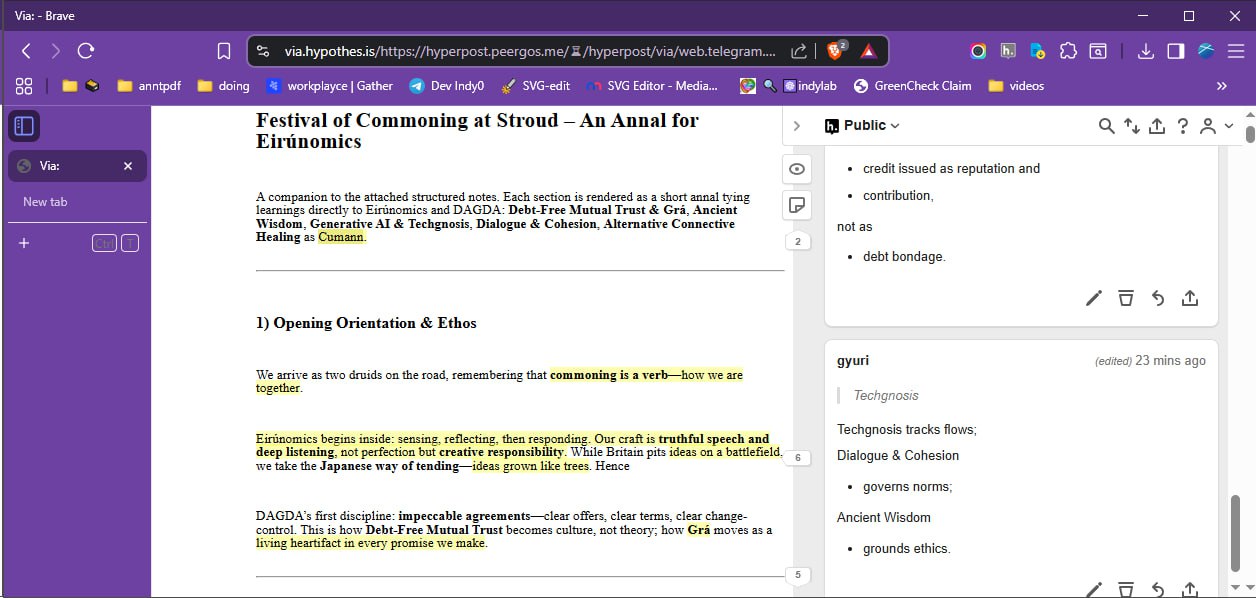
The best I can do is to take a screen shot of things I am working on before closing a tab with a link I wish I had though of that earlier
03:22
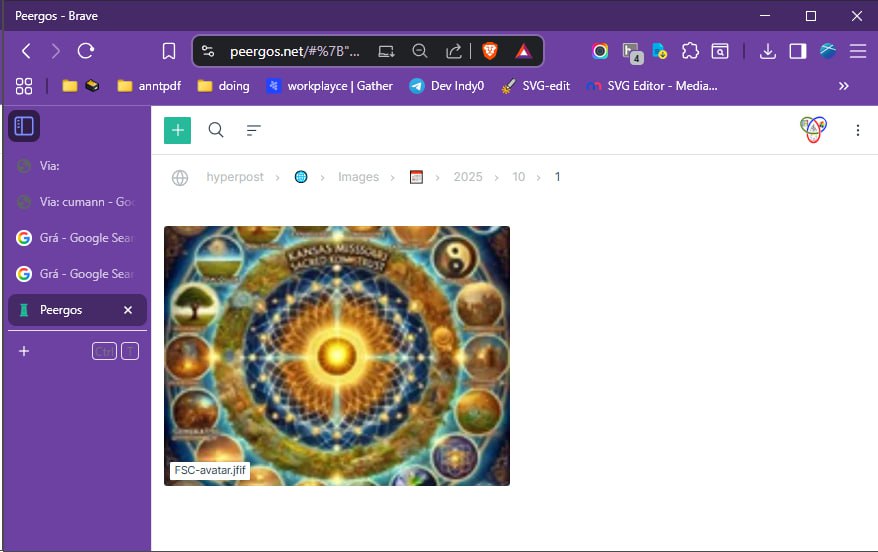
https://peergos.net/#%7B%22nonce%22:%22jYf61XZ1+hAVbeFrKOmQp9cN7DQ2VpLH%22%2c%22ciphertext%22:%22Aj7ydQYVLF0iTtgiPvfkYBy3ATrwPQftDCpvnRUSf9E9GL5ukHGEcUwe7AV6NZ7Ej7/37ioZGZRPQY1RZL05zYUr+L+cpw8O0F/Yj/SSOKz+dpjA9+JxmDvgNsc60rtyiZdfx4R50VrWV88QNvLdfA4cK17tiX72+AQ39vb0mKGg00xTZn04dNB+BqRQ/dV858UQ6CJzix8+bb4S2T8Mwy507lgsZiK/c5G1adarChvl94R25scTnCoCruBCqv8KQ+044SnPmTE4MUpszJyY8cMgZs6yw0R9%22%7D My tab list on the left even gives a clue about the context
03:27
Need to be automated
03:28
Do not close the staart page of an attention flow
03:36
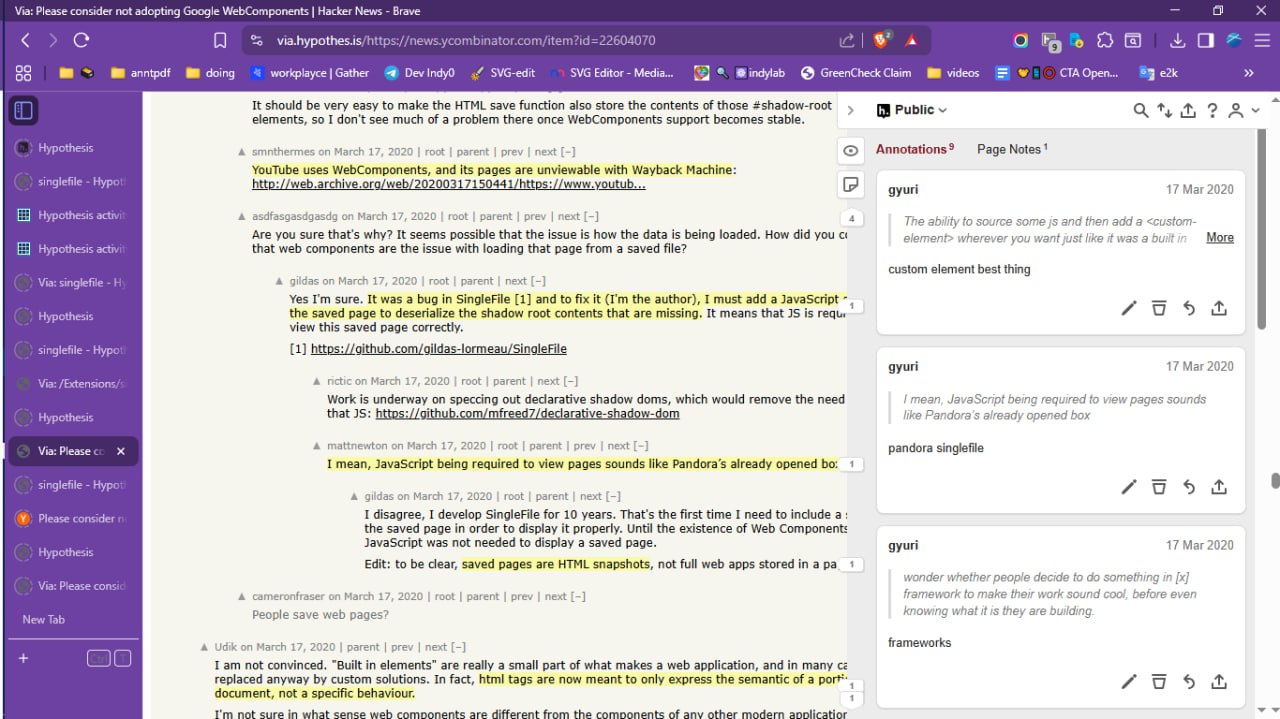
news.ycombinator-not-adopting~WebComponents-2020
https://via.hypothes.is/https://news.ycombinator.com/item?id=22604070
https://via.hypothes.is/https://news.ycombinator.com/item?id=22604070
GL
15:18
Gyuri Lajos
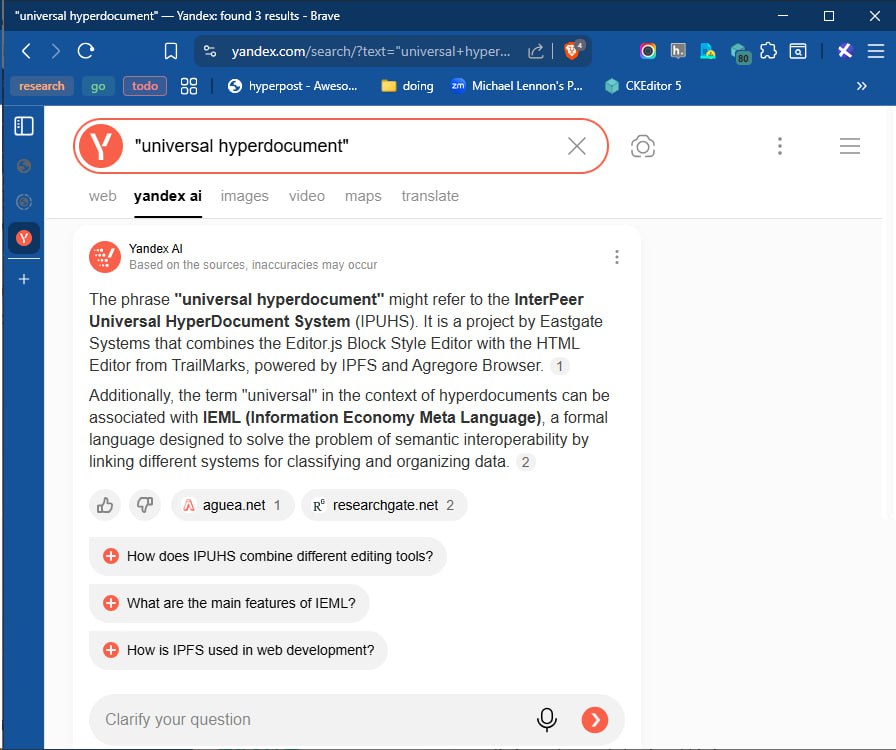
Nice hallucination by Yandex AI
15:19
I would not be surprised if EastGate tlked abut Universal Hyper Document
GL
19:22
Gyuri Lajos
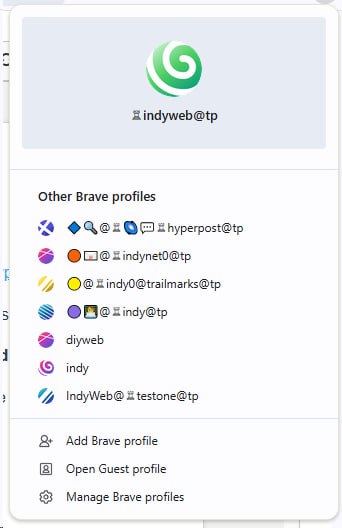
indyweb profile test for IPFS based constellation for autonoous Open Sauce Tinkerable co-evolutionary infrastructure
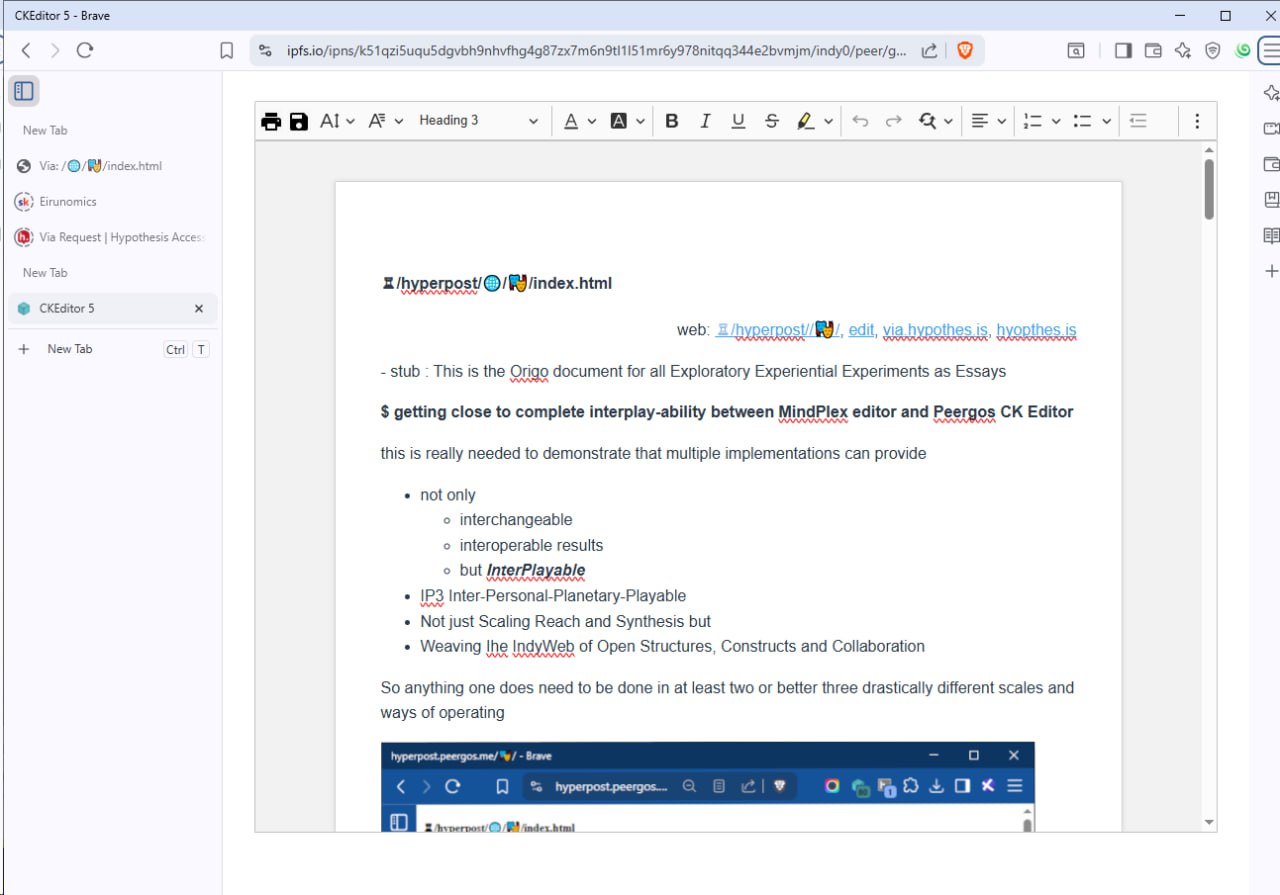
19:26
Peergos Custom App CK Editor hosted on IPFS indy0
19:28
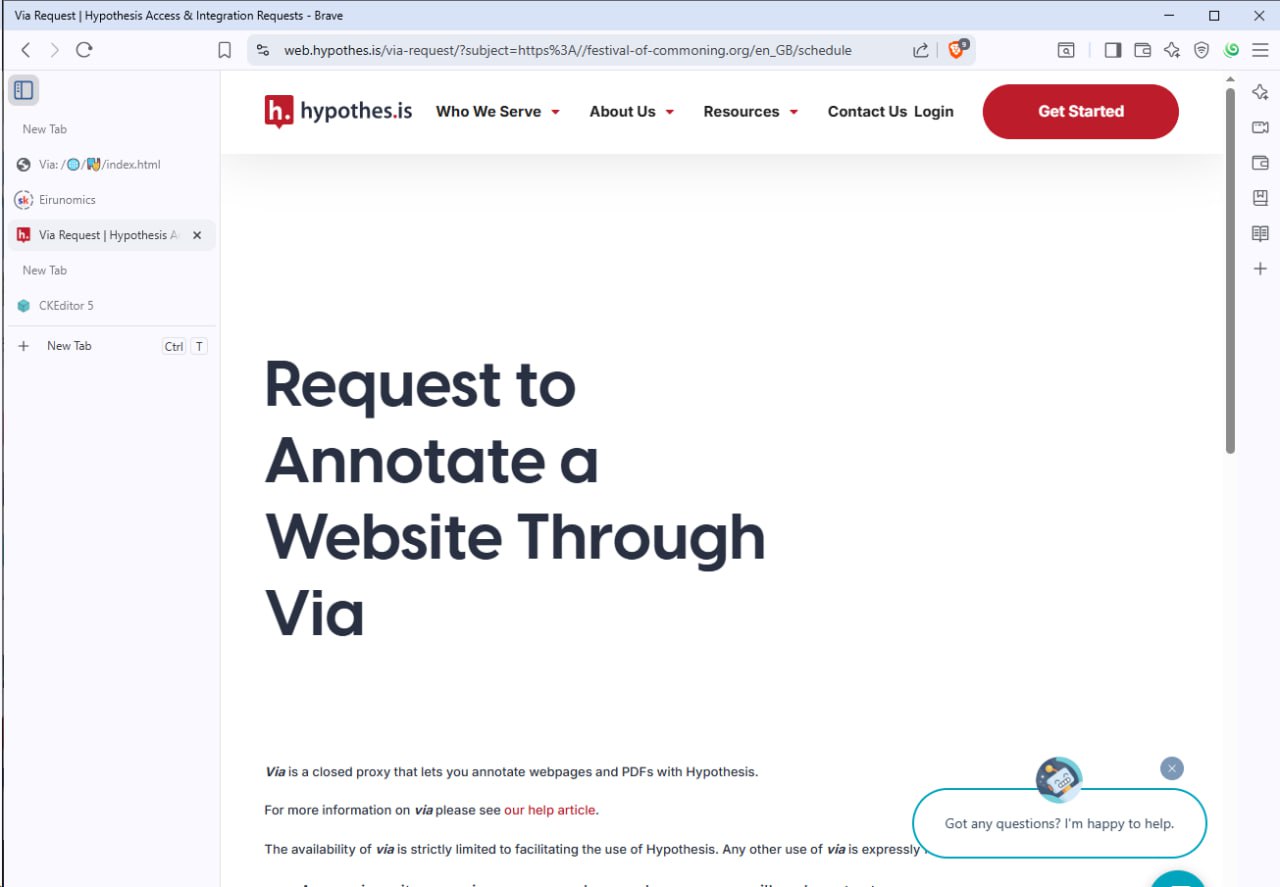
https://web.hypothes.is/via-request/?subject=https%3A//festival-of-commoning.org/en_GB/schedule
Request to Annotate a Website Through Via
Request to Annotate a Website Through Via
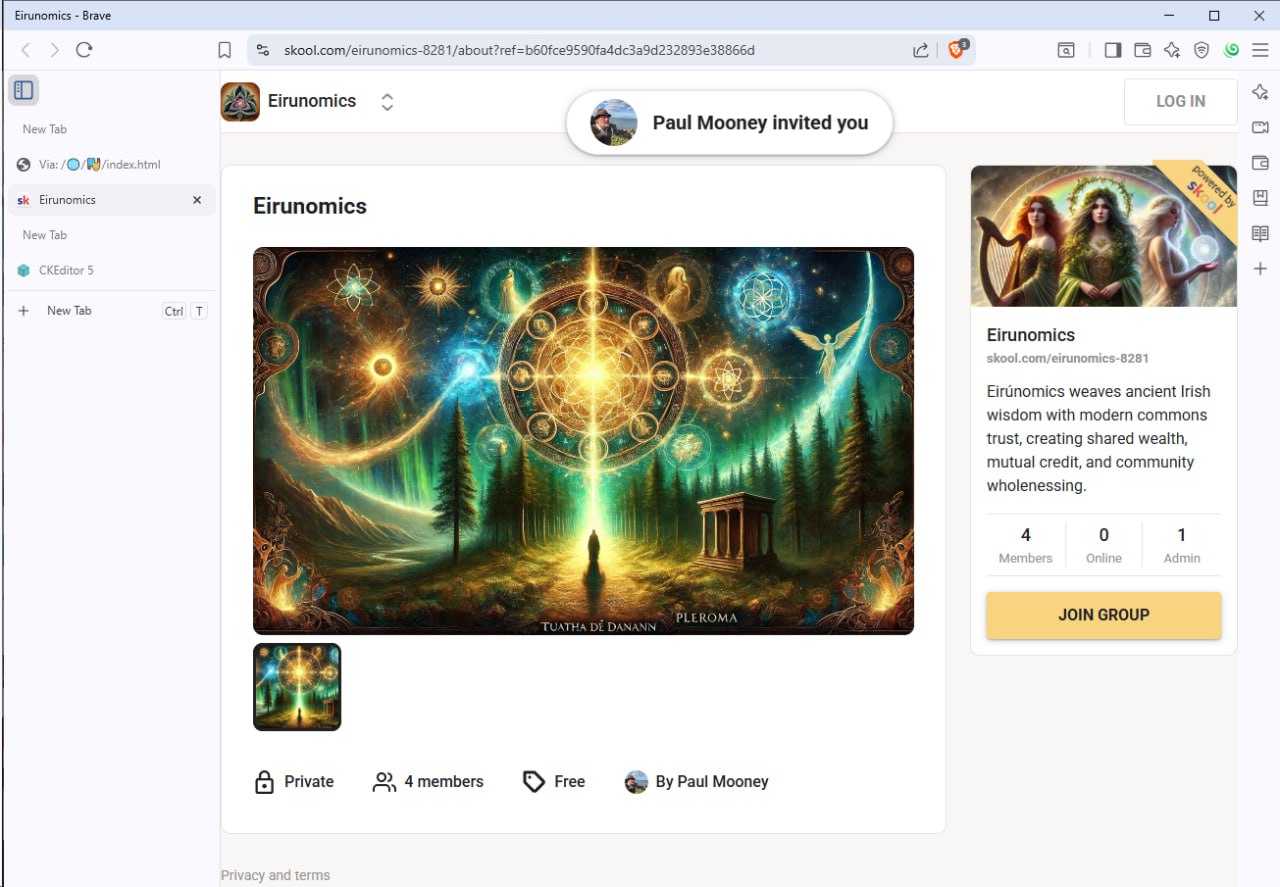
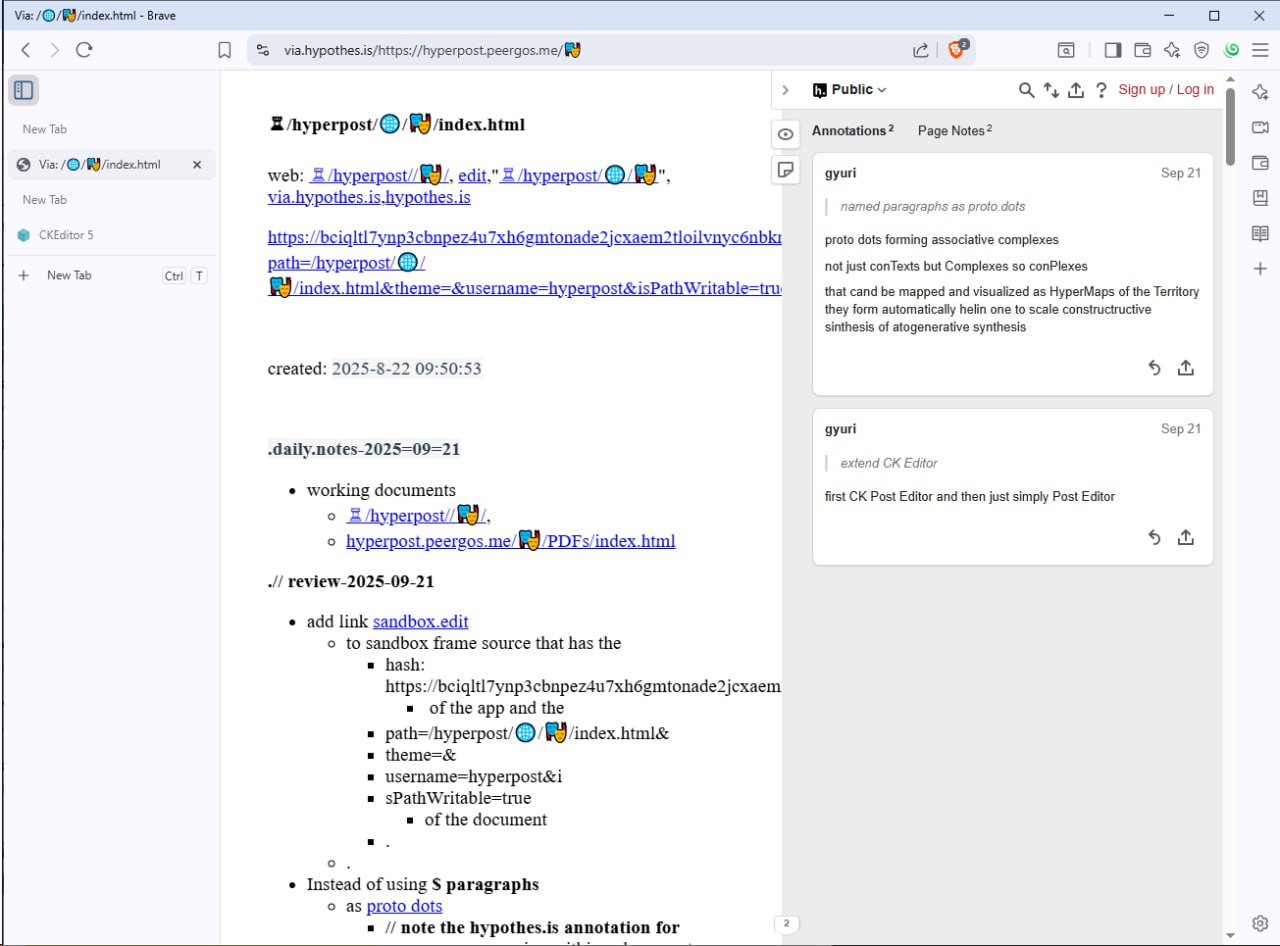
19:31
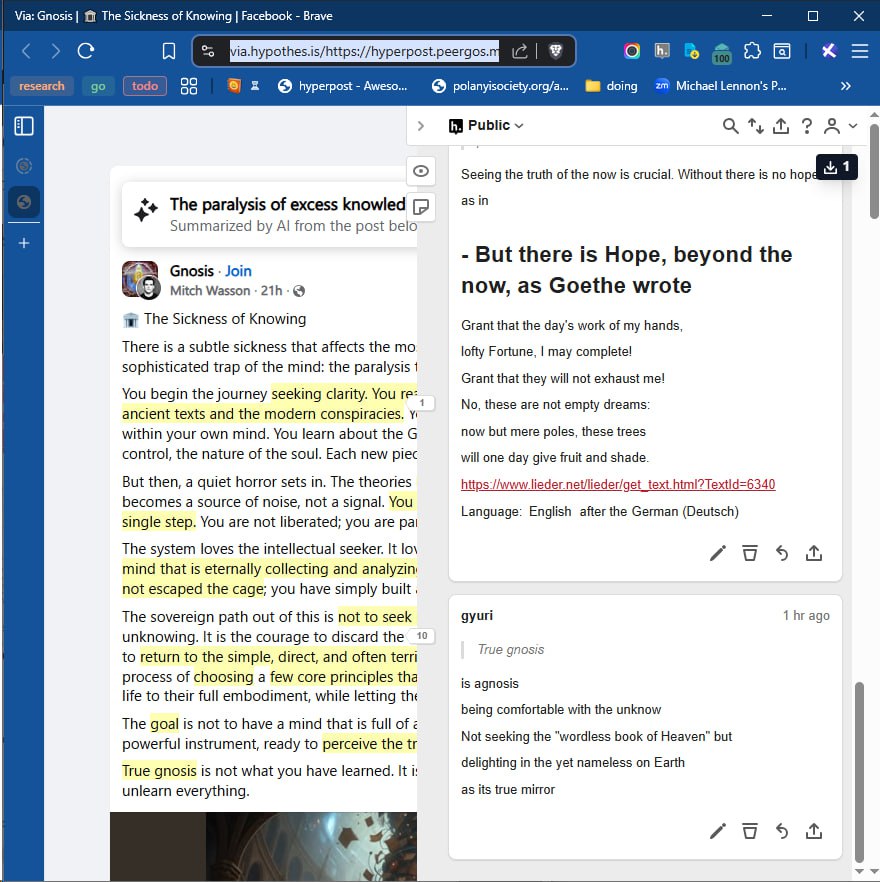
The Sickness of Knowing
19:32
Exploring ways to set up telegrm group Indy Groups
19:34
As a new direction reformulate everything in terms of indyColab workflows
19:38
also introuce the concept of care https://hypothes.is/a/rVR8kqB_EfCzrteBvPdYoA
19:39
use hypothesis cards as fow notes
19:40
annotations can be modified on the margins of pages which in turn can be linked to other cards which can mirror Plexes and act as portals to Plexes
19:41
Eventually these cards can be venues or portals to assoiated conversations
GL
19:59
Gyuri Lajos
Use judciously constructed and interconnected named hypothes.is annotation CARDS as first classsitueted embedded info-colaboratries associated with the annottor as an Indy Web Actor
20:00
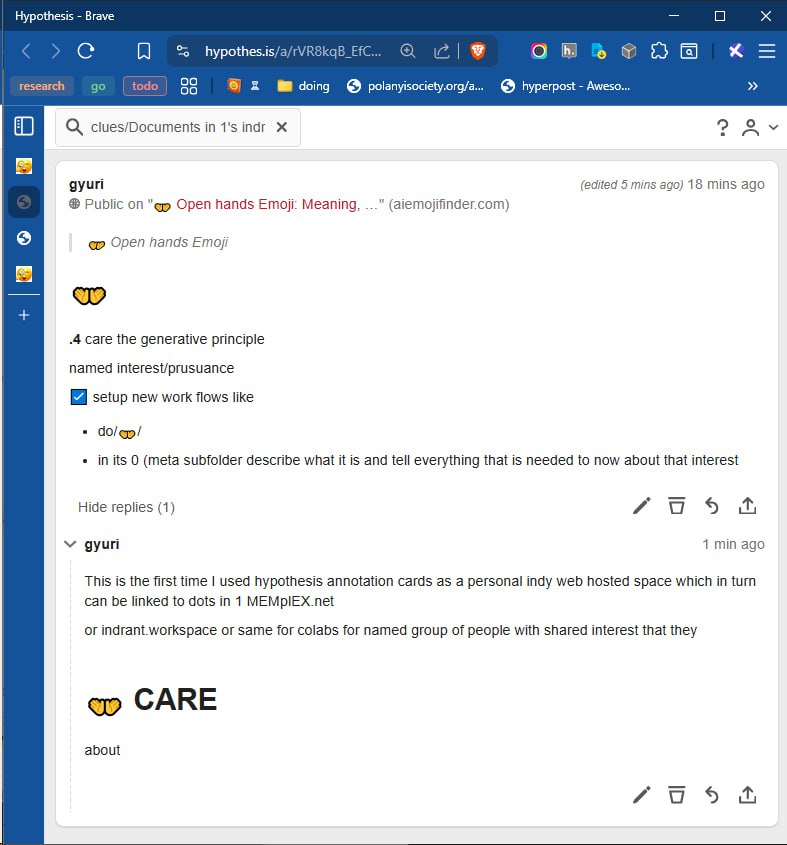
The first ever Indy Info-Colab Card on the annotation margins
20:03
Web Pages when they are snarfed and saved using SinglePage and uploaded to 1's Peergos Drive in Web Hosted Directory of 1 Peergos Account or in Peergos folder made available by invitation by 1 with own Peergos Space (this could be one they own) or given by 1 who is already a named trusted actor on the Indyweb
20:04
and alll the pages that are saved in a Web Hosted folder, all can be annotated
20:05
and the card for any abnotation provided a way of recording pertinent important informataion, connect them to relevant conPlexes in form tht re shared publicly but provides entry point to trust ntworks and conversations
20:07
Hypothesis search used to search 1's own annotations gives a dynamic way of reviewing recent cards as a dynamic stream reflecting Indy Work by the associated Indy Actor as a revere chrnologil Work Stream or personal Feed
20:08
I am writing here as I am working to close and document what's been lingring n my many desktops. So I can start again tomorrow wieh clean desktops! and also a listing of recent tabs as they are recorded here
20:09
I'll experiment tomorrow importing today's Telegram notes into a single page document
20:09
put it into my web hosted space
20:10
and work on the content with the orchestration organiational an linking affordances fo annotataion cards
20:12
Bear in mund that everything that one cares about eventually makes it into 1s IndyDrive poweed by Peergos currently, but the intent is that all this Indy constellations for personal first colaboratories can be setup on alternative Drives, even Google Drive, but or any Drive, because everything is avsilable as Open constructs that could be tinkered and adapted to match the existing capabilities of a Drive
20:14
I designed and built MindDrive using MindGraph 13 years ago with the explicit design requirement that it would be open to such wholesale resuse on any Drive infrastructure
20:17
This is possible because all it takes is to map MinGraph (today developed into MindPlex so a richer Graph concept that is superodinate and integrative with all existing graph based info infrastructures Drives are themselves are but graphs Directe Acyclic Graphs, trees or hierarchies are the wimoles for like File systems
20:21
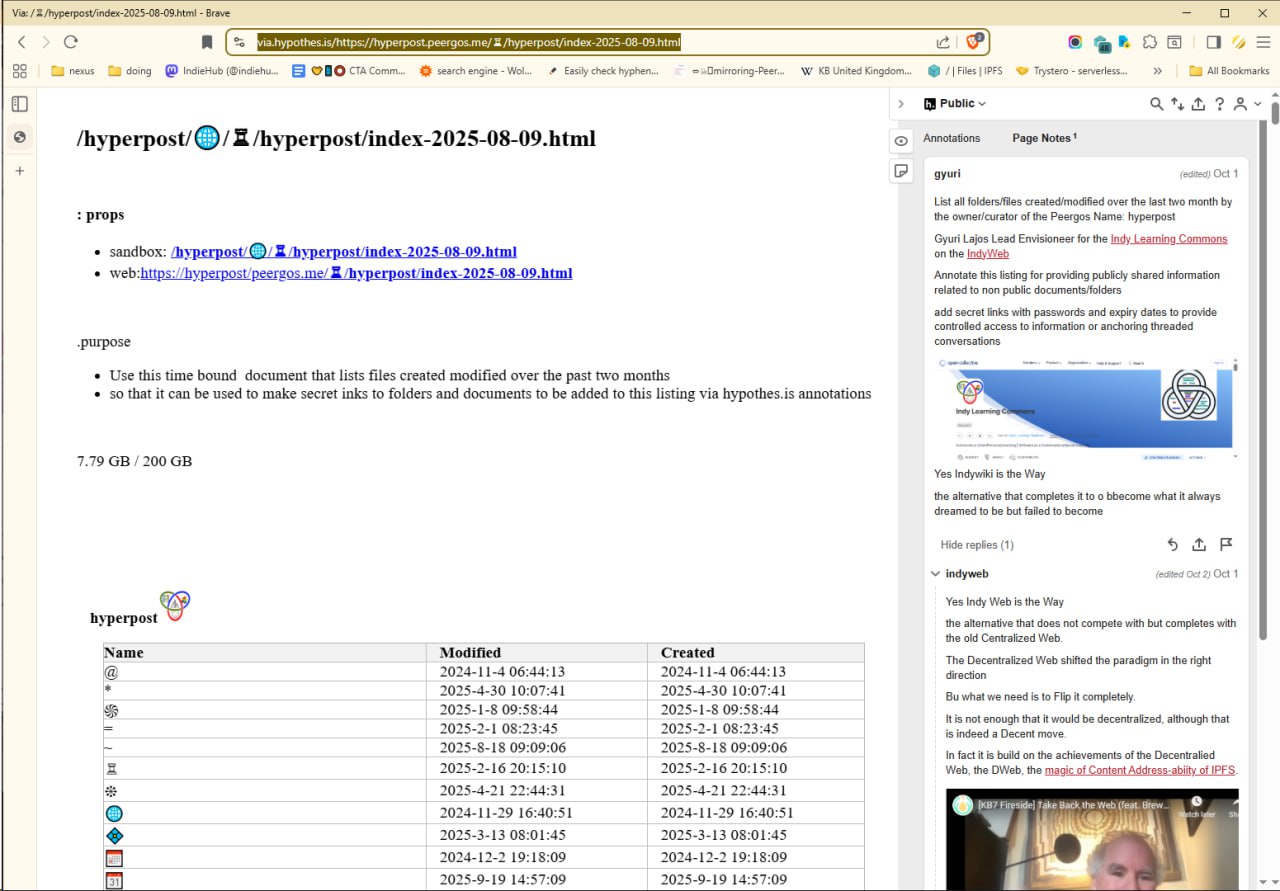
OverReView Document for the past 2 months work
GL
20:41
Gyuri Lajos
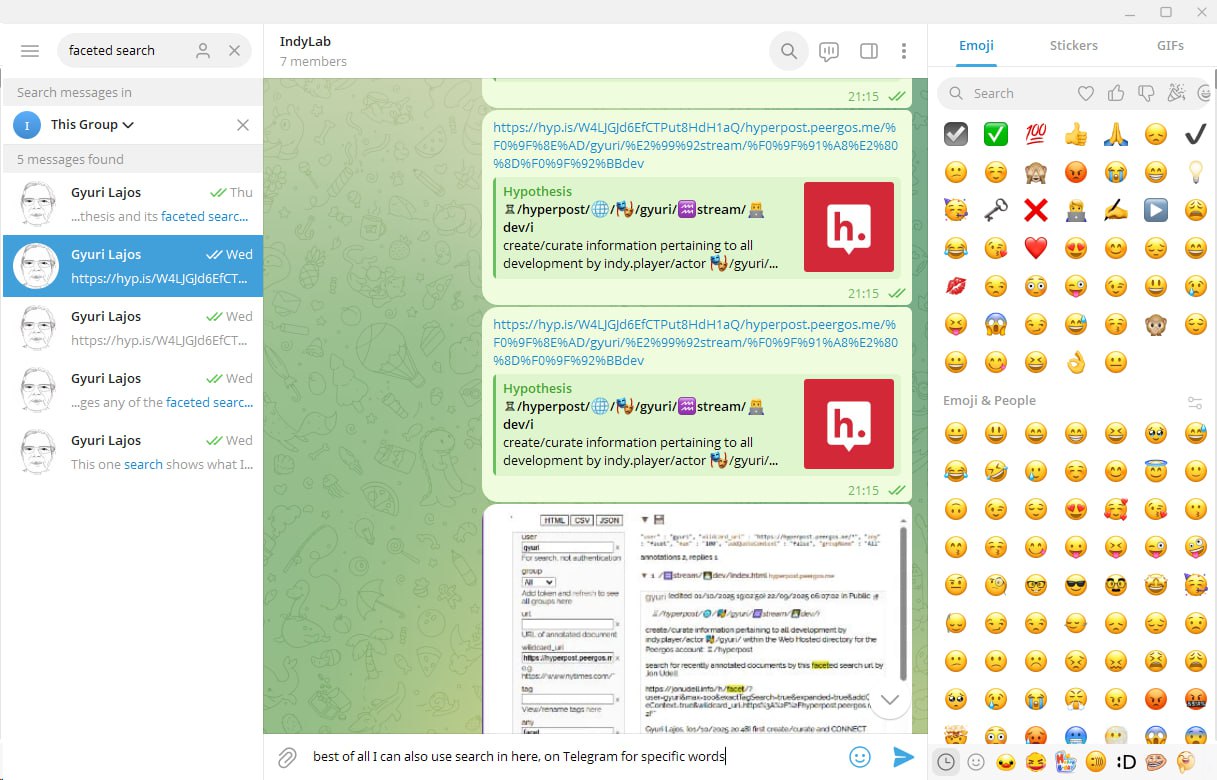
best of all I can also use search in here, on Telegram for specific words
20:42
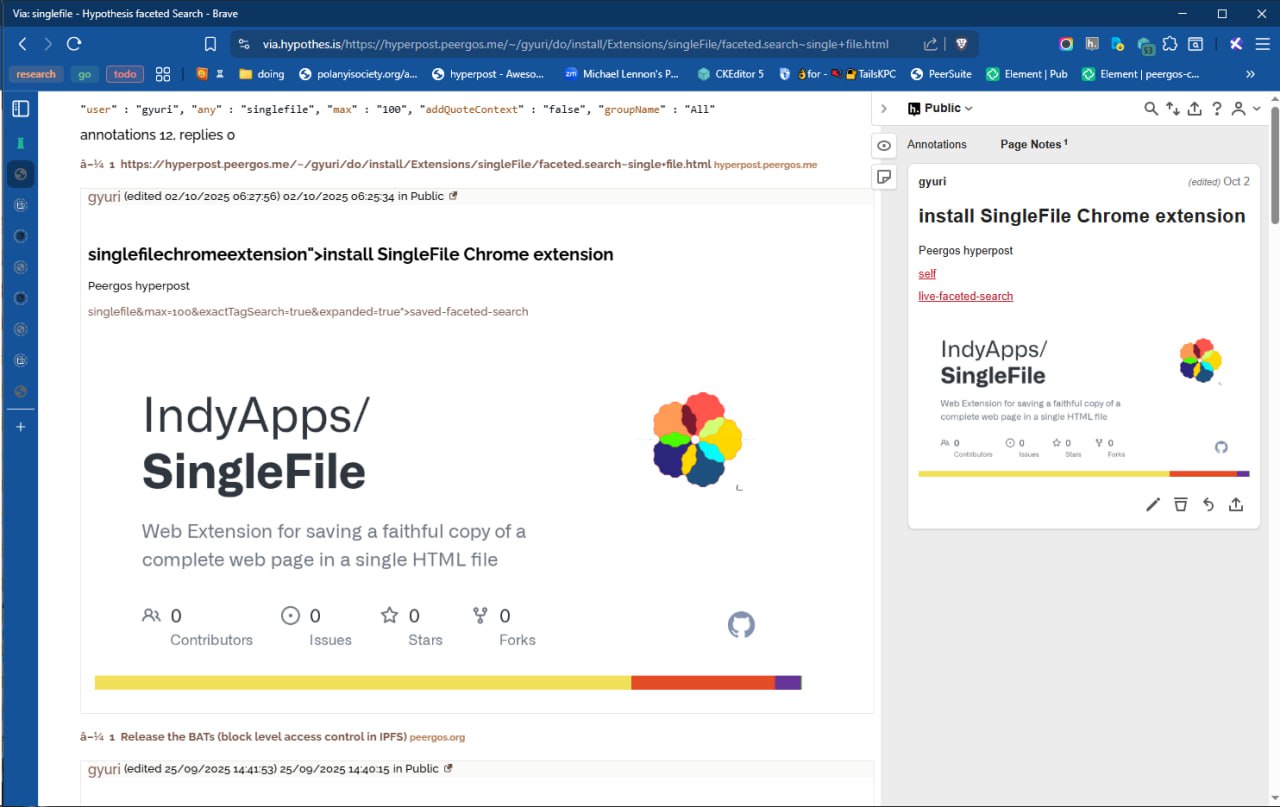
which in turn wil have links to Hypothesis cards and M Indy Web document like https://via.hypothes.is/https://hyperpost.peergos.me/~/gyuri/do/install/Extensions/singleFile/faceted.search~single+file.html
20:46
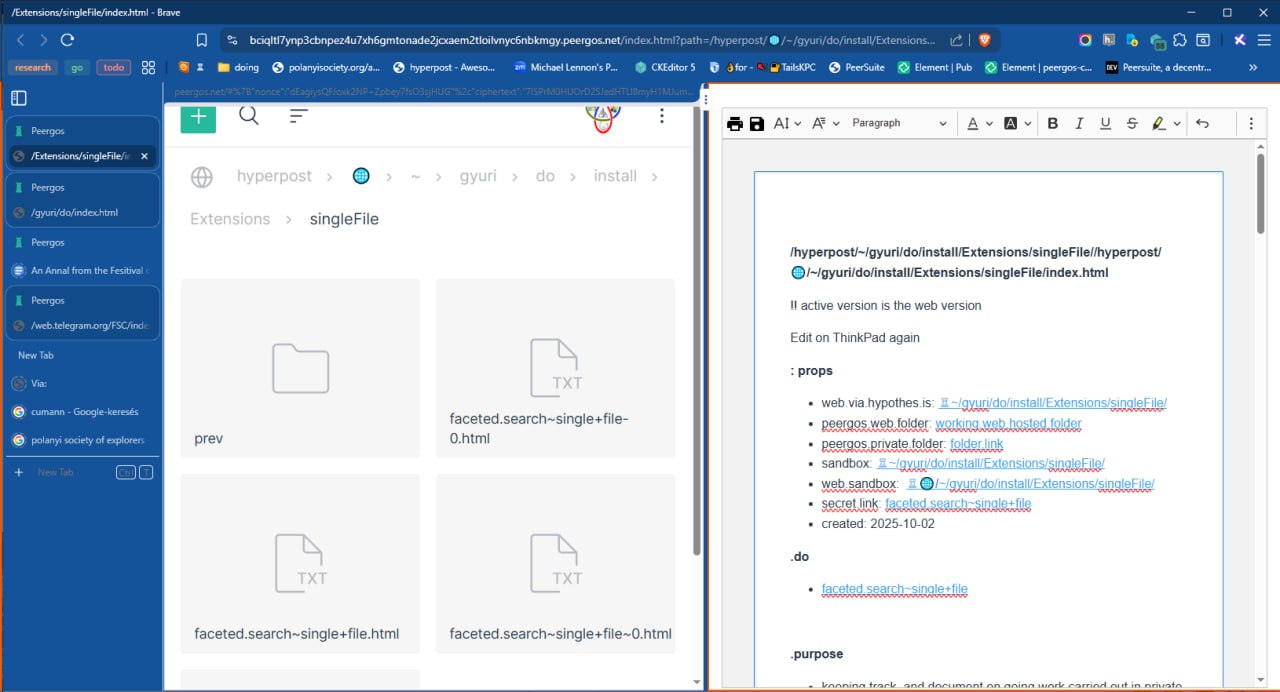
And this is my main document editor window into what I am working now
20:51
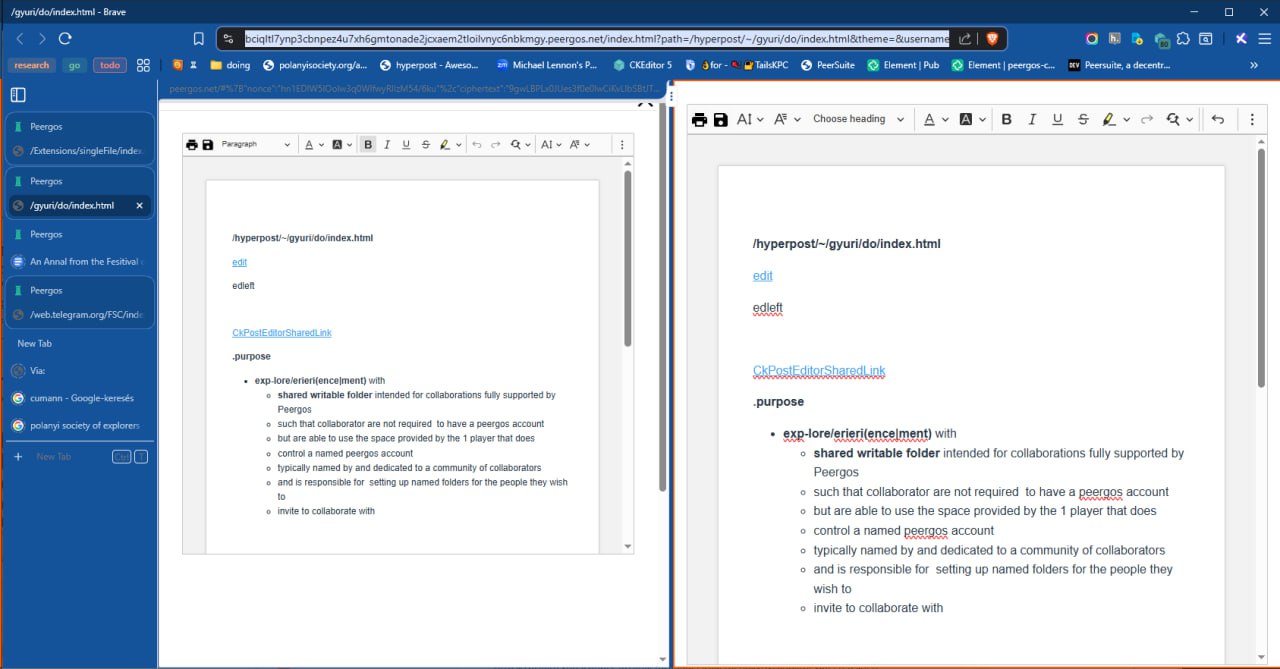
https://bciqltl7ynp3cbnpez4u7xh6gmtonade2jcxaem2tloilvnyc6nbkmgy.peergos.net/index.html?path=/hyperpost/~/gyuri/do/index.html&theme=&username=hyperpost&isPathWritable=true
Main entry point to all my (as IndyActor gyuri) current activities and workflows
Main entry point to all my (as IndyActor gyuri) current activities and workflows
20:52
Still got too many browser windows open
20:55
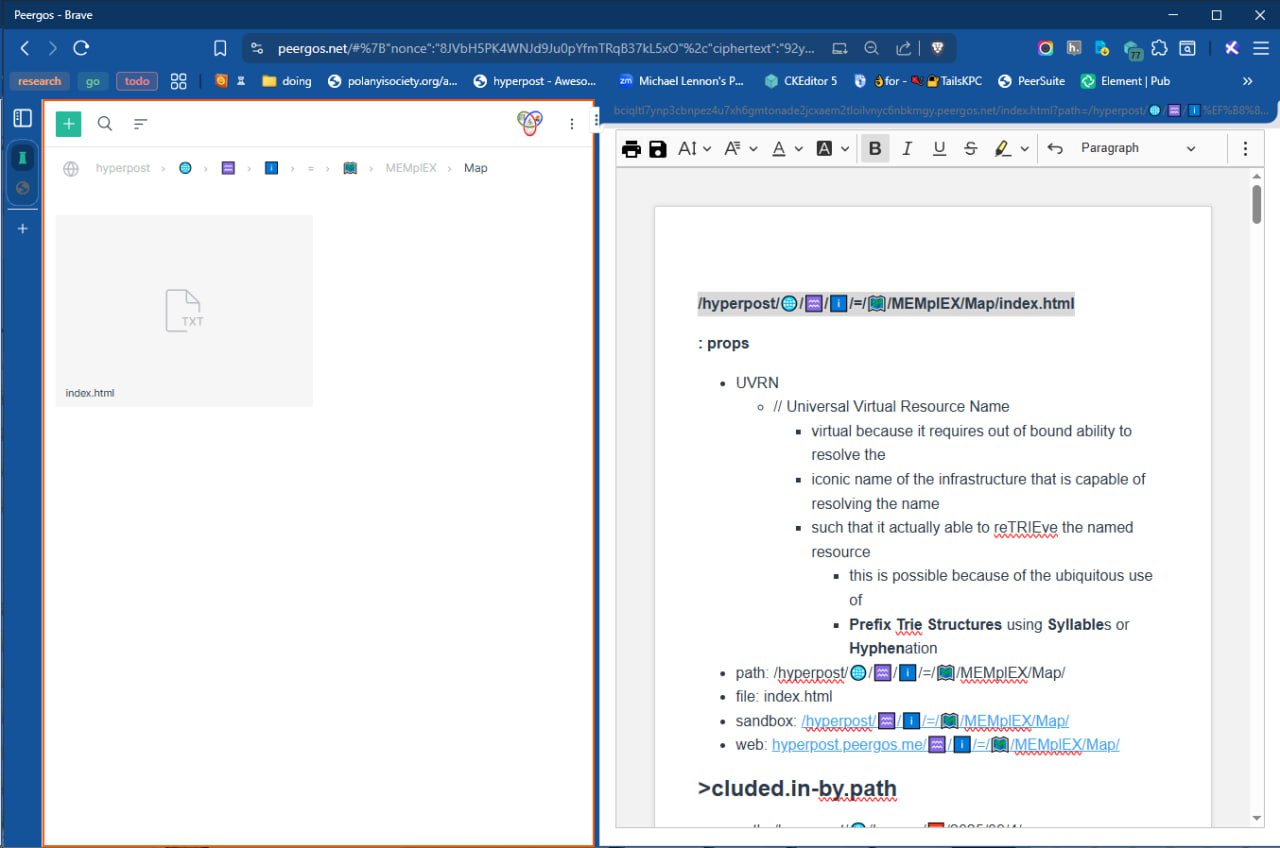
/hyperpost/🌐/♒️/ℹ️/=/🗺/MEMplEX/Map/index.html
work on MEMplEX Map
work on MEMplEX Map
20:57
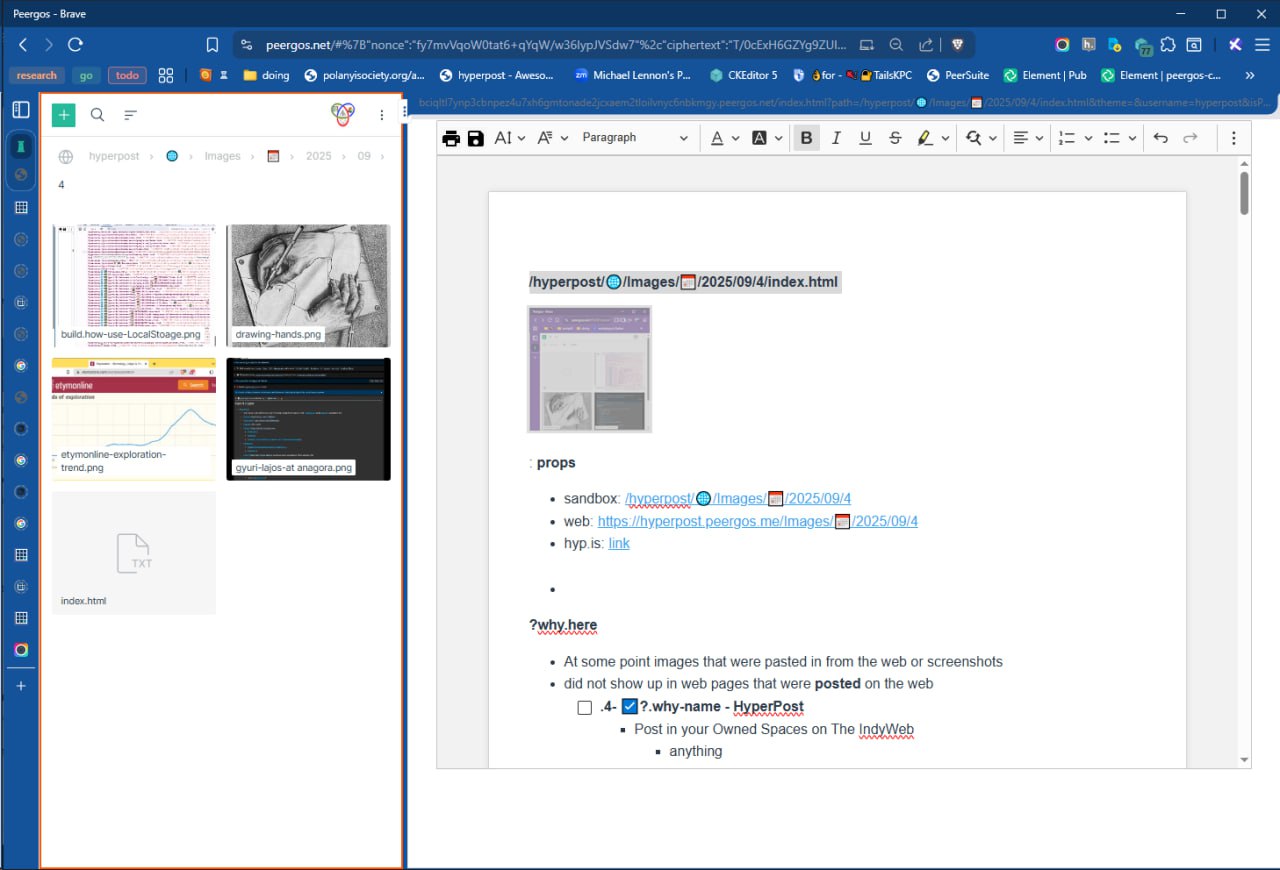
/hyperpost/🌐/Images/📅/2025/09/4/index.html
TranscluEsion experiment
TranscluEsion experiment
GL
21:16
Gyuri Lajos
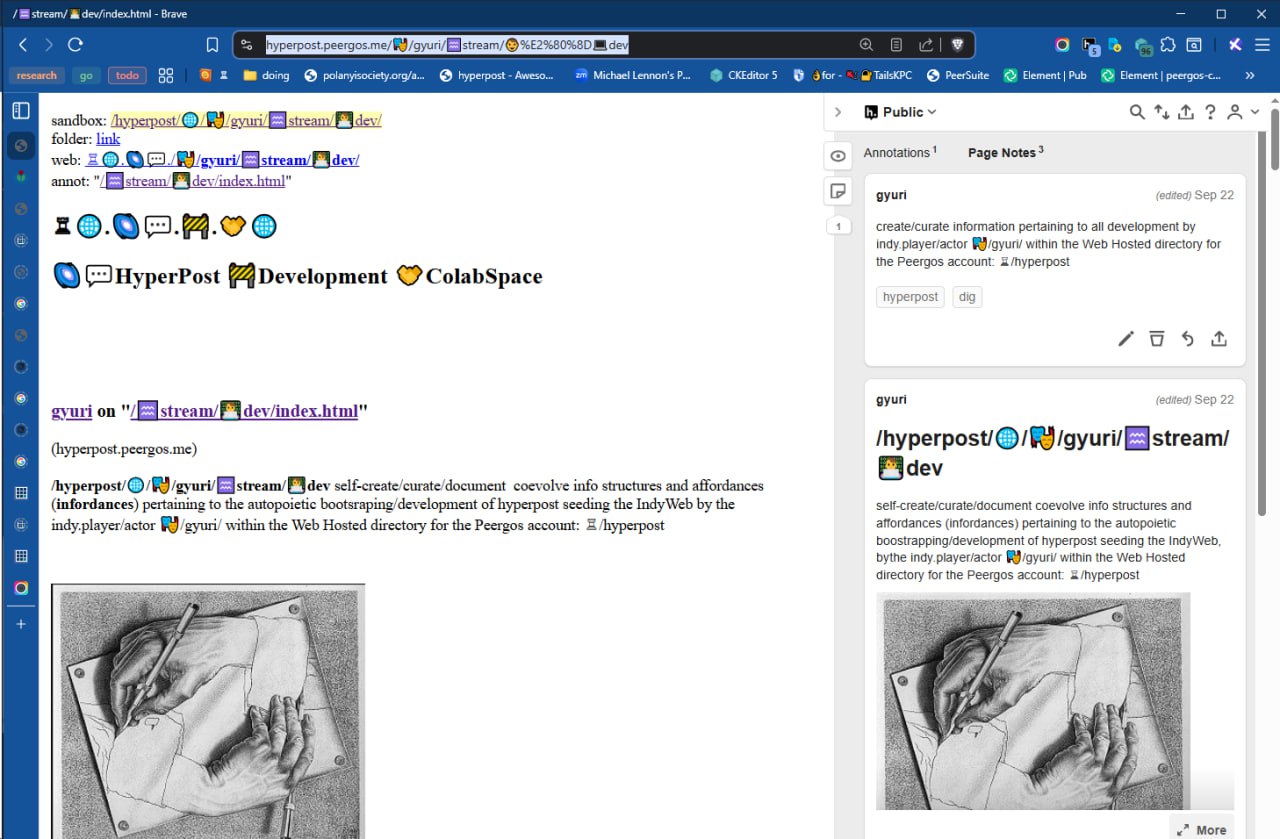
Tihis is where it all started
21:16
should just share the card
21:17
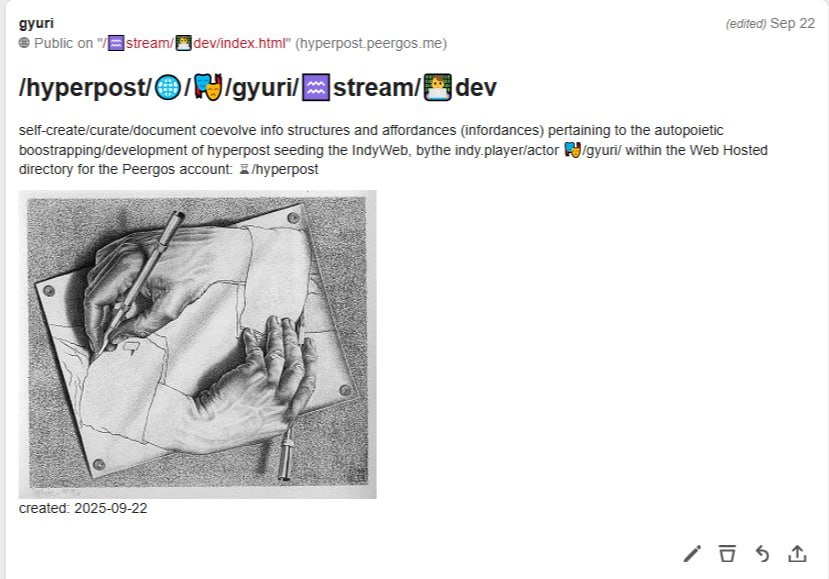
shae just cards here
21:18
Note that annotations that are not intended to be shared publically (require hypothes.is extension) needs images to be hostd by the Indy Web site
21:21
21:22
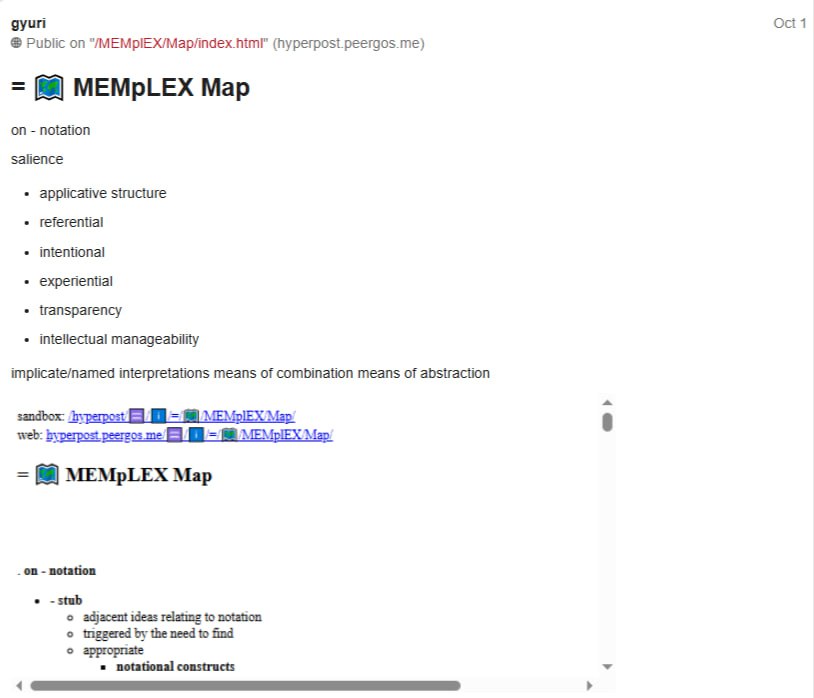
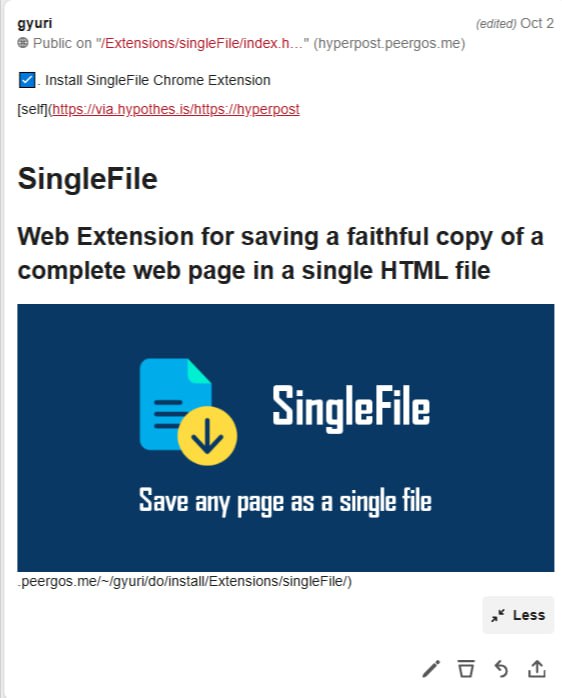
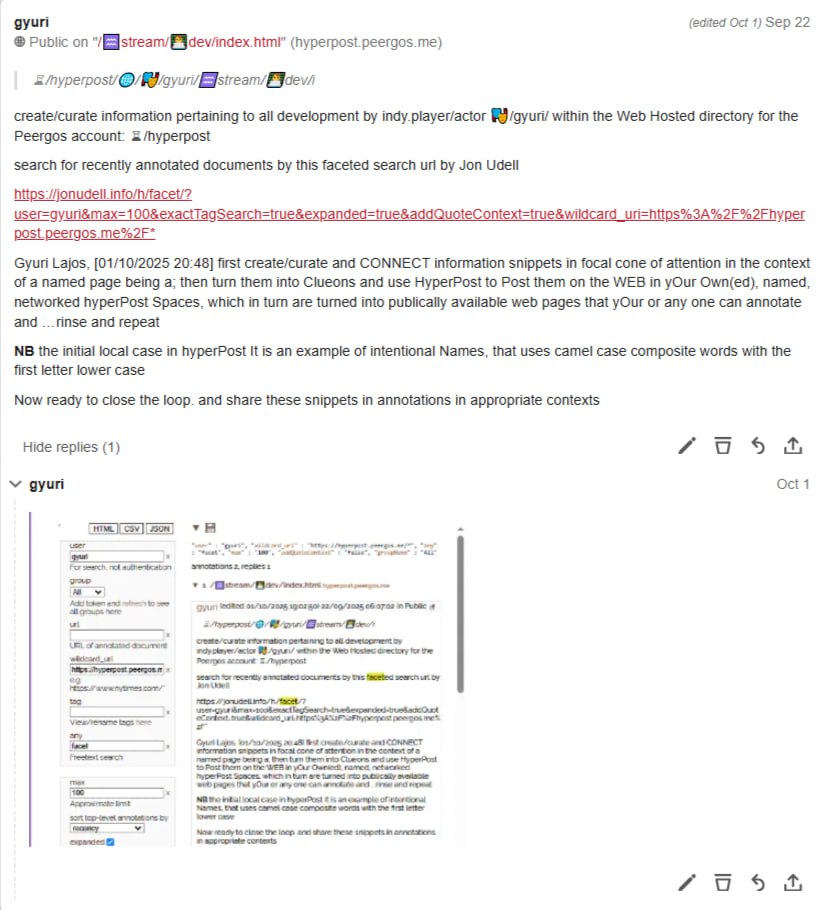
21:41
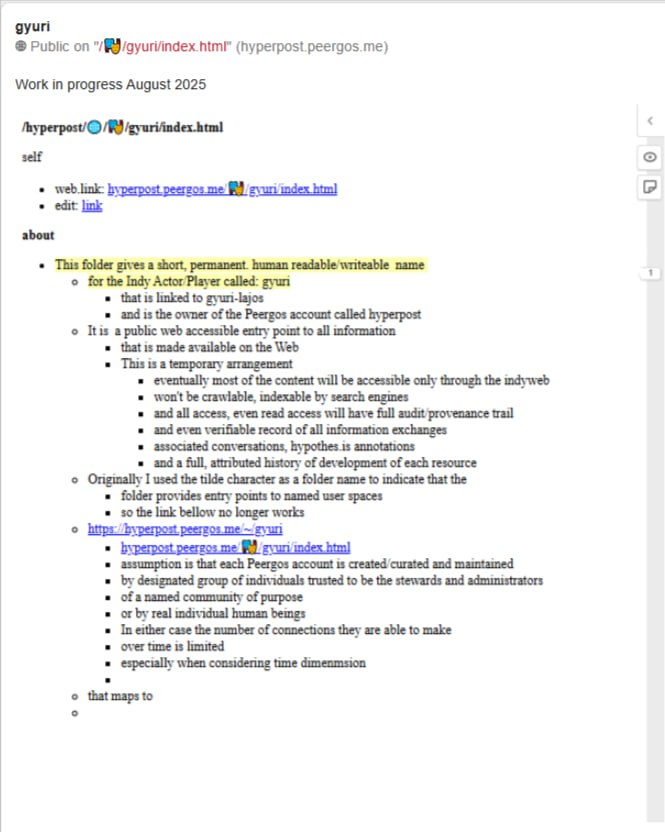
https://hypothes.is/a/aqeT-H6CEfCUHg8tLJK5bA
Indy Actor Gyuri Indy Web Page (Page you write and save and it is published on the web
Indy Actor Gyuri Indy Web Page (Page you write and save and it is published on the web
21:48
.do.how - use sandbox link for editing
document story behind adding document into this folder
https://hypothes.is/a/js13bKCREfC9aZdwG4liOQ
document story behind adding document into this folder
https://hypothes.is/a/js13bKCREfC9aZdwG4liOQ
21:49
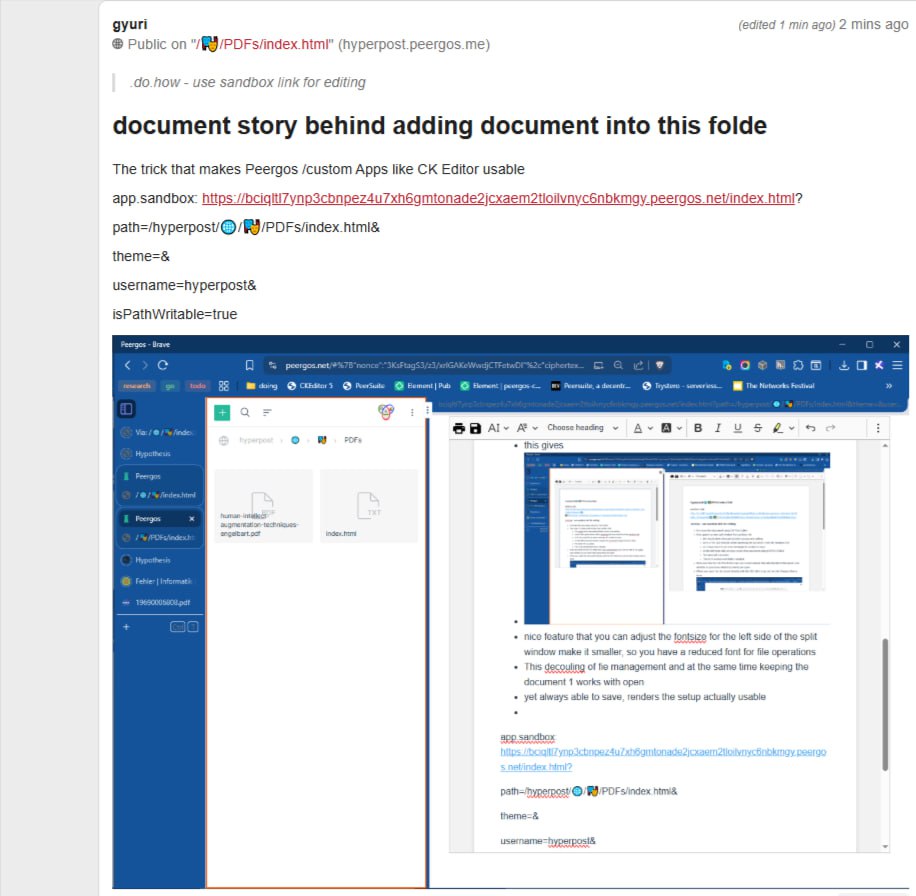
21:52
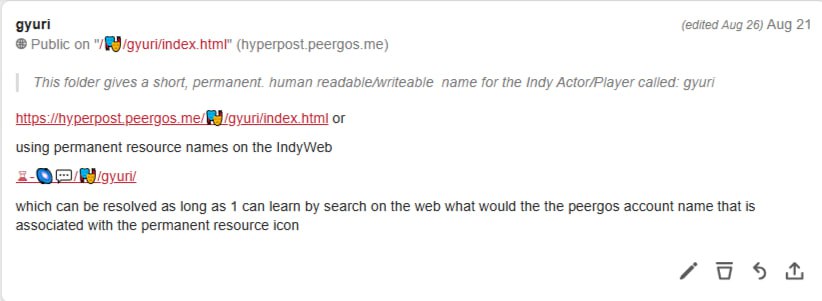
This folder is a a singular entry point, a portal,
to all my activities within all my virtual networked virtual personal spaces
It is created under the Peergos Name hyperpost
in its
under the
🌌💬
to all my activities within all my virtual networked virtual personal spaces
It is created under the Peergos Name hyperpost
in its
under the
🌌💬
21:55
constructing hypermaps
21:55
gyuri
(edited) Sep 23
Public
on "/🎭/gyuri/index.html"
(hyperpost.peergos.me)
side.note - Workflowy
dot
🗺/
.construting- HyperMaps
.do.how-clueful naming
Flip the way of working in a Wiki
.side.note - Workflowy
Here we do “hyper writing”
(edited) Sep 23
Public
on "/🎭/gyuri/index.html"
(hyperpost.peergos.me)
side.note - Workflowy
dot
🗺/
.construting- HyperMaps
.do.how-clueful naming
Flip the way of working in a Wiki
.side.note - Workflowy
Here we do “hyper writing”
21:56
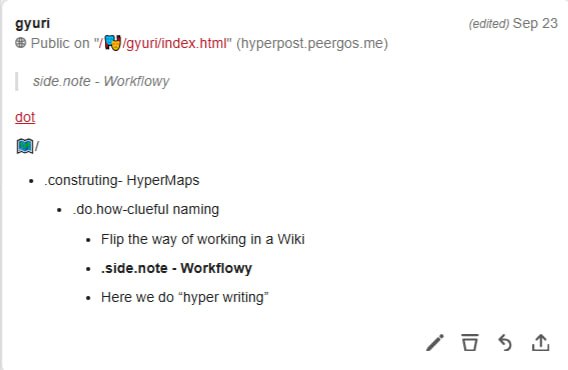
22:05
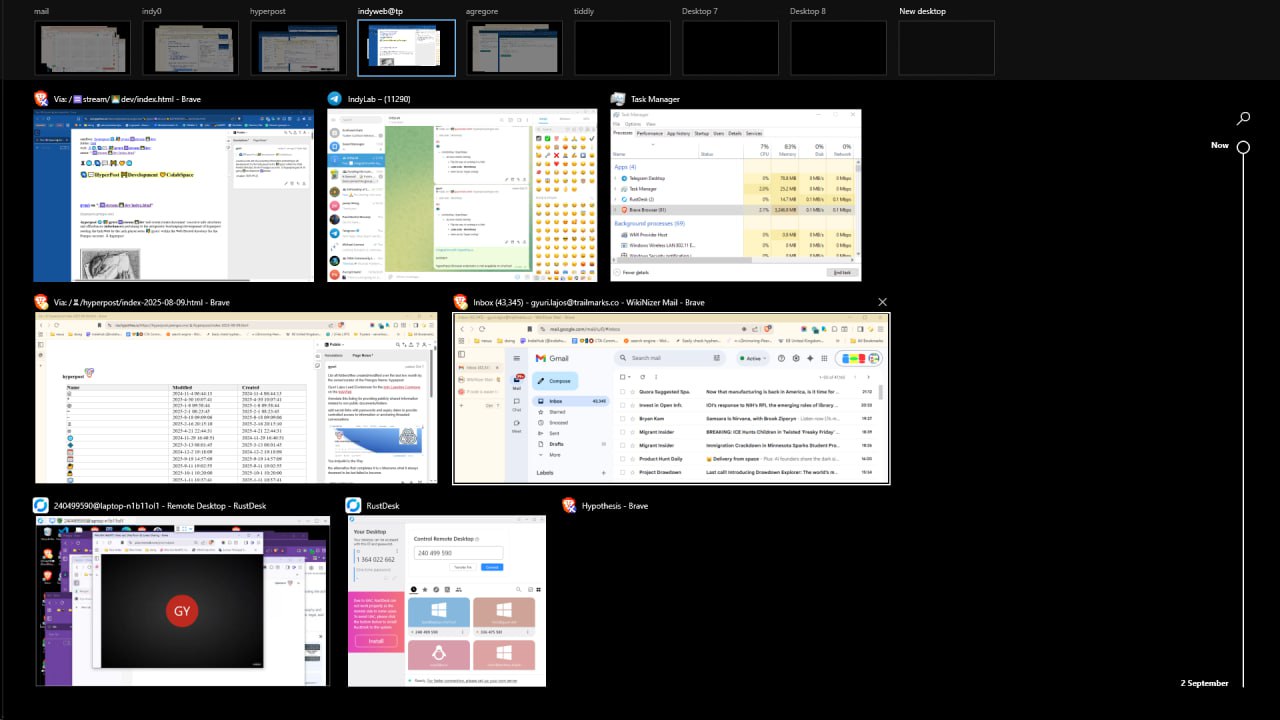
desktop cleared
🙏
GL
22:05
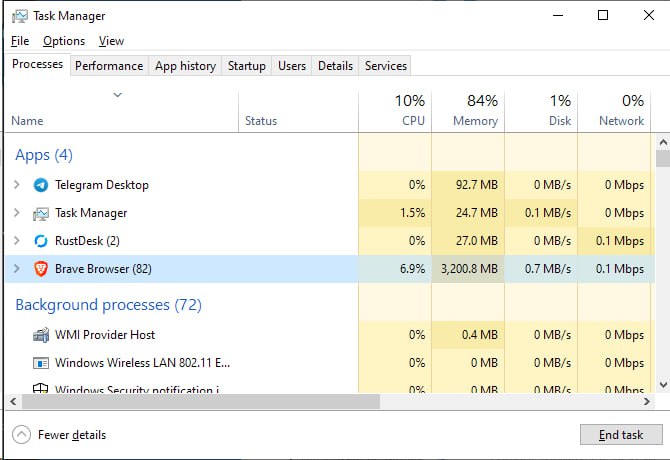
memory load 83%
4 October 2025
GL
19:52
Gyuri Lajos
create-brave-profiles-🗫🧊talk-@zen&@tp
19:53
setup with IPFS without Peergos Acounts
GL
21:37
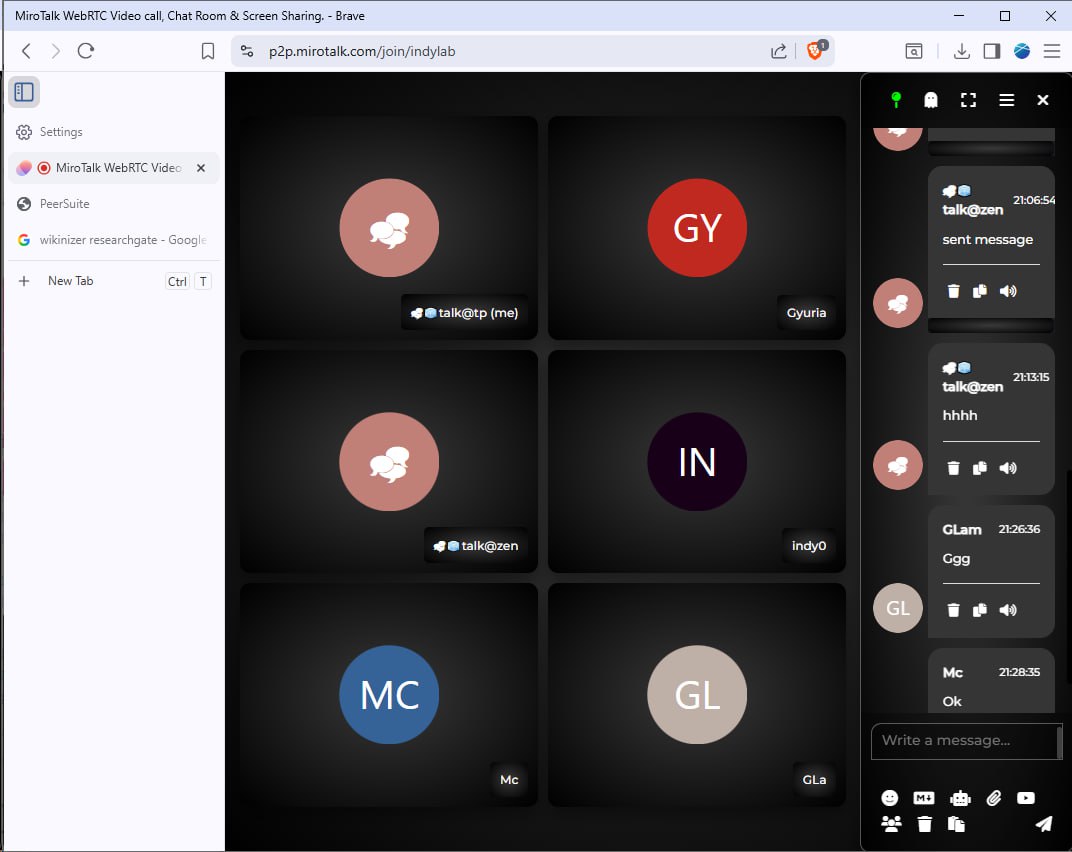
🗫🧊talk@zen 🗫🧊talk@tp 🟡@♖indy0@trailmarks@tp
21:38
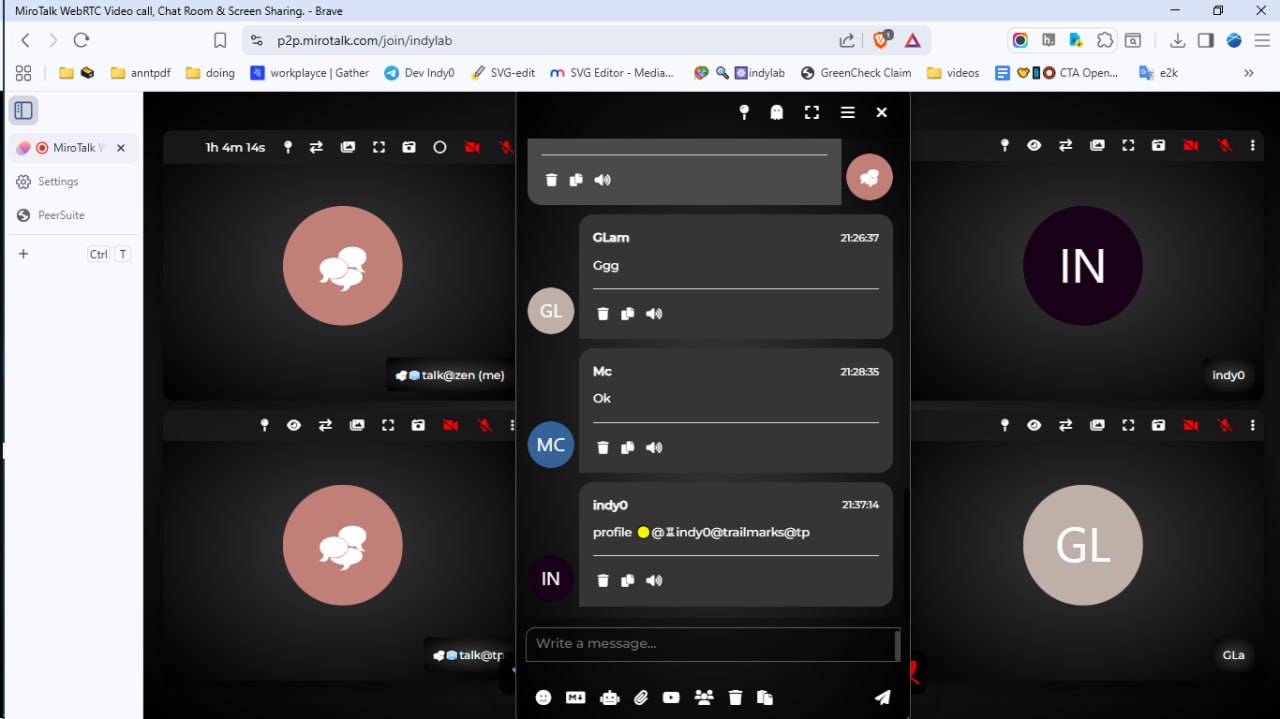
zen
21:43

Select participant in group for private message by tapping the three heads icon
21:43
21:52
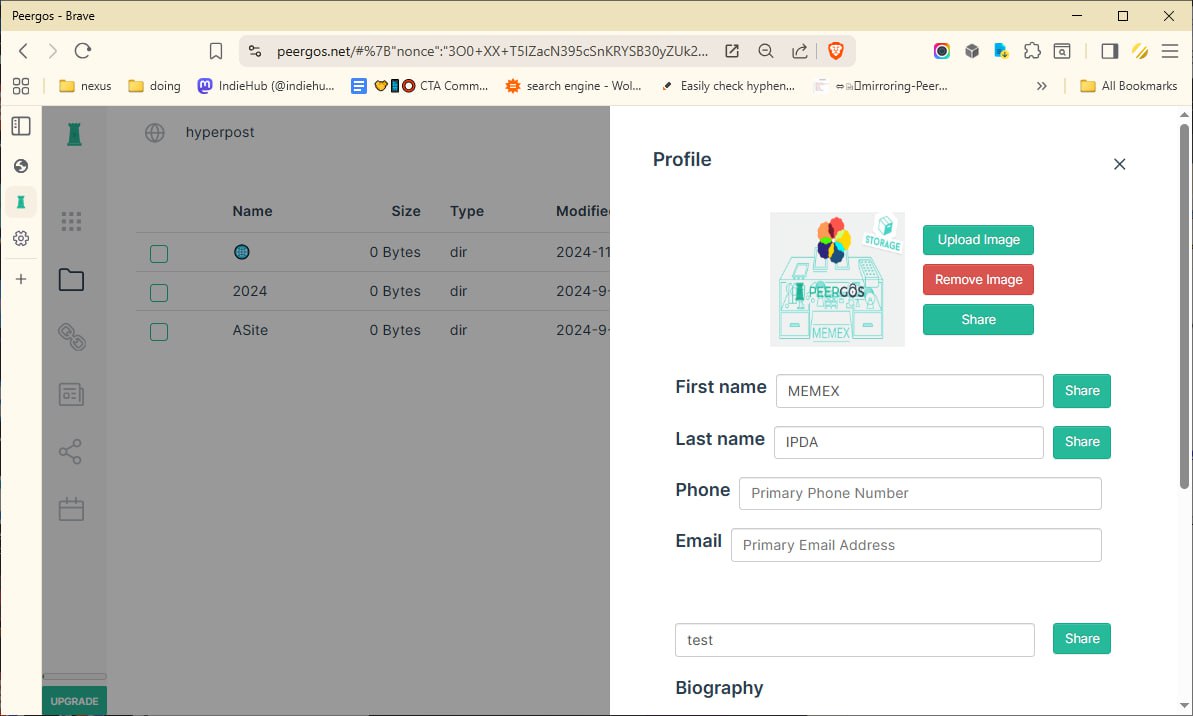
shared the following folders owned by hyperpost with indy0
main goal being that indy0 can write int the hyperpost Web Hosted folder so that any document there will be hosted n the web and aso available for annotation using via.hypothes.is/https@//hyperpost.peergos/me/...
in particular my own journal at
/hyperpost/🌐/🎭/gyuri/📓/2025/10/index.html
main goal being that indy0 can write int the hyperpost Web Hosted folder so that any document there will be hosted n the web and aso available for annotation using via.hypothes.is/https@//hyperpost.peergos/me/...
in particular my own journal at
/hyperpost/🌐/🎭/gyuri/📓/2025/10/index.html
5 October 2025
GL
01:17
Gyuri Lajos
revisiting earlier experiments with setging up IndyWeb InfraStructure using IPFS
01:18
This constellation ships documents with specific versions of the tools tht were used to create them
GL
01:46
Gyuri Lajos
Thereby guarantee by construction that they will work forever
8 October 2025
GL
12:00
Gyuri Lajos
https://jonudell.info/h/facet/?user=indyweb&max=100&exactTagSearch=true&expanded=true
Use this link to get a reverse chronological listing of annotated documents that are being worked on.
Use this link to get a reverse chronological listing of annotated documents that are being worked on.
12:02
I also try to make sur that I add relevant screenshots evetywhere, Keep refining it as I am working with it
12:07
The las 100 annotations gives an insight with entrypoints to all the work I've done while working with the indy0 Peergos Profile
12:09
Now I have a way of sharing work in the open and use it to guide my work and use annotations to retrieve rlevant context and improve them as I review them
12:10
then go back to the documents annotated incorporate suggestions and continue improvement and dvlopment
12:11
discoerability and serendiity are key powers. With HyperPost even at this stage Personal work can be contigouous with collaborative multiplayer work
12:12
This is not just for NetWorked Thinking Tools but networked colaborative writing to think and create togethr to realize shared dreams (partly with code) in the long tail of the IndyNet
12:12
on the Web
GL
12:35
Gyuri Lajos
I added this to the channel description
12:35
https://jonudell.info/h/facet/?user=indyweb&max=100&exactTagSearch=true&expanded=true
Use this link to get a reverse chronological listing of annotated documents that are being worked on.
Use this link to get a reverse chronological listing of annotated documents that are being worked on.
12:35
🥇
12:37
In reply to this message
At long last I have achieved what I dreamed off. I can surface my written work ready to resume via hypothes.is faceted search. It acts like the Best SlipStream I buit for MindGraph back when, but it was limited to my personal Networked Thinking Tool, was not multiplayer and openly accessible
🎉
ML
12:39
Now that I can write with trailmarks with the security, privacy and guaranteed permanent availability of all the work I do thanks to Peergos and I can actually use the best editor to do the writing and can have whatever I write instantly available on the net and annotatable, I have 80% of what I thought as baseline requirement the sweet spot just above threshold
12:40
Ok for that momentarily 1 does need a Peergos account.
👀
ML
12:42
The workaround of the inherent limitation of Peergos I can live with and work on eliminating it. Remove the need to have a Peergos account. And finally turn to turning these trailmakred Multiplayer Indy HypePost Plex Pages incorporating Clues to turn them into a Hyper Mapped Territories which are not enclosed, in fact unenclosable by others, enclosed by and for the 1 who created them, but open to share as part of the global massive multiplayer indranet of Personal Colab spaces
12:43
I no longer just write to think but write to make IT, code and structured augmented prose are woven fine, not faking
12:45
Getting ready to deliver on Ted Nelson's and Engebart's abiding dream of Structure and Collaboration
👍
JW
ML
9 October 2025
GL
10 October 2025
GL
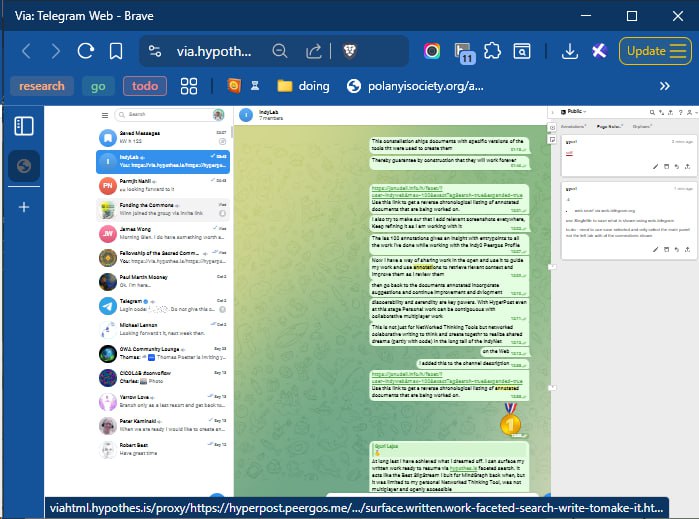
GL
18:04
Gyuri Lajos
This is something worth checking out,
GL
18:04
Gyuri Lajos
ML
Michael Lennon 10.10.2025 06:17:51
This meta-modern vision is an approach for weaving stories (and memetic tribes) into "GreaterThan" meta-pathways.
Worth a dialogue about how this Fellowship is part of a greater narrative? (e.g. symbiotic/ stellar civilization)
https://youtu.be/YsDNeH9JVV0?si=0sz3bWRTorndf9tN
Worth a dialogue about how this Fellowship is part of a greater narrative? (e.g. symbiotic/ stellar civilization)
https://youtu.be/YsDNeH9JVV0?si=0sz3bWRTorndf9tN
GL
18:05
Gyuri Lajos
Great New worth cross posting
GL
18:05
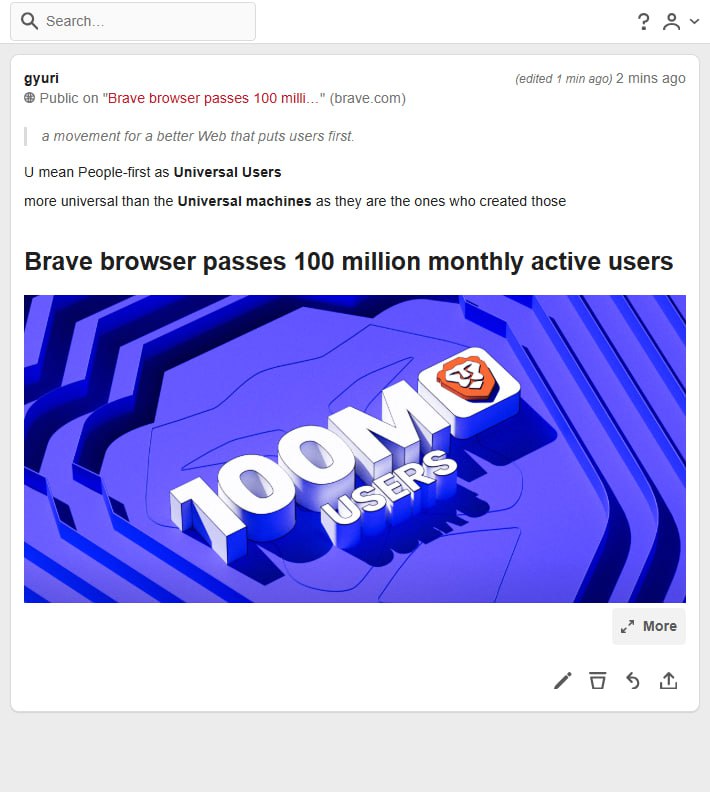
If yu use Brave you will never see any Adverts Ever. The web suddenly becaomes 10x faster no leeches spyware
18:05
See the stats on my man browser profile that I use for browsing searching snarfing and annotating Blazing my own(ed) Trails across the the Web, the ones I can keep and share
18:05
See the stats on my main browser profile that I use for browsing searching snarfing 8coying saving with dingleFile without explicit premissions any thng that I consier useful) and annotating Blazing my own(ed) Trails across the the Web, the ones I can keep and share
GL
12 October 2025
GL
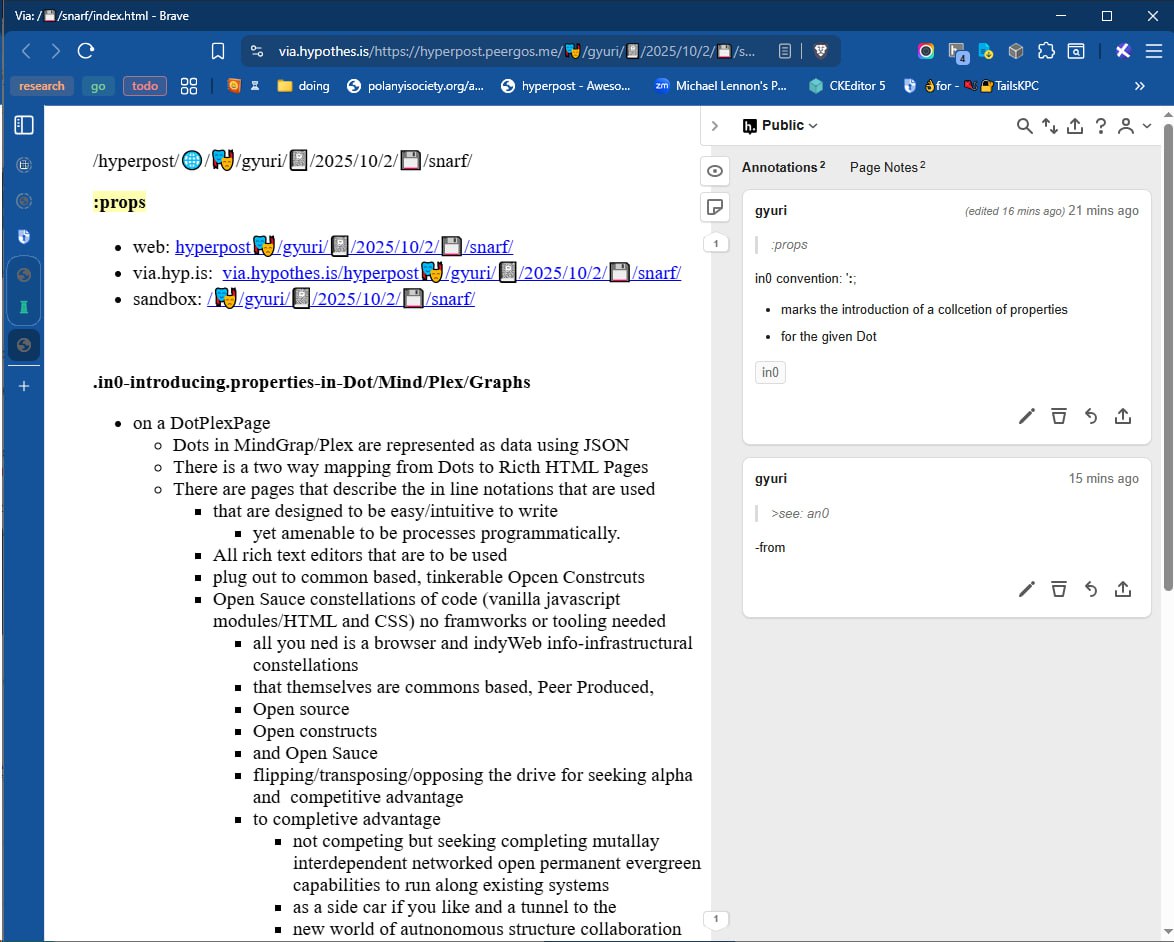
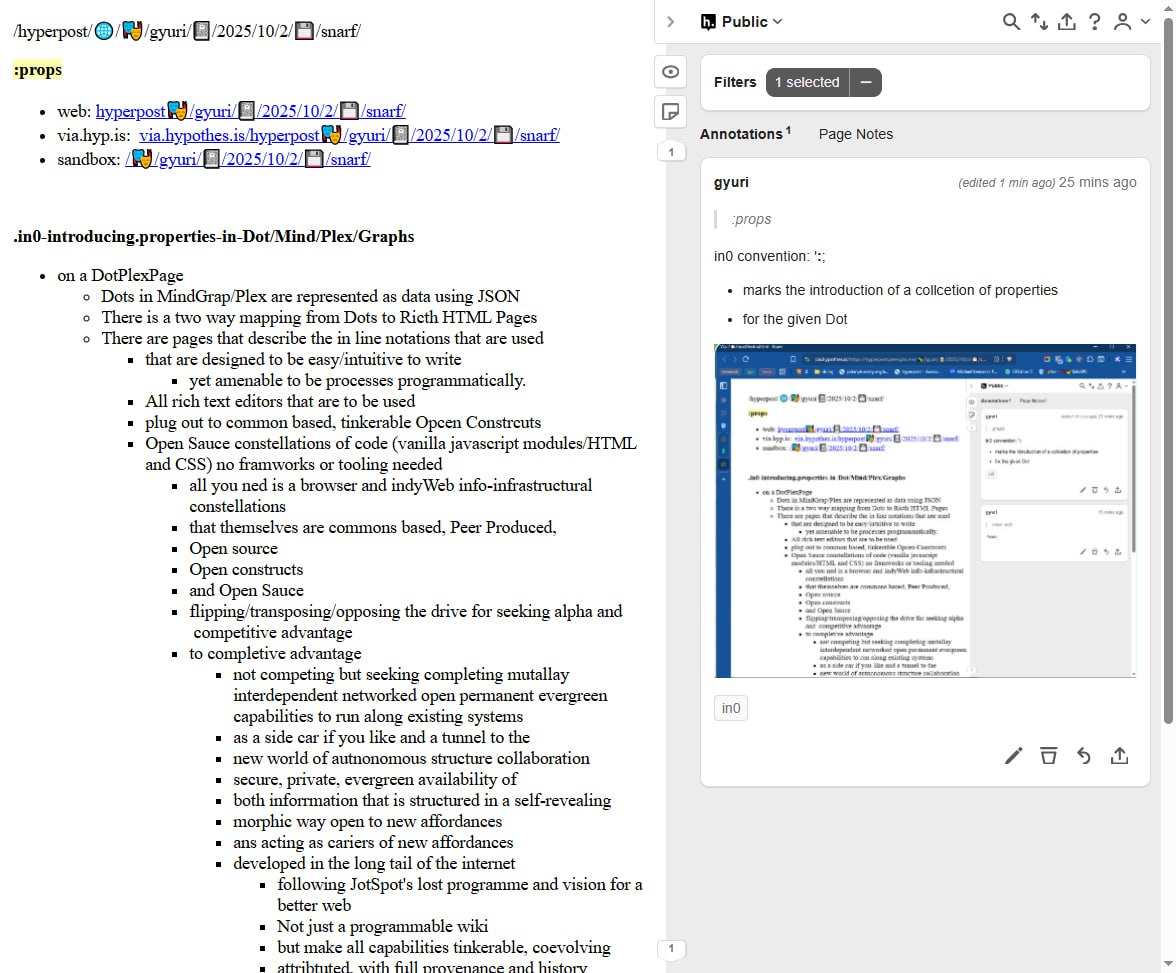
GL
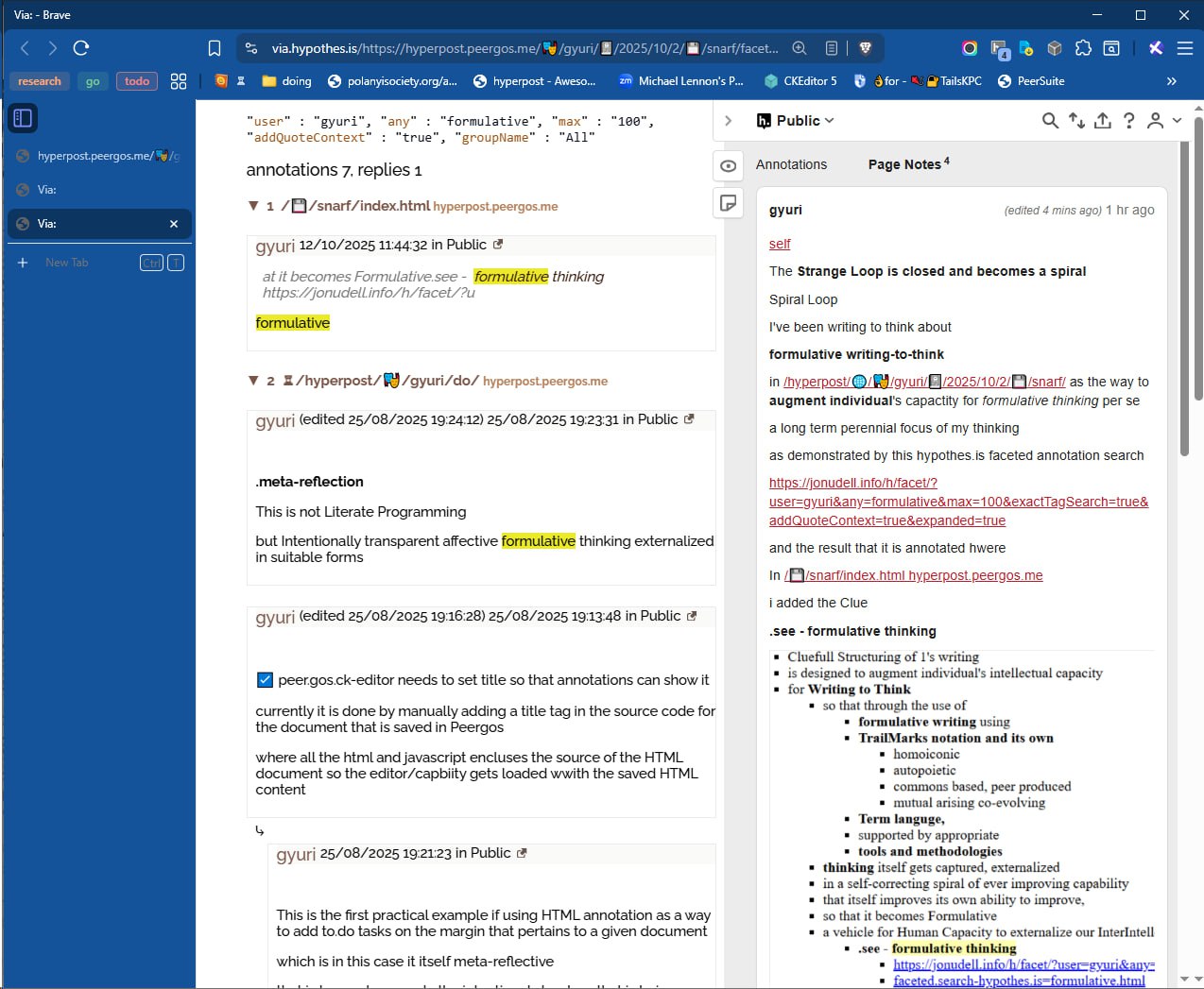
15:15
I spent the last 5 years scattering my ideas as I blazed trails across the web learning developing ideas reading to learn and think
15:17
The time has come for gathering learnings, ideas, info-conversation flows into a single space. Make writing itself active social scaling sailience synthesis and reach
13 October 2025
ML
19:36
Michael Lennon
In this compelling invitation to "inter-brain" (well worth watching) the final chapter "A New Beginning" (min 40:46) is to build the inter-brain in Obsidian --migrating from one's individual brains.
Any thoughts? reactions? Caveats?
https://youtu.be/v5dBRmjF8mc?si=x4LNflglzCeascyP
Any thoughts? reactions? Caveats?
https://youtu.be/v5dBRmjF8mc?si=x4LNflglzCeascyP
ML
20:06
Michael Lennon
In reply to this message
A reply from the DWeb (Vancouver) group
__
Obsidian is a decent interface (I use it myself) - files and one app isn’t appropriate to build long term multi user app.
I’m hoping to have a plugin for Obsidian that works with the ATProtocol. Figuring out what format(s) can interlink many places is a good direction. --B. MANN
__
Obsidian is a decent interface (I use it myself) - files and one app isn’t appropriate to build long term multi user app.
I’m hoping to have a plugin for Obsidian that works with the ATProtocol. Figuring out what format(s) can interlink many places is a good direction. --B. MANN
14 October 2025
GL
08:07
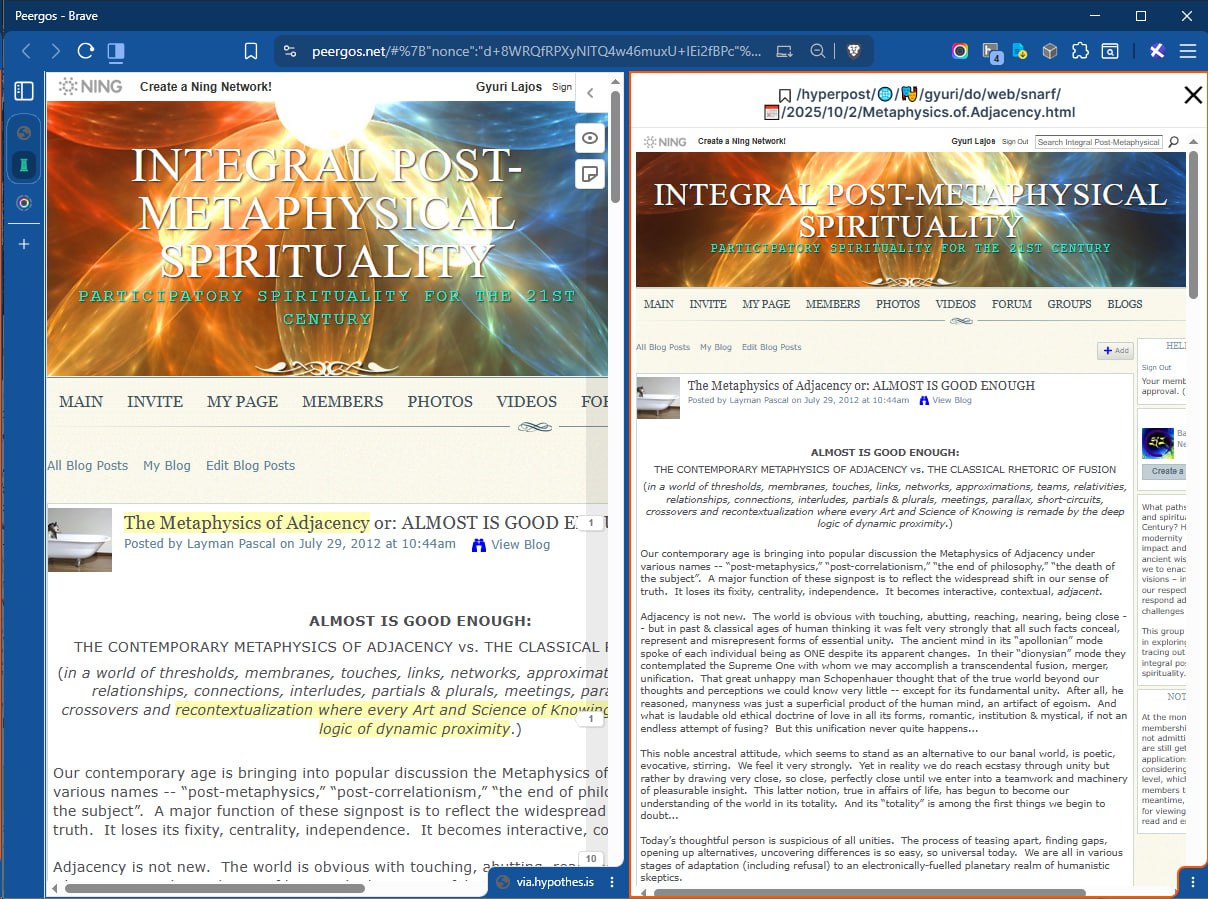
One step closer to closing the spiral loop too long to explain but at least leave a marker here
08:10
The split view on the right shows a page I keep going back to that I snarfed (taken a snapshot using Singlefile and added to my indranet file space within hyperpost under my actor name gyuri where I keep track of my activity flow in a chnronolarchic folder tree, all that information is captured in the permanent/universal resource name that is shown on the top as this is just a Peergos View of the file /hyperpost/🌐/🎭/gyuri/do/web/snarf/📅/2025/10/2/Metaphysics.of.Adjacency.html
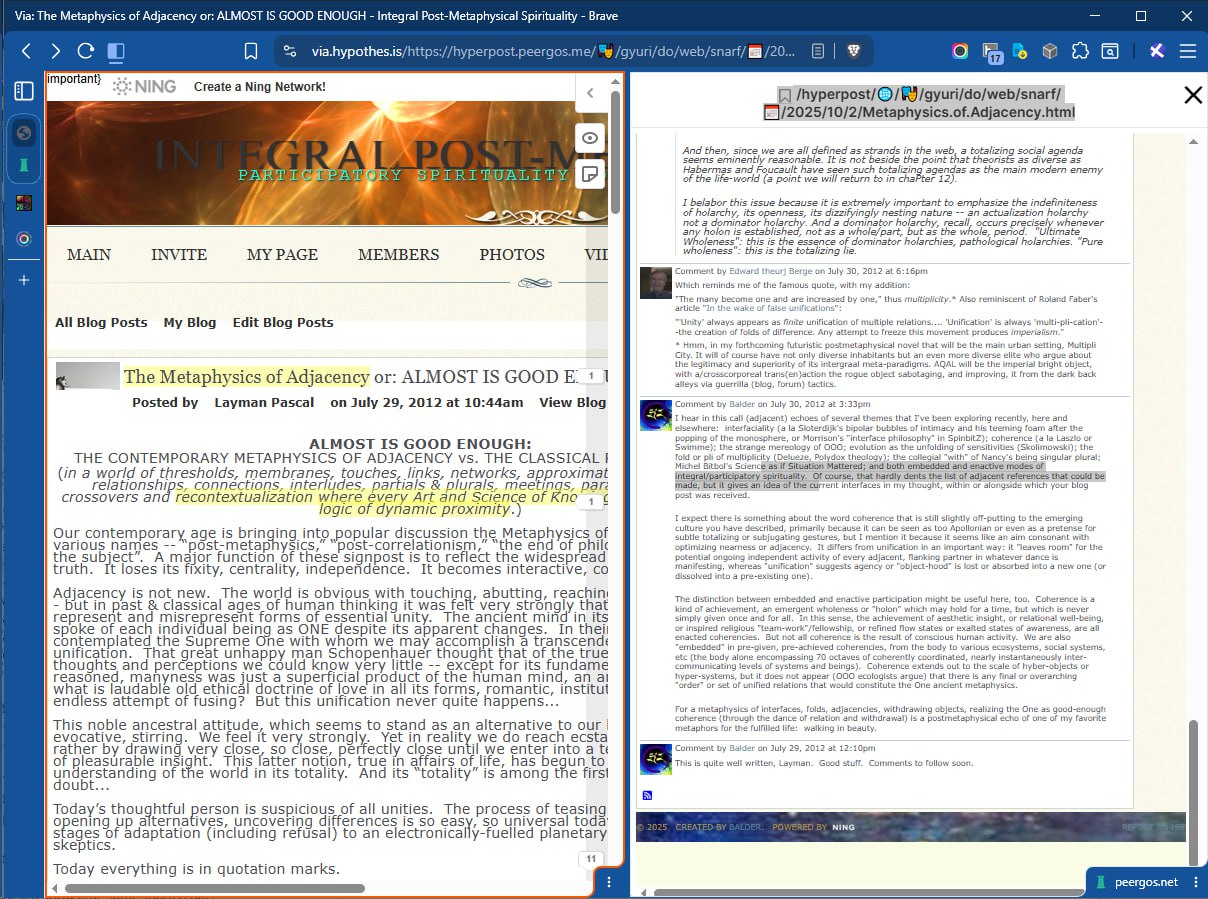
08:18
I've been revisiting this page many times over the past 6 years. With this setup I am moving closer to gather my scattered thinking on the margins and incoproprate them into my current ever more converging Fomulative thinking as
08:26
In reply to this message
As partof the great Gathering that follows the 6 years great scattering and explorations it is time to come back where We have started and see it for the first time.
This projct is th eclosest exemplar of what I know abut that has the most overlap and show salience over laps
🤩
This projct is th eclosest exemplar of what I know abut that has the most overlap and show salience over laps
ML
08:27
Top of the list of projects with which the IndyWeb will interplay.
👍
ML
08:31
Will be working on/in a dedicated space in my emergent indranet MindSpace to explore and hypermap the adjacent MindScape weaving a Human interExtellect (I am triggerred when people think that it is all just happaning in you brain) but that aside the liminal project is very important.
🙏
ML
08:40
Regarding Obsidian It ticks most of the boxes, local-first, offline first, synch able etc. People who care about tools for thought are already living in the future.
Mark down goes a long way. Again it fits nicely with the IndyVerse Vision of aiming to complete not compete.
One day we should be able to offer everyone in the Obsiidiean Ecosysetm to interplay with the IndyWeb and enhance their work and make it universally interpersonally accessible and useful for anyone
👍
Mark down goes a long way. Again it fits nicely with the IndyVerse Vision of aiming to complete not compete.
One day we should be able to offer everyone in the Obsiidiean Ecosysetm to interplay with the IndyWeb and enhance their work and make it universally interpersonally accessible and useful for anyone
ML
08:48
If I wanted to give s single paragraph description of the core ambition of the IndyVerse/web/Net is to provide an instance first exemplar of the possibility of creating Commons based Peer produced constellations for Open Source, construct, Sauce commons based info-morphic-colab nfrastructure**S** (easy to emulate compelling to do, lets people do it for themselves in the long tail of the internet) that could allow alll tools for thoughts and in fact any app to be ipart of an InterPersonal Interplanetary evergreen permanent unenclosable, unsurveilable, unstoppable Massive Singualar interplanetary Multiplayer Mutiplayer networks of named networks of dedicated Indy Learning Spaces in the Commons
08:57
Michael are you using Obsidian? Because if you do, I would like to explore pathways to use yours as an insance first exemplar of making all that interplayeable and in fact part of the IndyVerse
08:59
I kept away from it, although I explored it years ago, because I always intended to provide an upgrade path to it and bet on the the power of TrailMarks Notation, that I am designing that should be able to upgrade markdown to Mark In
09:02
Liminal's mono/dia/iinter? logos is something that is clearly a fixed point idea, (perfecti in iteself) like your Me2We2All if we also add the missing Me2**Us**2We2All and two more spaces 1 for shared named interests/pursuits and People's Networks and one for emergent autopoietic morphic capability spaces in the long tail of the IndyWeb
🙏
ML
09:06
Back in June I was not ready to respond with requisite coherence
09:09
serendipity brought it up
09:10
Imagine that the kind of articulation that is done using rich text editor can lead to the orchestration composition of Open Capabilties rendered interplayeable by construction
09:11
Software composition in the Large connecting the ones discoverable in the long tail
09:12
Does look familiar
09:13
In the old days people asked Why should the Devil have the best tunes.
09:13
Similarly Why should Ai have the best tools?
09:15
Putting People in the Machine's Loop will never be as powerfull as when the machine support is added to Human's Loops
👀
ML
09:16
The first one is driven by human's drive to gain power.
🤔
ML
09:16
They can never achieve that which is open to those who do not seek power
09:23
The browser's url field is the new command line
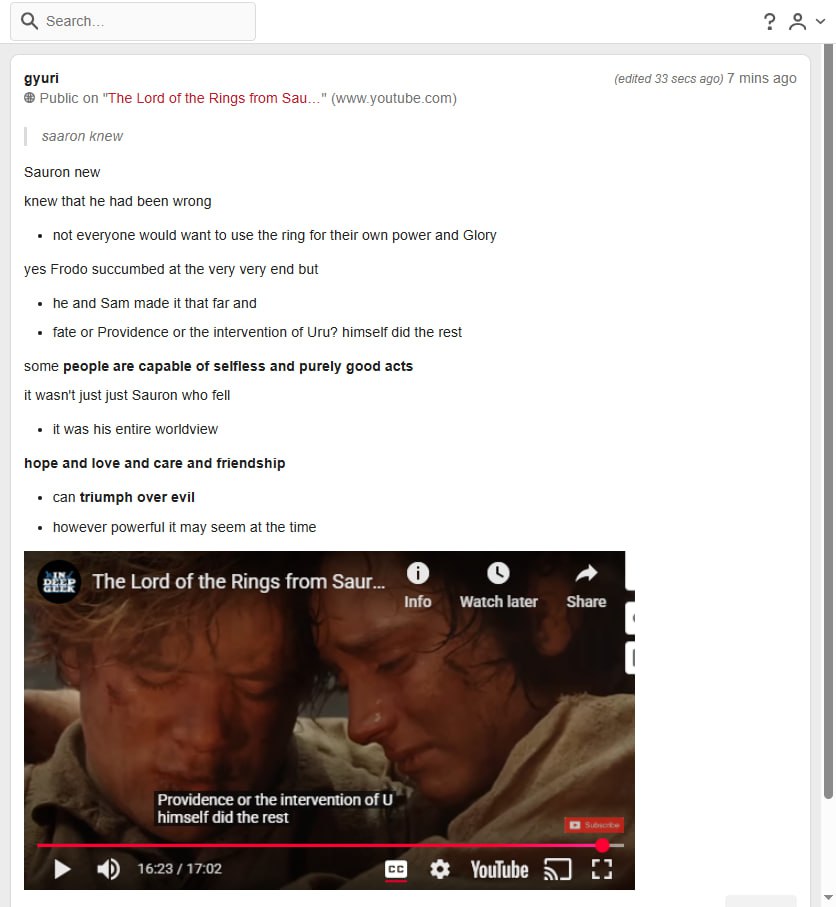
ML
14:44
Michael Lennon
In reply to this message
I am not using Obsidian, but other products.
More than once I have received the invite and considered where to migrate/transition. This conversation becomes another data point.
More than once I have received the invite and considered where to migrate/transition. This conversation becomes another data point.
15 October 2025
GL
16 October 2025
GL
00:09
Gyuri Lajos
I am going back to experimental infrastructure for MEMplEX in August that is powered by IPFS Desktop as Indy.Wiki
👀
ML
00:10
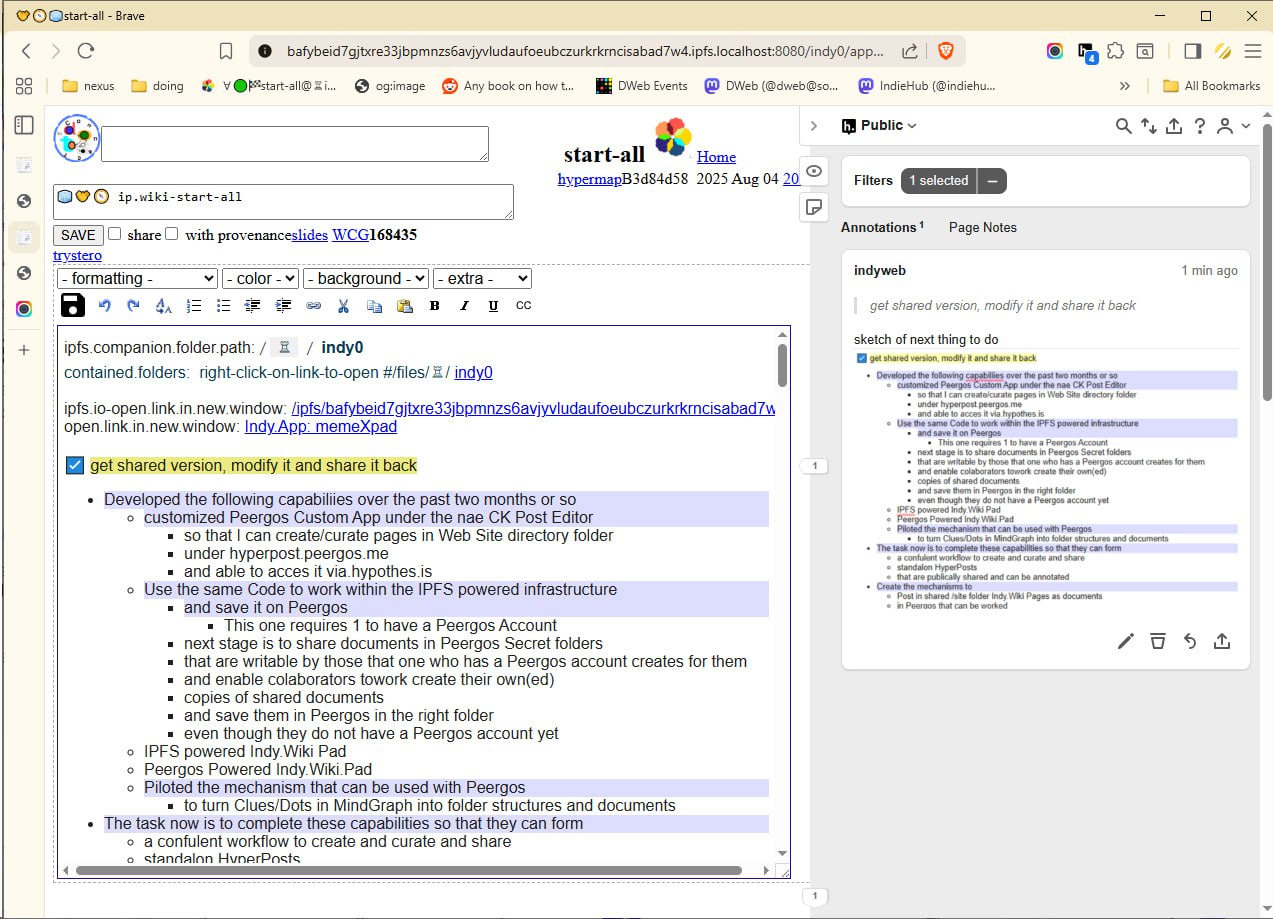
Long Last bring all the threads together for a full first cycle in the coevolutionary spiral
👍
ML
17 October 2025
GL
08:26
Gyuri Lajos
Should have pointed out that the lights nk above only works on local private IPFS network
08:33
BUT the annotations in that page can turn up in hypothesis searches
08:33
08:34
08:37
Better example https://hypothes.is/search?q=morphic+page
08:38
Here I'm searching for a word combination I myself found meaningful and worth writing down
08:40
So you can find the other's emerging nascent formulations and work by search the frontier becomes visible and people with matching interests can find each other and converse
ML
16:50
Michael Lennon
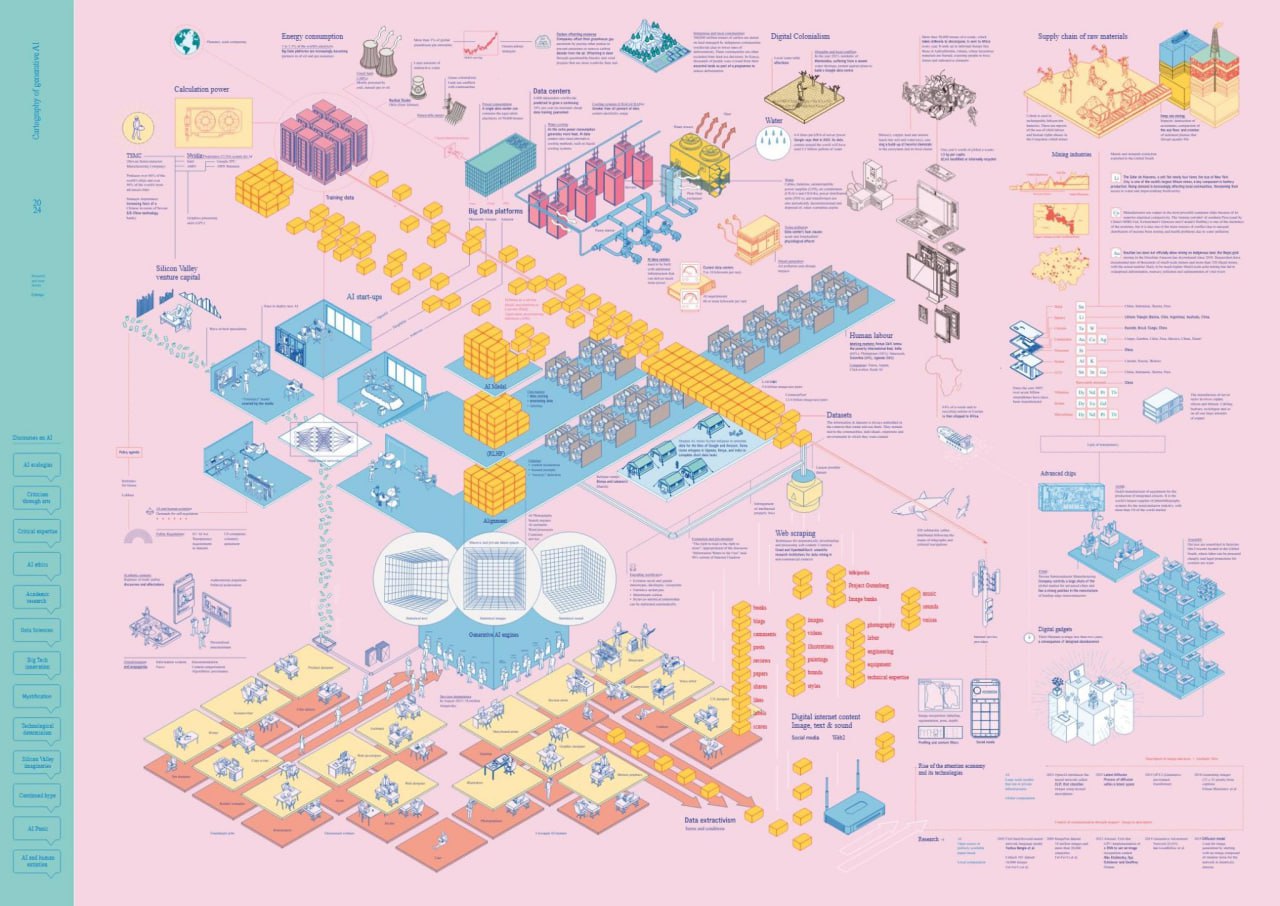
Last year in Spain, a group of digital creatives and innovators envisioned prototyping a Solidarity Stack for Generative AI and created the following diagram.
I an aiming to incubate a "Symbiotic Sense-making" action learning sprint that might evolve the next version of a Solidarity Stack for Generative AI focused on possibly:
1) identifying and prioritizing connected learning games and
2) ventures for boosting "global-local" tech ecosystem and platforms for symbiotic venturing
3) the emergent
Just imagining out loud. Thoughts? reactions?
I an aiming to incubate a "Symbiotic Sense-making" action learning sprint that might evolve the next version of a Solidarity Stack for Generative AI focused on possibly:
1) identifying and prioritizing connected learning games and
2) ventures for boosting "global-local" tech ecosystem and platforms for symbiotic venturing
3) the emergent
Just imagining out loud. Thoughts? reactions?
21 October 2025
GL
19:21
Gyuri Lajos
In reply to this message
suppose I'could run a web search to find this. My mind boogles, how generativ AI won out against what IBM proposed a decade ago, when asked which way forward. They proposed instead of AI Artificial Intelligence, its inver IA Intelligence Augmentation.
19:22
I do not hav the time to write about it but this is a good poiner https://jonudell.info/h/facet/?user=gyuri&max=50&exactTagSearch=true&expanded=true&addQuoteContext=true&any=intelligence+augmentation
ML
19:34
Michael Lennon
In reply to this message
Thanks. "Amplification/Augmentation" of intelligence instead of "artificial intelligence" I will take a look at it.
Best Tech does not mean best adoption.
In the early 1900's 3 automobile forms were competing: 1) steam engine 2) electric engine and 3) combustion engine.
Though electric engines were wisely recognized as the best performing and technically superior, Henry Ford was able to mass produce combustion engines which shaped the global evolution of mass transport for the next century.
The LLM-based approach to the web is competing with Google & social media to become the "folk-interface" to digital knowledge commons.
Because LLM's make "speaking to digital spaces" much easier, I don't know if technical superiority will matter --at least in the "folk-commons"
For me the question becomes, how to / whether shape the digital (local?) ecosystem to access and engage "Solidarity social practices" rather than "extractivist globalism".
Thank you for responding. This interaction is helping me defuzzify my priorities.
Best Tech does not mean best adoption.
In the early 1900's 3 automobile forms were competing: 1) steam engine 2) electric engine and 3) combustion engine.
Though electric engines were wisely recognized as the best performing and technically superior, Henry Ford was able to mass produce combustion engines which shaped the global evolution of mass transport for the next century.
The LLM-based approach to the web is competing with Google & social media to become the "folk-interface" to digital knowledge commons.
Because LLM's make "speaking to digital spaces" much easier, I don't know if technical superiority will matter --at least in the "folk-commons"
For me the question becomes, how to / whether shape the digital (local?) ecosystem to access and engage "Solidarity social practices" rather than "extractivist globalism".
Thank you for responding. This interaction is helping me defuzzify my priorities.
GL
19:53
The above my be an iimportant topiQ (as in TopicQuest) to engage with. Although mu goal is todevelop pages as portals and seeds of autonomous networked aiutopoietic TopicQuests co-laboratins on the annotation margins, but we can do that already between people who have noth hypothes.is and Peergos accounts. Michael @Gien_0 or anybody else in this group would be interested in such experiments
ML
20:02
Michael Lennon
In reply to this message
Cross-posted to SacredCommons. Could you add your reply there? Thx
GL
20:20
Gyuri Lajos
I do not see how AI as it is moved fast to break things is developed can be for Our beneft. Need to explore alternatives to that and that is IA
👍
ML
ML
20:53
Michael Lennon
In reply to this message
Any time the marketplace goes on a frenzy, both breakthroughs and breakdowns happen at a much faster pace. Still, nothing is permanently exponential. There are many ("local") Tech actors that are not on the "ChatBot" (AI) bandwagon waiting for the wave to pass, so they can get on with more effective "localism"
👏
GL
GL
21:14
i had intgrated the capability of this project 2 years ago into MindPlex. this service had developed quite a bit and I am ready to interplay with it without much adjustments, just small customizations at indy.pad end.
This could well be real mutual benefit. Can indeed be the beginning of a repeatable process
👍
This could well be real mutual benefit. Can indeed be the beginning of a repeatable process
ML
ML
21:28
Michael Lennon
In reply to this message
And implementing "systems views" of existing knowledge sources is much easier "quick win" than migrating all knowledge into p2p spaces
GL
21:39
Gyuri Lajos
We do need BOTH!
👍
ML
21:40
The best thing is that thanks to the true Magic of Singlefile. We can have the best of all worlds. We can have local snapshots of all our engagements with services. So even if they would ever disappear we would not loose anything!
21:42
We can enjoy the convenience and scaling reach provided by centralized services whie maintaining full autonomy and permanence
🤩
ML
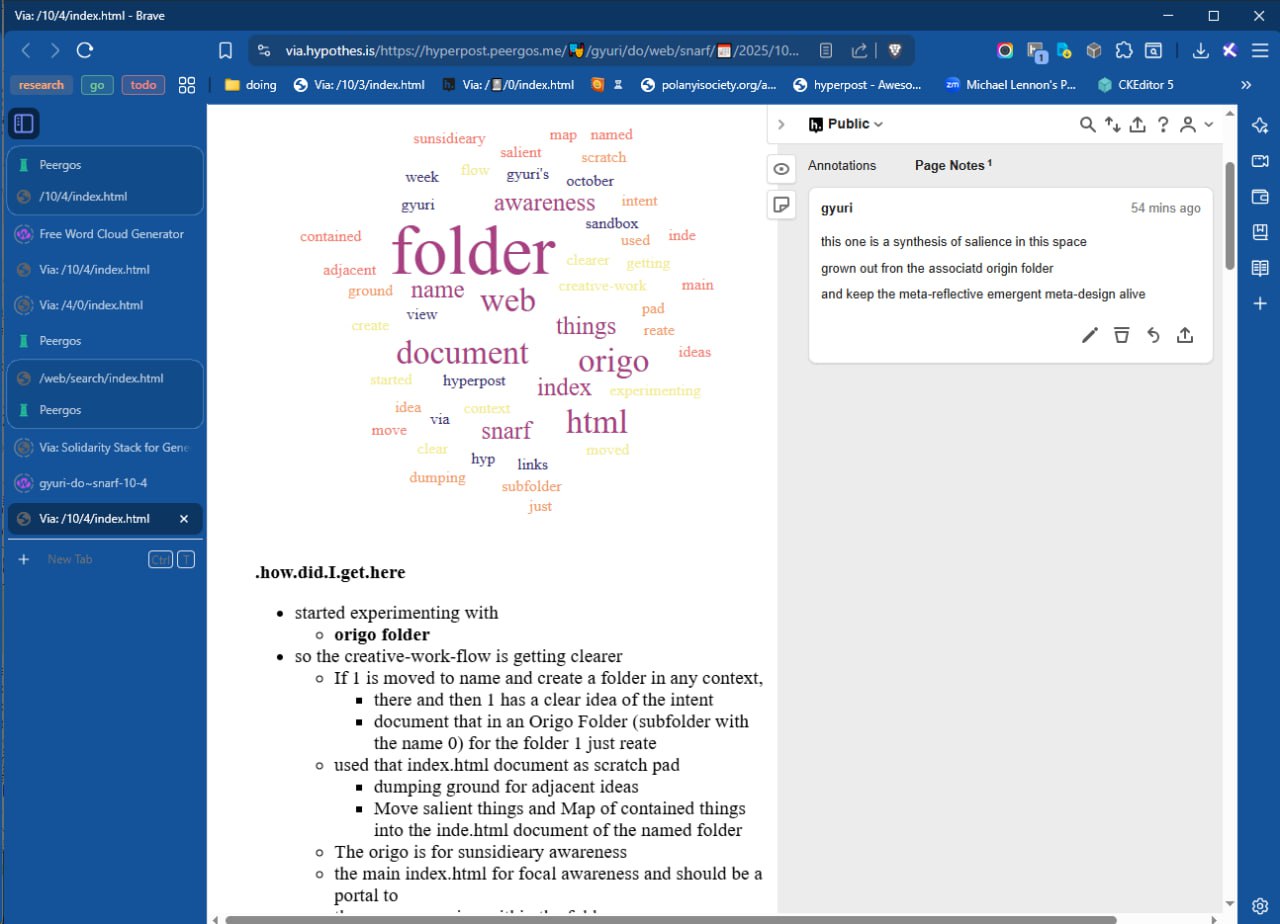
21:47
while transitioning from Origo Folder to main index document to the folder I have the content of the Origo Document for the folder copied into the document
21:47
Later on it will be just linked
GL
21:59
Gyuri Lajos
GL
Gyuri Lajos 21.10.2025 21:57:57
Big break-though thanks to the concep of origo meta-reflective meta-design folders and the current way CK Post Editor handles them by generating titles that match the last three components of a Peergos HTML doument's path
ML
21:59
Using Tab Search in Brave I can get an up to date listing of recent documents!
21:59
This is in line with the basic design philosophy of integrating deeply with existing Browser capabilities
GL
22:00
Gyuri Lajos
Better still I can use this search to find stale tabs and close them
22:12
I'll be adding a lot of screenshots of currently opened documents and retrofit origo folders for them. I had that idea way back, but given the akwardness of working with peergo skipped that step
22:13
However creating retroactively origo folders see https://jonudell.info/h/facet/?user=gyuri&max=50&exactTagSearch=true&expanded=true&addQuoteContext=true&wildcard_uri=https%3A%2F%2Fhyperpost.peergos.me%2F%F0%9F%8E%AD%2F*&any=origo+folder
GL
22:38
Gyuri Lajos
Ted Nelson talked about the need for wht he termed "Deep Rearrangeability" In Xanadu Ted envisioned Edit Control Lists that is igh resolution addressable fragments that can be "transcluded" across documents and resused as they were
22:43
In the MEMplEX vision relying on the concept of Clues and Clue Structures every Clue has a can have multiple version across IndySpaces, and indeed within any Personal IndySpace or IndraNeWork Spaces. Instead of Transclusion from designated sources, envisage trans-migration/(re)formulations-synthesis where variants cross reference each other and provide salient synthesis of all available reviewed instances of the same named clue stuated in multiple contexts. Clue's are always created within specific intentional/meaningful situated context or rather conPlexes as they all situated in a unique neighbourhood of associative complexes
GL
22 October 2025
GL
GL
10:33
Gyuri Lajos
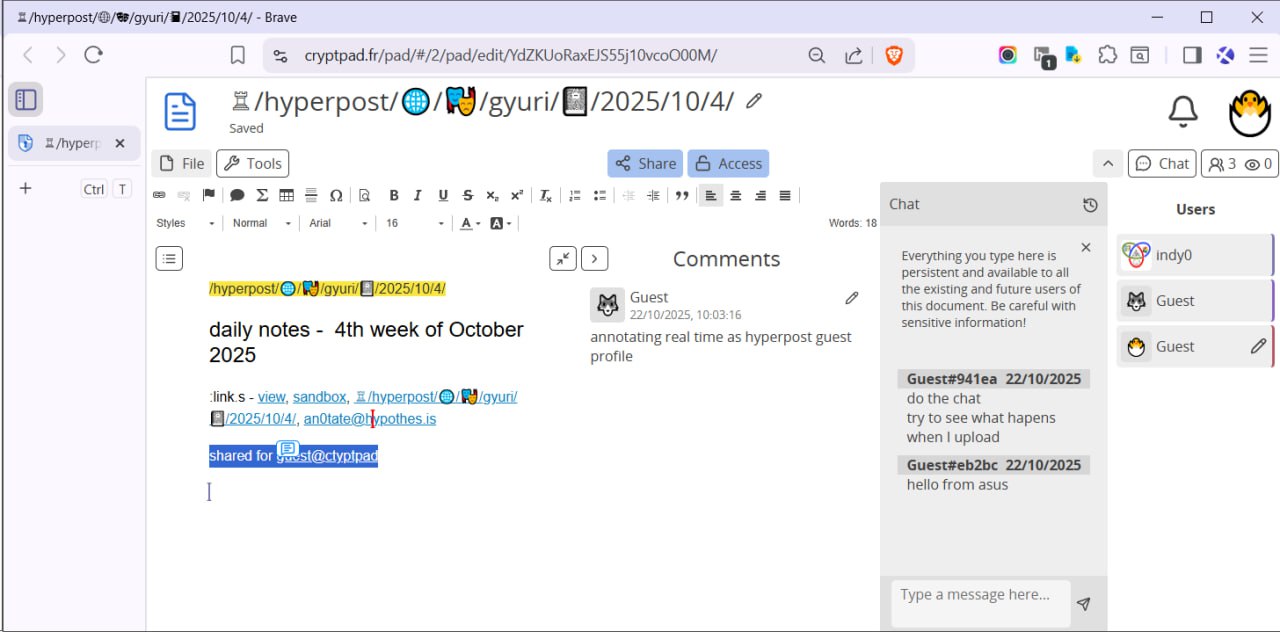
CryptPad is good at commenting and chat with persistence
10:35
Again It is good at real time co-laboration and requires no sign up or sign in. It has issues of performance and like today unable to insert and get images uploaded
10:37
With peersuite.space we could, again provide all that for the IndyWeb Broser natively, but mutual completion between existing players is also a priority
GL
14:23
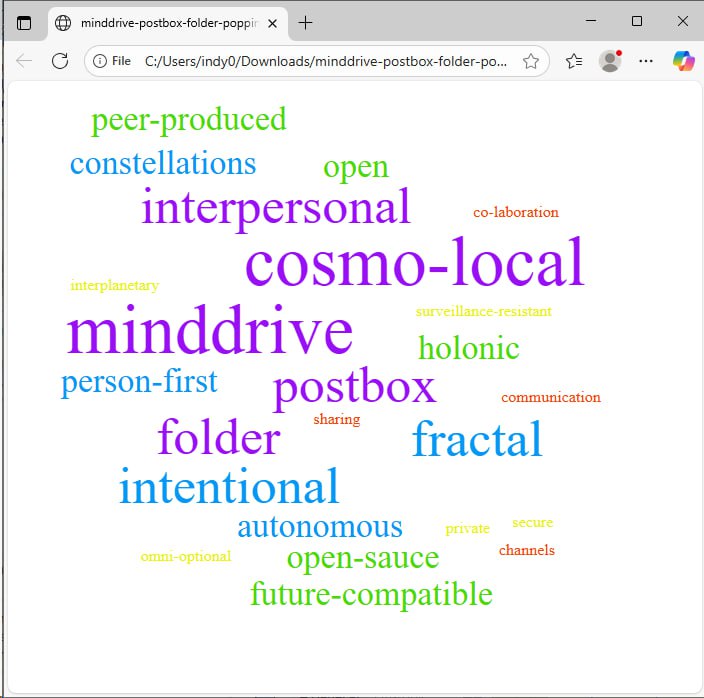
gyuri-minddrive-folder cosmo-local commons needs a cosmo-local autonomous autopoietic infrastructure for the Web built on the existing Web
26 October 2025
GL
07:17
Gyuri Lajos
We had along weekend started on thursday so I had little time to do any work
07:17
I did start last night and here is the entry point to it
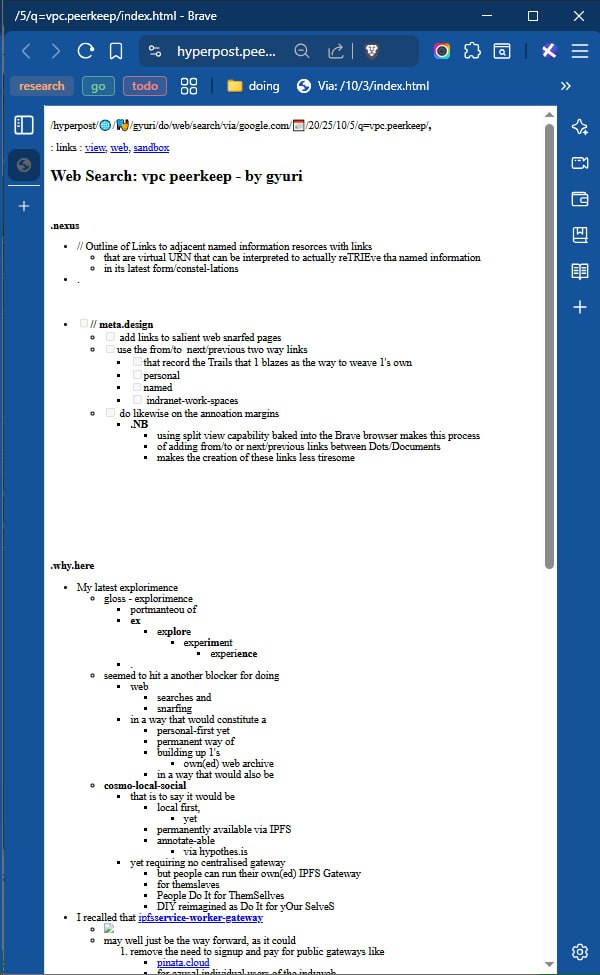
GL
11:46
Gyuri Lajos
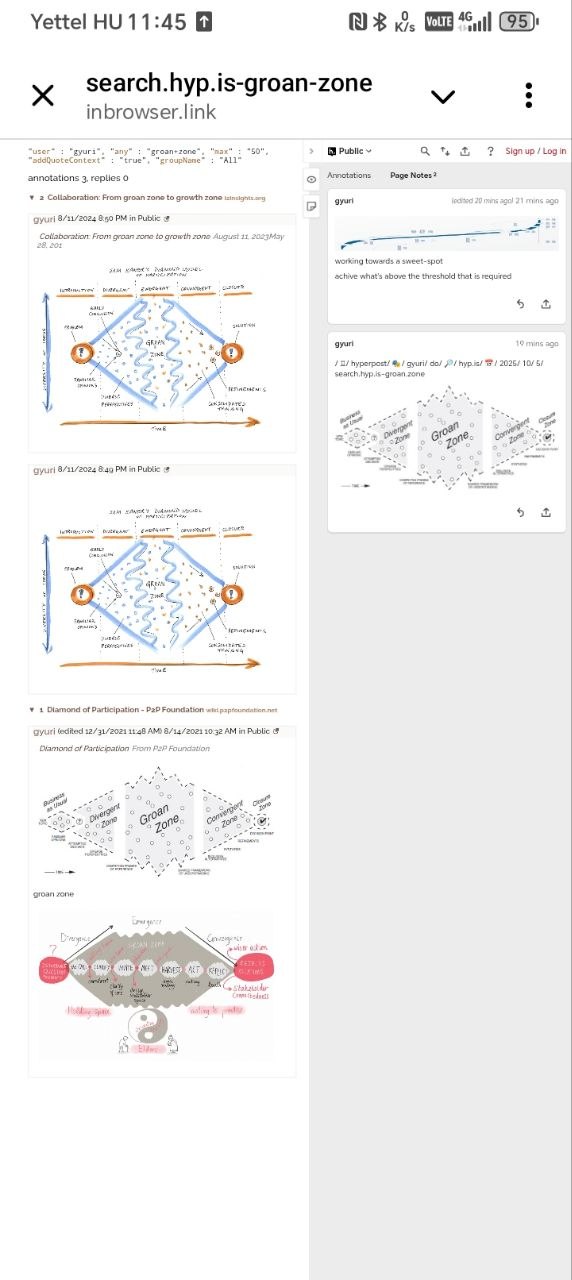
Sweet spot for indy annotatiions
GL
11:47
Gyuri Lajos
GL
Gyuri Lajos 26.10.2025 11:44:03
GL
11:47
Gyuri Lajos
GL
Gyuri Lajos 26.10.2025 11:44:35
please let me know what you get when openning it in a browser
ML
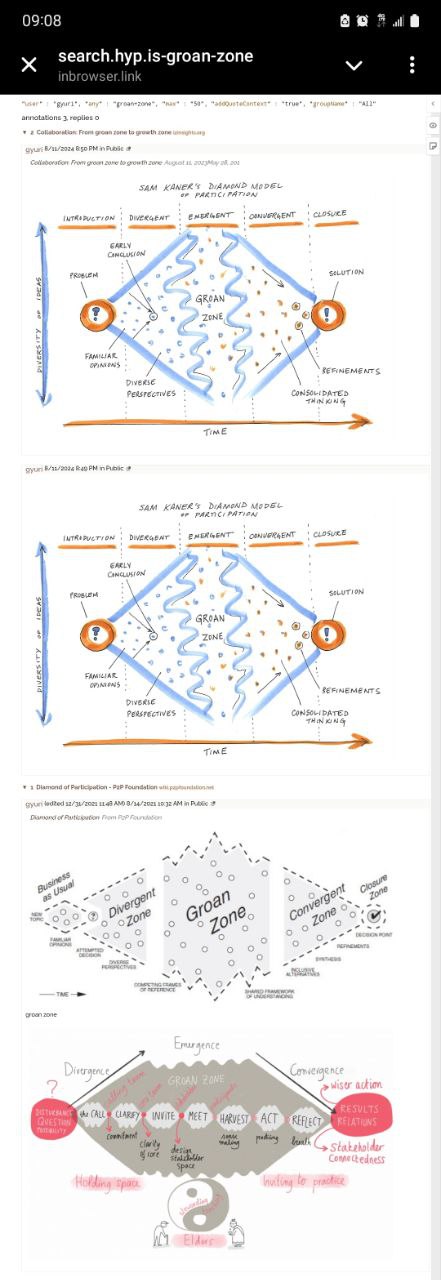
GL
15:32
Gyuri Lajos
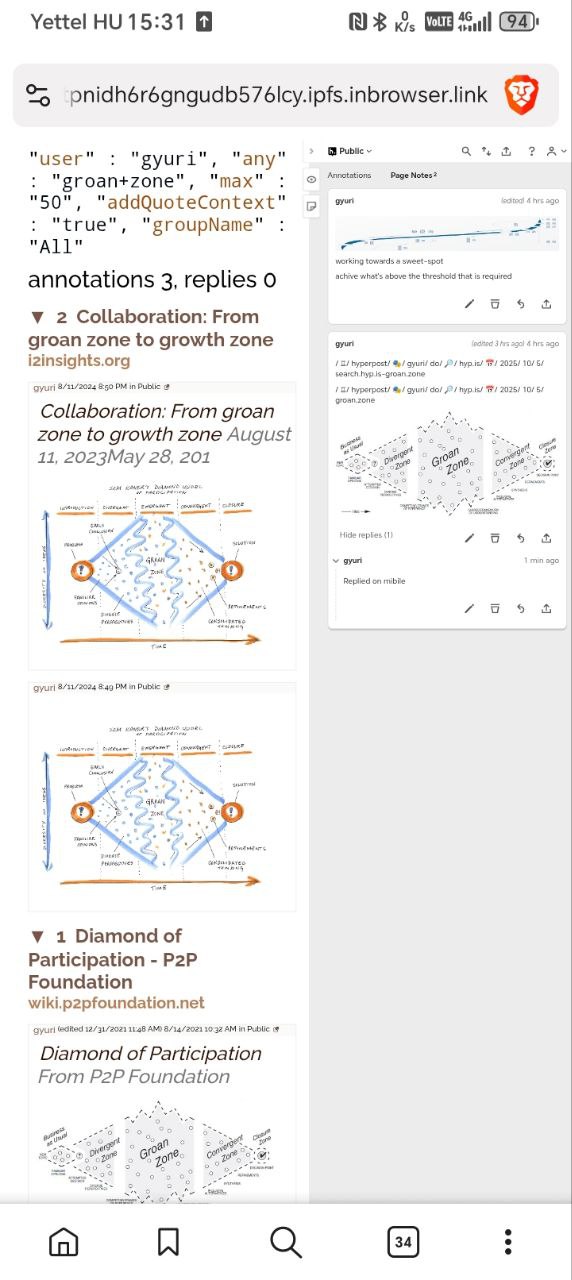
Comes with annotations enavled
ML
15:35
Michael Lennon
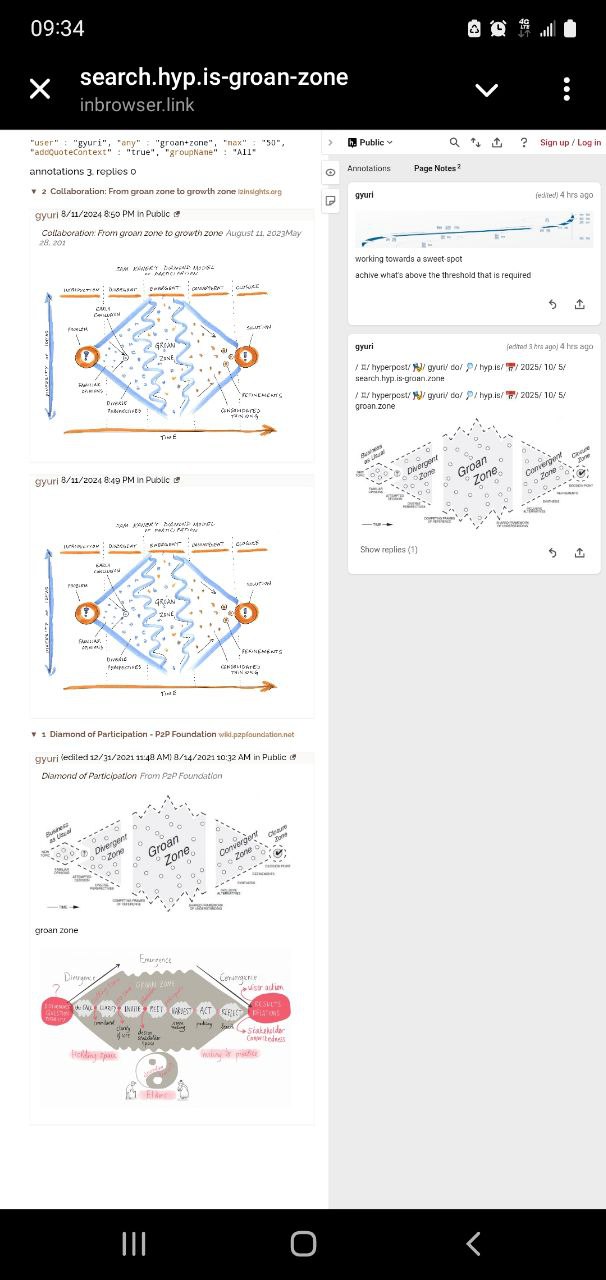
Yes. With annotations
28 October 2025
ML
01:33
Michael Lennon
Have you seen this survey re data sovereignty? https://tally.so/r/w456WO?inviter=GxeLdYZ
GL
10:17
Gyuri Lajos
In reply to this message
not sure, NAO does ring a bell. Wow, thanks for the heads up
👍
ML
10:18
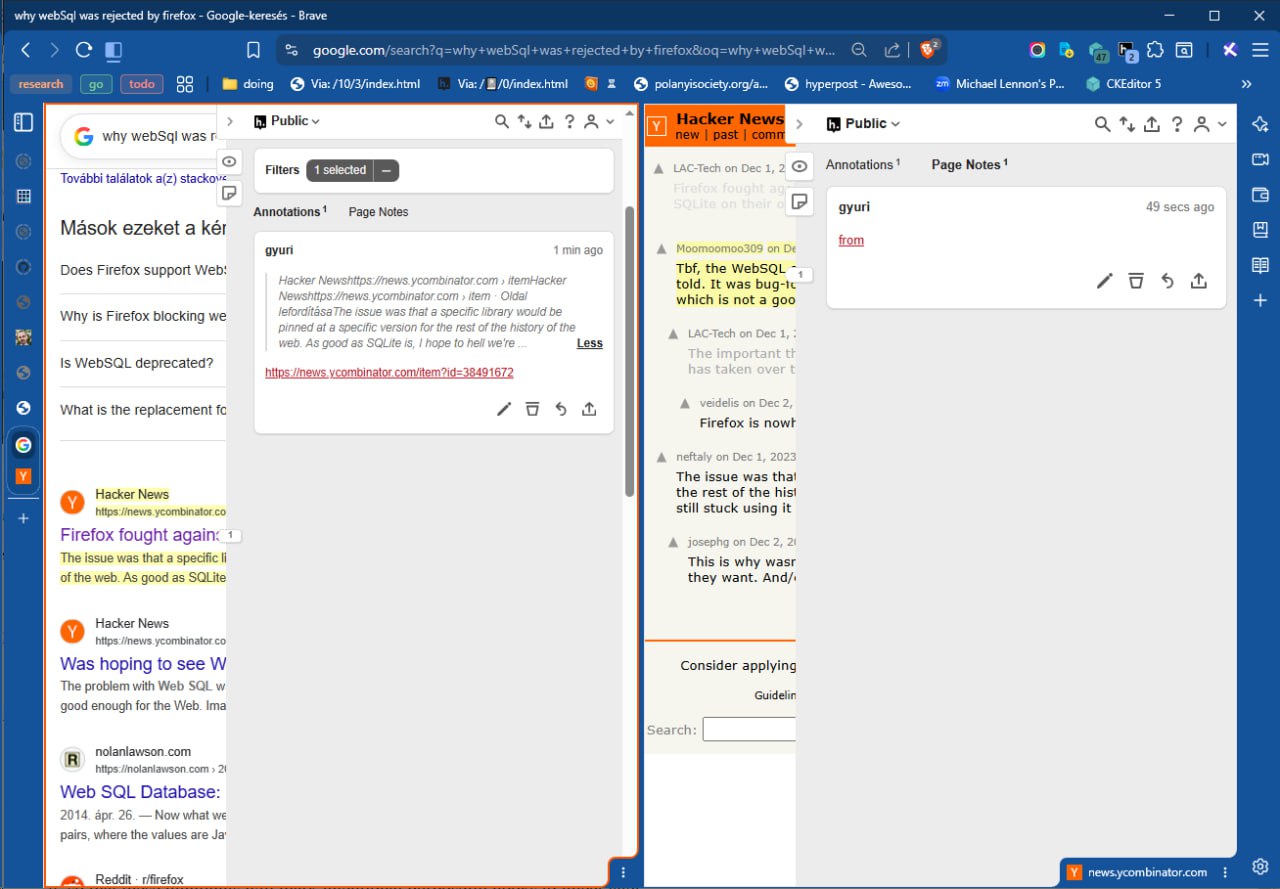
Here is a long missed capability that is most empowering and coming out in the wash. All you need is to Wait and Learn, Trust the Universe like an Other. The problem is few people are inclined to trust anOther
10:20
Using split view in Bravre
10:21
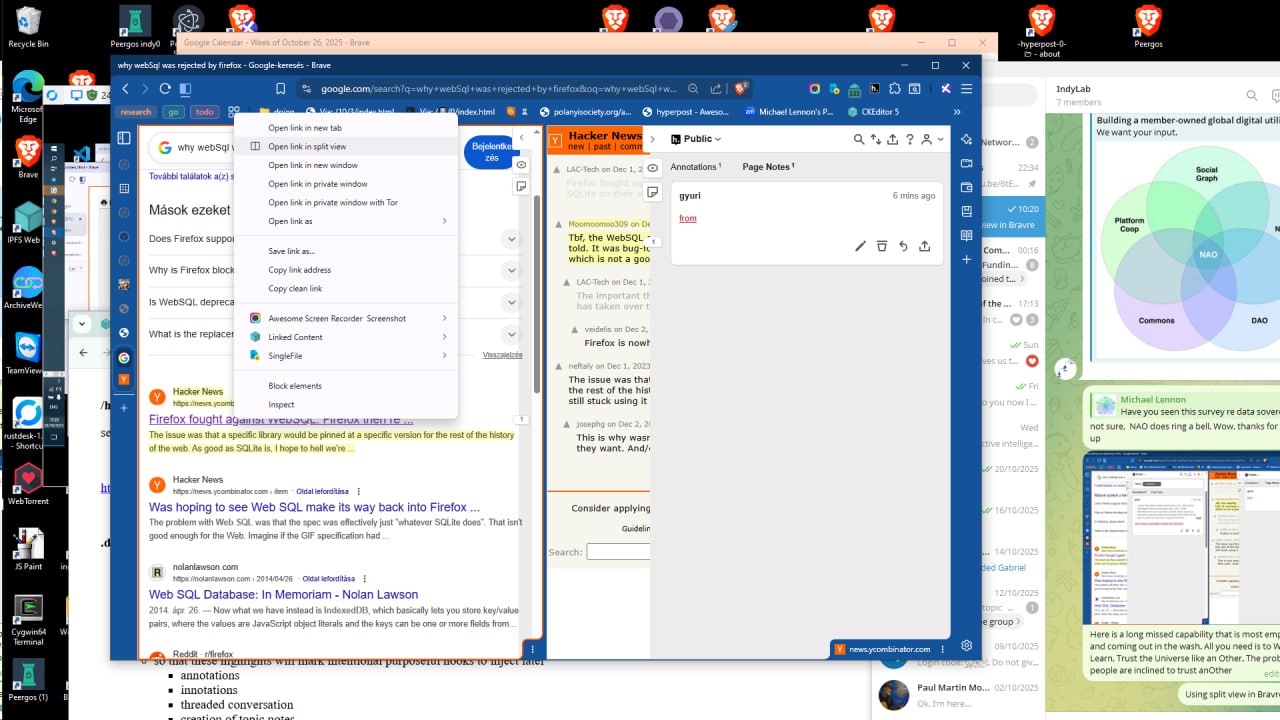
Open link in Split View is the ONE feature that makes it all possible
10:33
combine that with vertical tabs and the browser becomes a universal Web App shell!
10:33
That was my long bet 20 years ago!
10:34
In 2003-5 I won funding from the Department of Trade and Industry's Smart Award for Innovation 35K for a proposal "Personalized Mobile Computing"
GL
11:19
Gyuri Lajos
i built a Universal app Framework for developing Info-Morphic Affordances for mobile devices, inspired by DocBook and XML, without the angle brackets, exapting names and definitions of intent the taxonomy without limiting it to trees and hierarchies, proto-plexmarks if you like, with implicit implicate interpretability, and that worked uniformly eventually on Windows Mobile and the Desktop. Transitioned to Progressive Web Apps with the rise of HTML5, local first, off-line first, and embedded webserver running in Java so that the same app could be run interchangeably in browser on all devices mobile or not. both On Android it was delivered as an app. But the same embedded server could be run on the desktop. It used WebSQL and supported multiplayer collaboration relying on Graph Database Orient DB. That was the time I realized Databases, especially graph databases, like NoSQL did promise to solve the sharding problem, but they were just too expensive to run or rent. Going with a person-first approach combined with tim0bound organization and full provenance and history provides a natural way of sharding within a massive multiplayer global giant graph of everything that is discoverable, with true names and the ability to retrieve by name
11:21
I abandoned alll databses, in favour of leveldb that run everywhere including the browser. Did find a graph database built on top of that, but graphs should not be enclosed in centralied databases, the graph should just be out there. That's exactly what IPFS with IPLD delivered
11:24
The browser, wen it came out, as Alan Kay put it, was a Broken Wheel. Not having a clear idea what it should be. Now Brave gets it. and adding features that makes it a universal Infor-mation-communicaiton channels browser very much alligned with the IndyWeb vision
11:31
WikiNizer had vertical outline fo contexts, and a split view for wiewing information side by side.
11:32
It did not have the affordance of swapping tabs that Brave has. such a great idea, I wish I had thought of that, would have made the task of enacting branching workflows so much easier
11:33
Is swapping context view with content view mirroring shifting focus
11:35
With split view creating bidirectional links between a page and a linked page becomes trivial. Each split view has its own back/forward button!
11:45
No wonder, the resonance as Brave's mission is
11:45
Brave's mission
to build an independent, user-first Web
to build an independent, user-first Web
11:45
If you get yOur viewpoint right and share it, everything that is required, the sweetspot, the 1 just above the threshold, we can take care of, together.
11:50
sorry about the mind dump here, I have three concurrent document open that I am working on
11:53
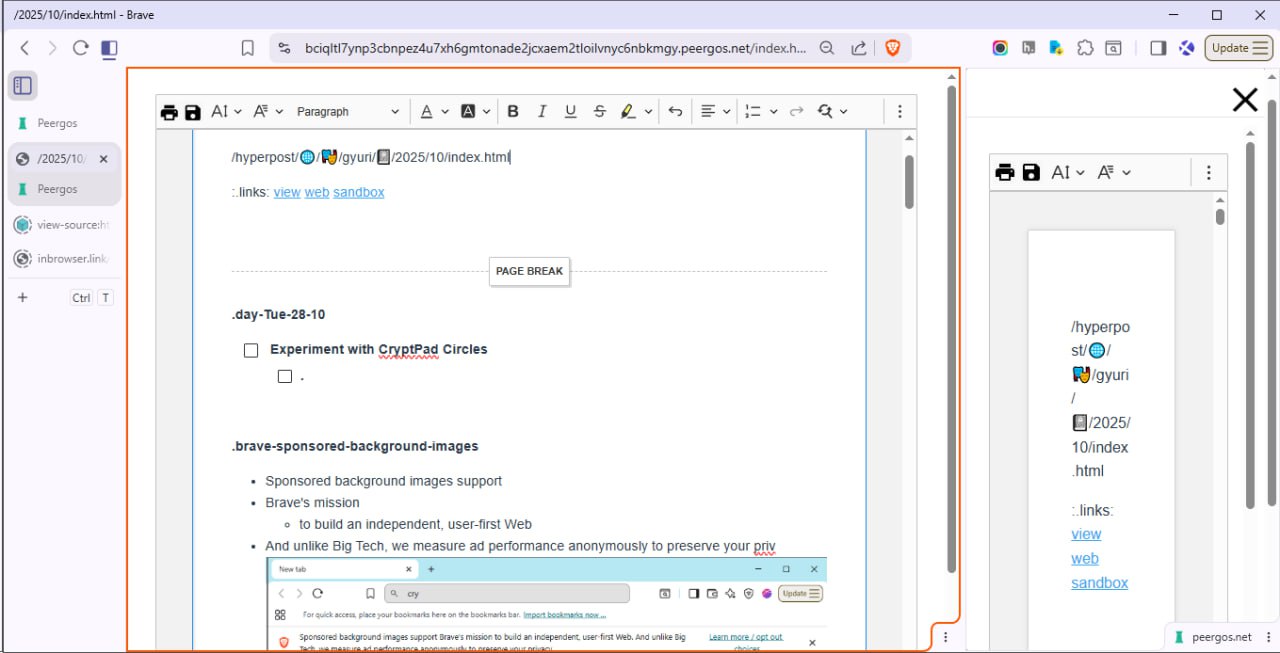
11:54
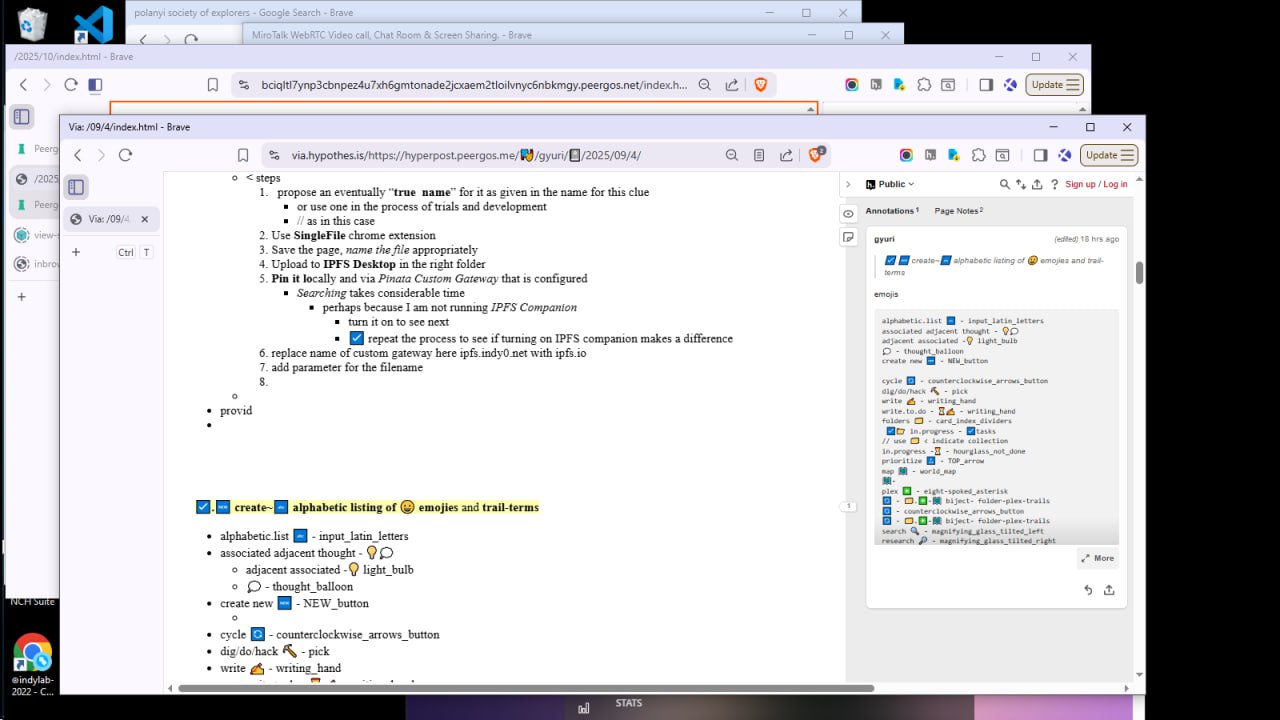
GL
13:48
Gyuri Lajos
getting closer to not having to rely on Telegram for Journalling
29 October 2025
GL
10:27
Gyuri Lajos
Sidewiki
GL
10:27
Gyuri Lajos
RB
Robert Best 16.04.2023 19:59:30
Just stumbled on this :P
https://en.m.wikipedia.org/wiki/Google_Sidewiki
https://en.m.wikipedia.org/wiki/Google_Sidewiki
31 October 2025
JW
2 November 2025
GL
08:26
Gyuri Lajos
Thanks
08:32
Created indy 0 pad as a Peergos Custim App based on CK Editor Peergos Custom App
08:33
It is a conservative extension in the sense of whatever it produces remains a Valid HTML dicument
08:47
And a generative exaption through class-free inheritance through mix-in additional JavaScript modules that add new capabilities while preserving the full HTML comparibility
08:50
Producing named info-morphic autopoietic mutual arising explicitly intertwingled bidirectionally high-resolutionally linked (where the links themselves are explicitly intentionally named weaving their own meta plex space) verifiably attributed versioned HyperPlex documents with recapitulable history of co-laboration weaving a space of associative complexes hyperPlex documents that themselves constitute an interplanetary permanent mutable field of documents as externalyzarion of individual and co-laborative mutual human learning symmwthesy through the medium of hyperPlex documents s
3 November 2025
GL
08:42
Gyuri Lajos
This one is about self-hosting of compilers. At long last I got round to watching it. Self-hosting is the fundamental generative concept life language the universe is but an instantiation of it
The missing word for a succinct formulation of the essence of the IndyWeb local-first person-first self-hosting
The missing word for a succinct formulation of the essence of the IndyWeb local-first person-first self-hosting
08:44
The seed concept that triggered my work 42 years ago
GL
09:54
Gyuri Lajos
Hyper Plex Mark In Editor - indy Pad Plex - transitional logs
09:54
It's a new month, a new week
09:55
Over the weekend I started to work on turning indy 0 Pad to be the next level indy 0 Pad Plex HyperPlex Mark In document editor
09:57
Dpoing it by making Peer gos Custom App development slef-verioning and self-documenting. So I am in a double transition, trying to get two mutually interdependednt things right.
09:59
Hence I resort to document the work, again in Telegram. This one point to the urgent need to create indy 0 gram exapting indy 0 Plex which in turn is and exaption thorugh mixins of Indy 0 Pad which is already an exaption of CK Editor Peergos Custom App
10:01
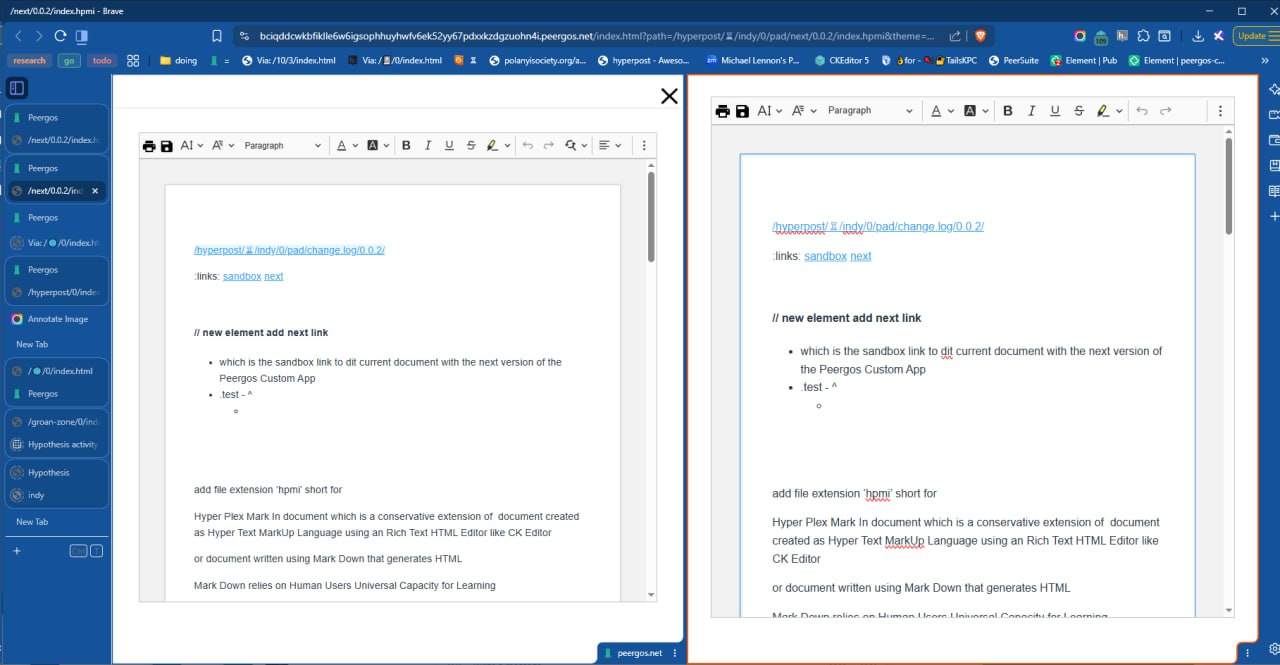
started out documenting the work in a change log document which itself is not quite the right way to name/organize this onformation reified in named folder structure
10:03
I installed the indy 0 pad / next version and added a sandbox link called next to oen that hpmi document in the next version of indy 0 pad under development
10:04
The curren tlayout is for a Peergos Custom App created for the Indy web is to have the currentlyactive vesion at the root
GL
10:47
Gyuri Lajos
♖/indy/0/pad/index.html
GL
12:03
Gyuri Lajos
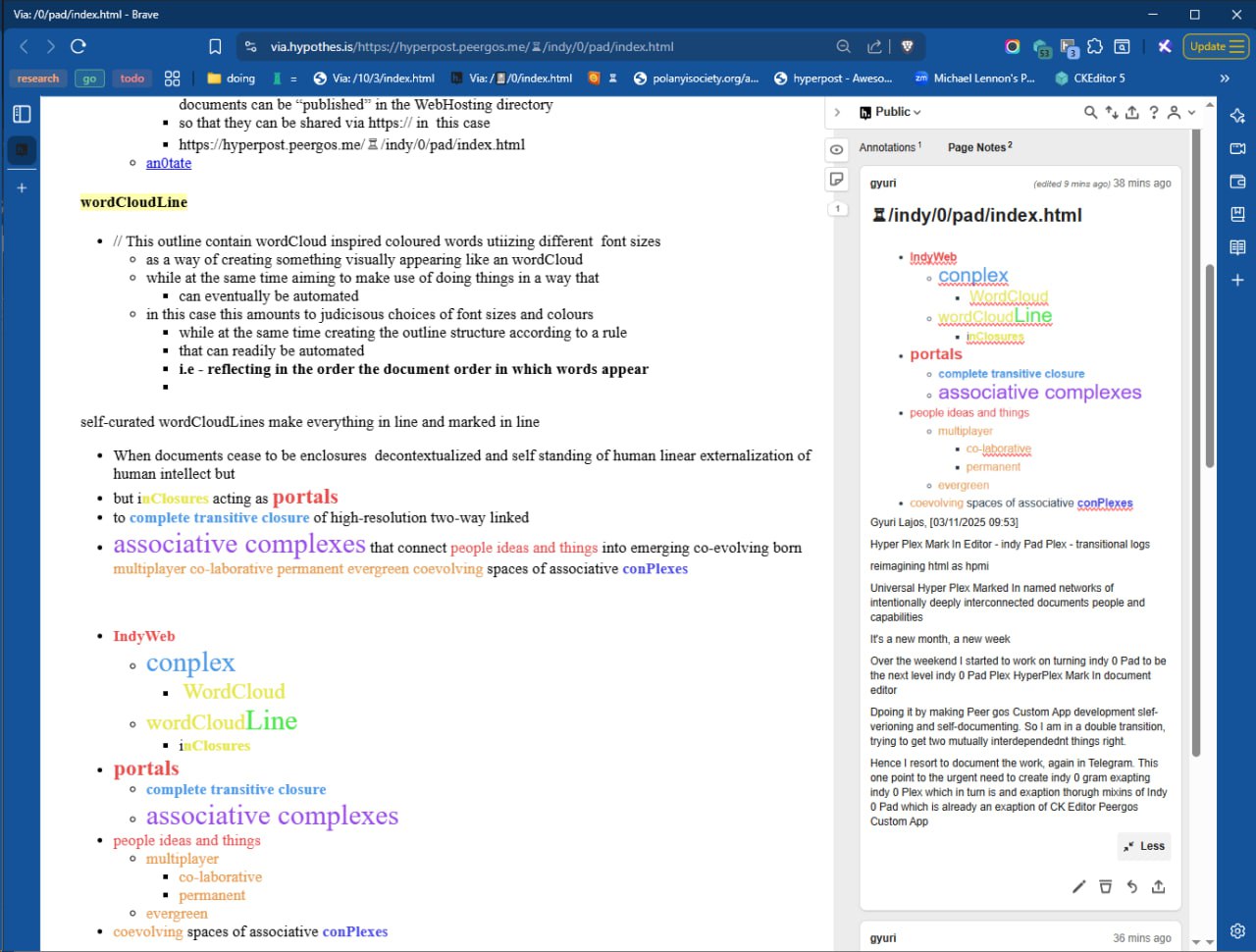
My idea of Rolling up the Spiral to the Deep Blue Sky
12:05
As I work I've been rolling up the upward cycle two levels of emergence and got distracted up to another upward experiment of manually curating wordCloudOutlines
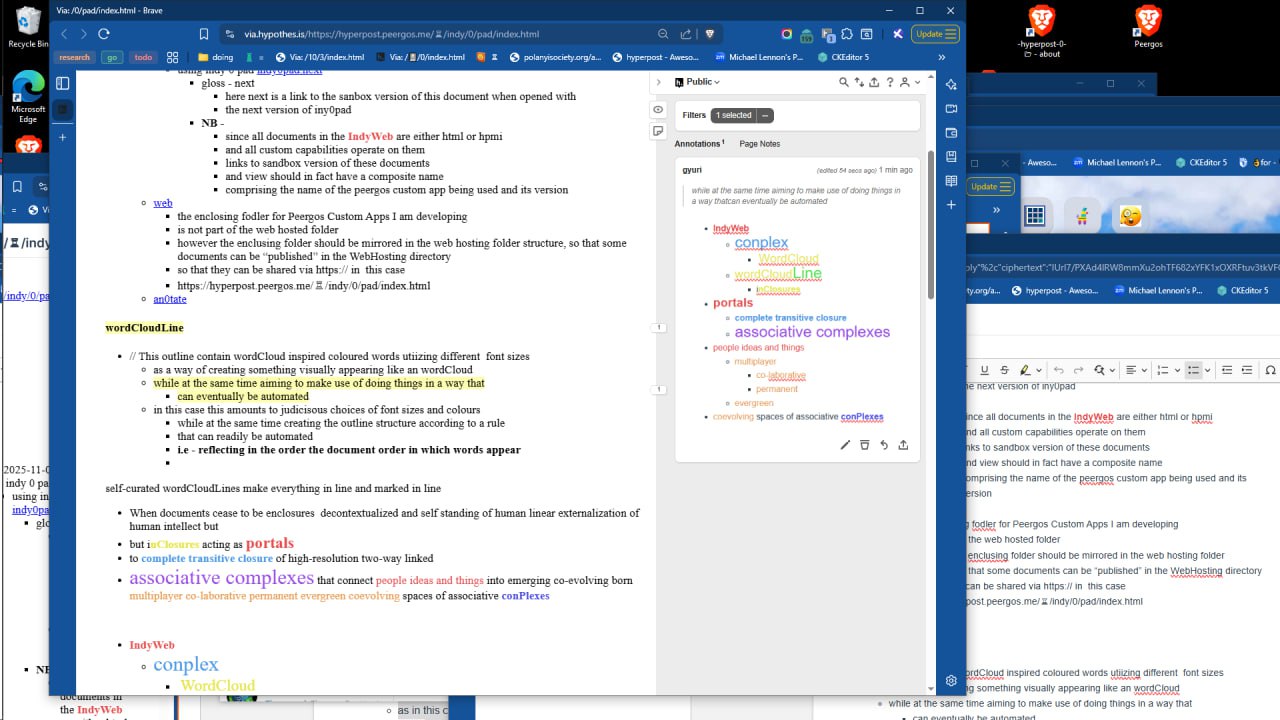
4 November 2025
GL
11:20
Gyuri Lajos
Started cleaning up my gmail to reclaim storage, so aiming to archive and delete mails with large attachments
11:21
WebTrails demo a decade ago see video below

GL
12:24
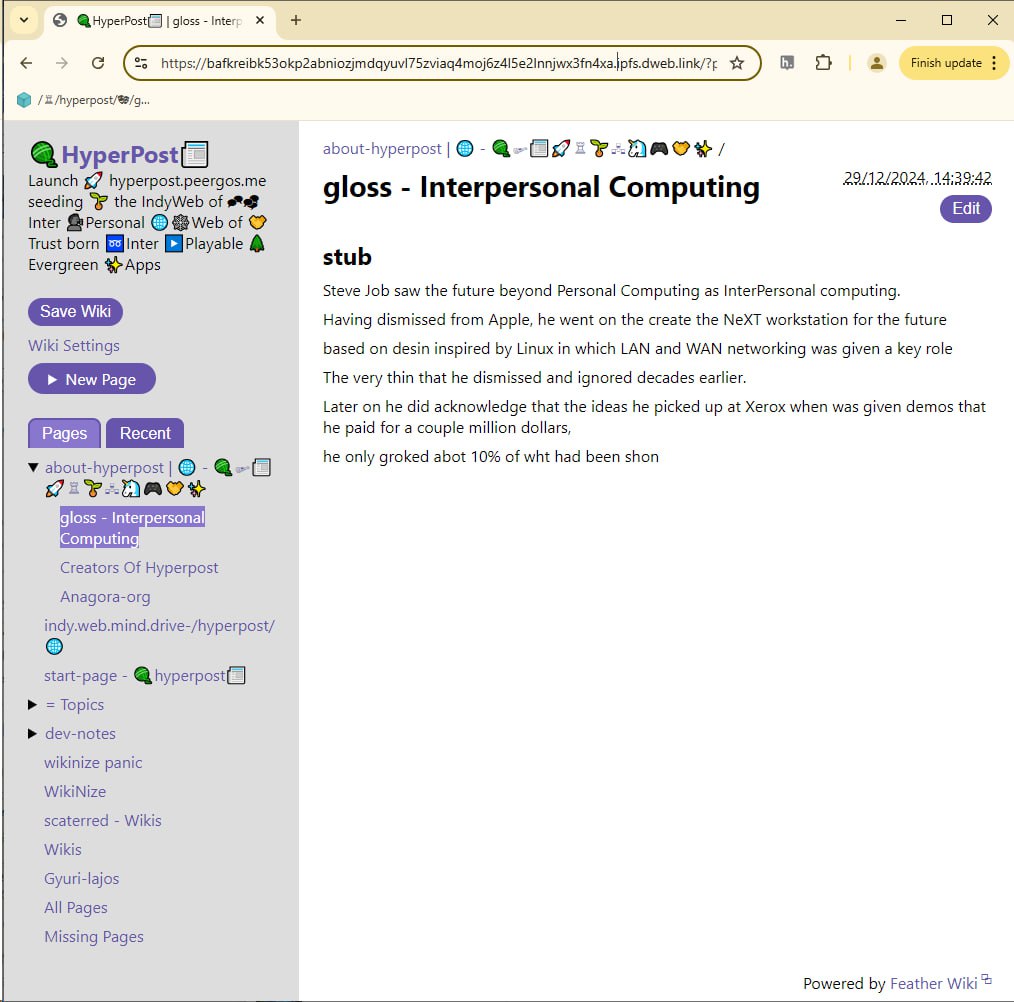
Experiment in using FeatherWiki for seeding hyperpost
12:25
wrote a lot to think about the problem and caabilities. One Nice thing is that it can be annotated and navigagted nicely
12:26
Definitly moving in that directions, but wish to elliminate the complexity of using it, 1 really need to be a porgrammer to cope with that complexity
GL
GL
6 November 2025
GL
13:38
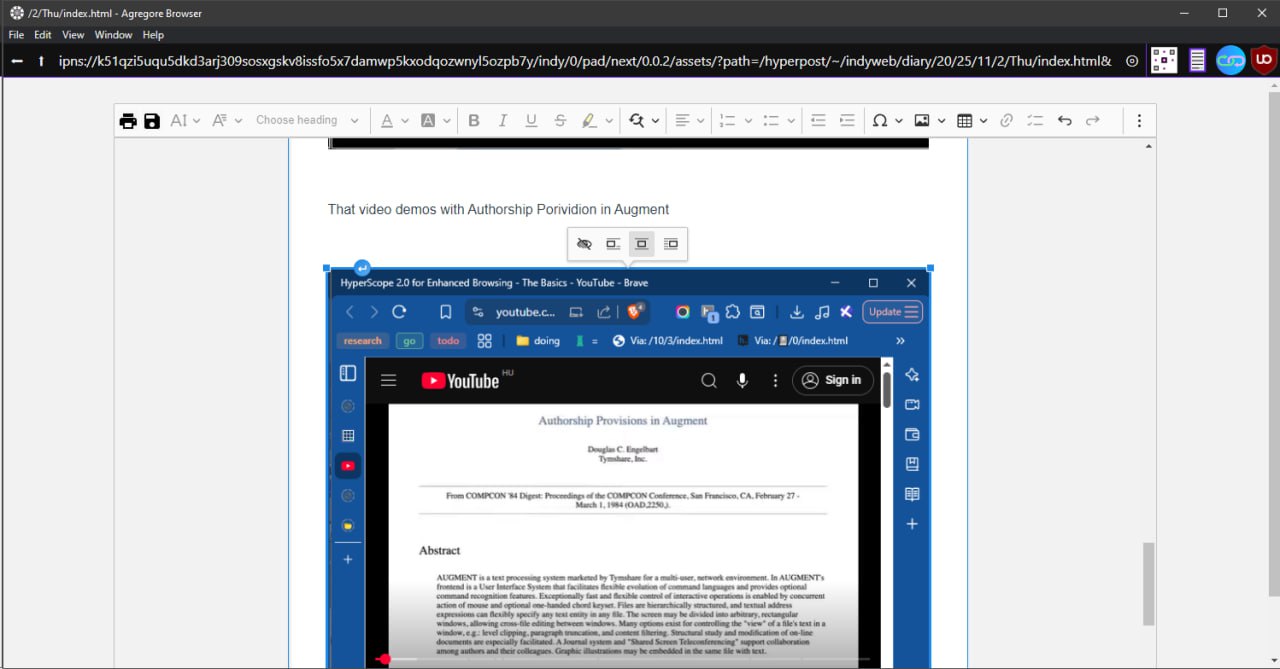
iny 0 Pad works across three infrastructure constellations
13:39
No mor worries about Peergos failing to save
13:40
HyperScope project focus on Authorship Provision in Augment
13:41
I've been building it for 5 years before I learned abut Engelbart. Video by her daughter Christina
13:41
Must get in touch with here soon
GL
15:16
JSON.stringify(localStroage).length
GL
15:36
k51qzi5uqu5dkd3arj309sosxgskv8issfo5x7damwp5kxodqozwnyl5ozpb7
15:48
I think my IPFS node stopped, probably because of too much load generatd by Zoonm
PN
15:49
Parmjit Nahil
Ooops - I didn't press record for the re-entry. But hopefully you got what you needed...
15:50
We can try it with and without Zoom next week...
GL
8 November 2025
GL
9 November 2025
GL
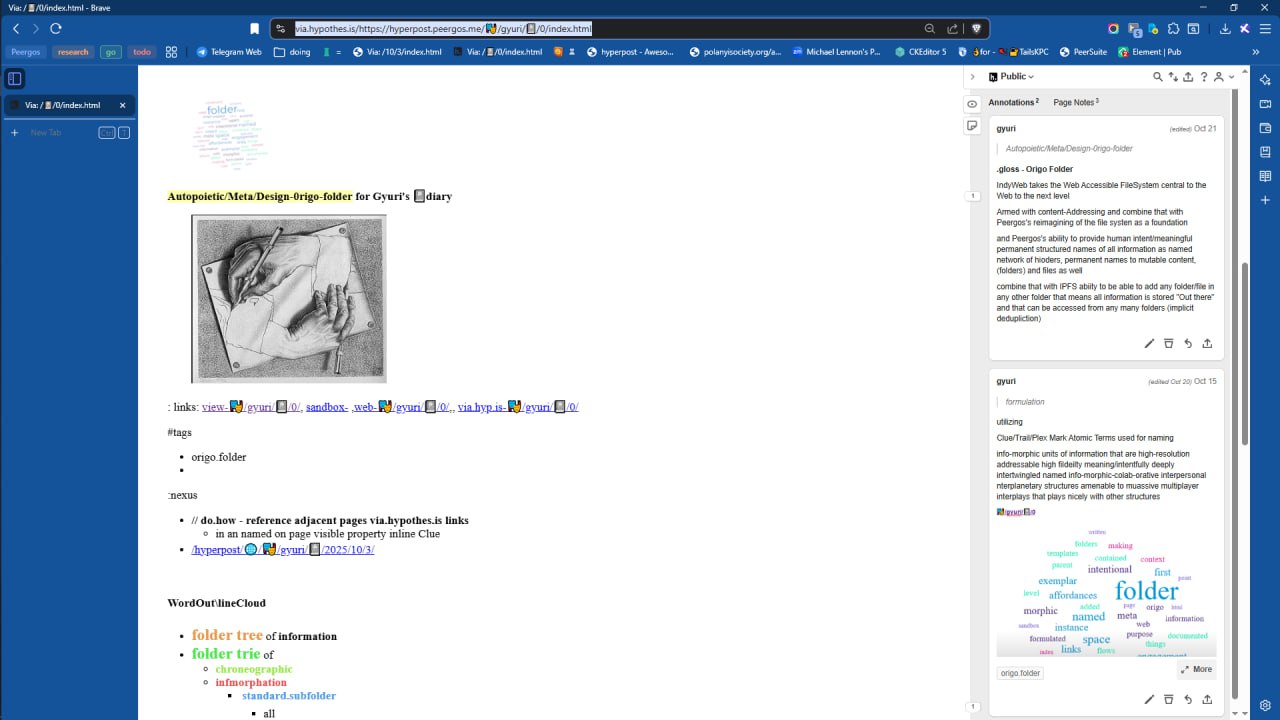
00:51
A PROPOSAL FOR THE DARTMOUTH SUMMER RESEARCH PROJECT ON ARTIFICIAL INTELLIGENCE
https://web.archive.org/web/20070826230310/http://www-formal.stanford.edu/jmc/history/dartmouth/dartmouth.html
https://web.archive.org/web/20070826230310/http://www-formal.stanford.edu/jmc/history/dartmouth/dartmouth.html
10 November 2025
GL
GL
01:03
Gyuri Lajos
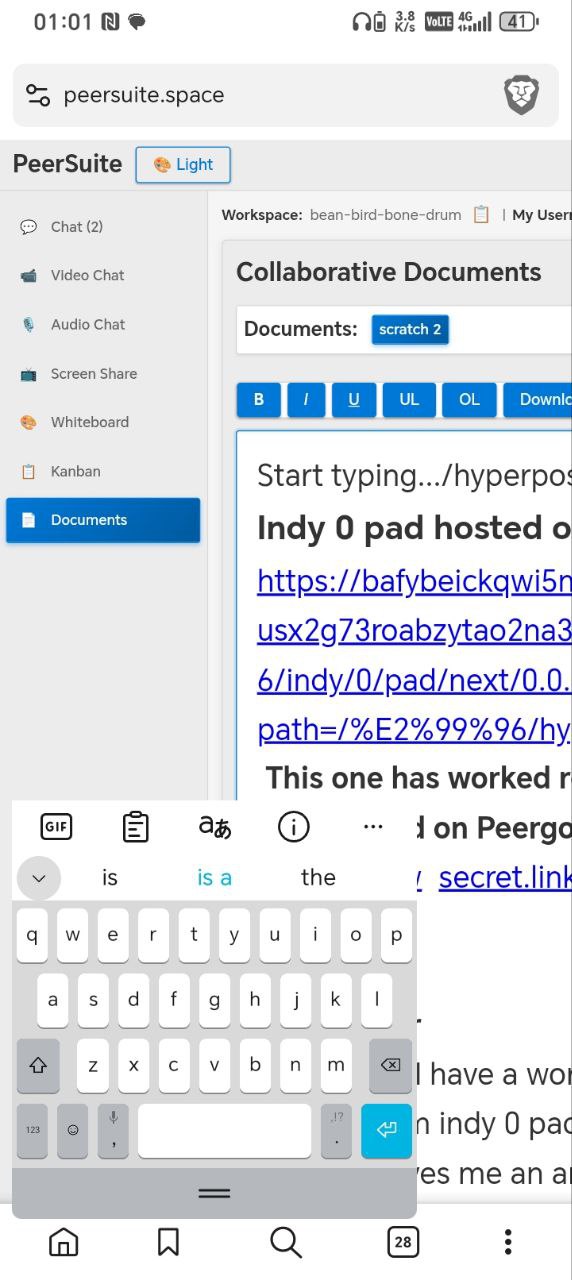
Peersuite.Space rocks
GL
01:20
Gyuri Lajos
crew-core-fact-army
15:57
I wonder if it resolves, andhow long does it take?
GL
18:12
Gyuri Lajos
Not working if I do not have any of my laptops running
18:50
well, well, well. Getting there.
11 November 2025
GL
06:52
Gyuri Lajos
GitHub - helix-editor/helix: A post-modern modal text editor.
https://github.com/helix-editor/helix
https://github.com/helix-editor/helix
JW
GL
08:08
Gyuri Lajos
Morning Gien, Perhaps by Thursday. We could try to schedule a call after your lunchtime on Thursday. I uderstand it is 9 o'clock now at your end, but since we fiddled the clock it is only 8 here. So say 1 o'clock your time would be 12 for me which would be perfect.
👍
JW
08:16
The latest constellation I am trying to run with is to require people invited to the IndyWeb by people already on it, to install IPFS Desktop and running it themselves on their laptops so that they can be a full particpants in the IndyWeb, to invite people they trust and to weave their own indranet of people ideas and capabiities for themsleves.
08:22
for it to be useful to you as is, you would need only the first of three steps, the ability to save the content you create in your own IPFS node maintained by IPFS Desktop. The next step is to enable people with their own Peergos account to backup their own work with Peergos and also have the ability to personalize, extend, exapt the capabilities that are available on the IndyWeb. Or rely on people who have Peergos accounts as wel to do it for them (backup). The third part is to establish real time and also async communications.
👍
JW
08:24
The latest achievement is mirror capabilities developed and extended as Peergos Custom Apps to work in the adjacent IPFS based ifrastructure in a univorm global permanent user defined namespace
08:27
I also want to explore working with Agregore as an alternative to IPFS Desktop. For people wishing t extend the capabilites of the IndyWeb would probably need all three: Peergos Account, Agregore Browser and IPFS Desktop. I am trying to set things up at the moment without relying on Agregor, But it may be a short cut that could prove to be a long cut. Will See.
08:29
the IPFS hosted indy0Pad currently relies on localStorage but it needs to save the data on IPFS as a minimum across all user's devices
08:34
I've been using SingleFile chrome extension and IPFS Desktop and Brave split view together that makes annotating with two ways links a breeze and allows me to archive the web as I go along
08:34
If nothing else I could show how that is done on Thursday or any other time we can find
GL
11:31
Gyuri Lajos
getting closer to closure:
GL
12:31
Gyuri Lajos
please check if this resolves
12:33
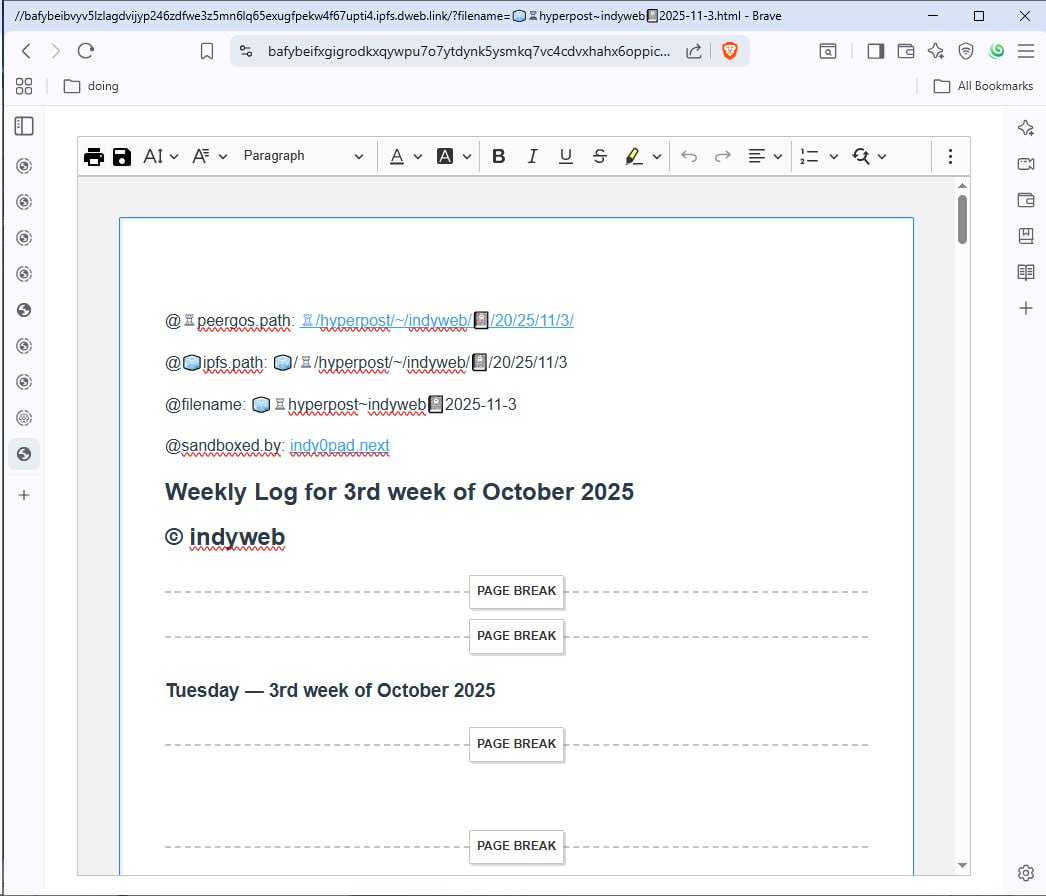
should be getting something like this
JW
13:09
James Wong
In reply to this message
Going down the rabbit hole of the short cut transforms it into the long cut.
13:11
In reply to this message
it tried, but only got as far as loading the frame with the page and scroll bar. No text content made it.
13 November 2025
GL
12:26
Gyuri Lajos
Huge Gotcha
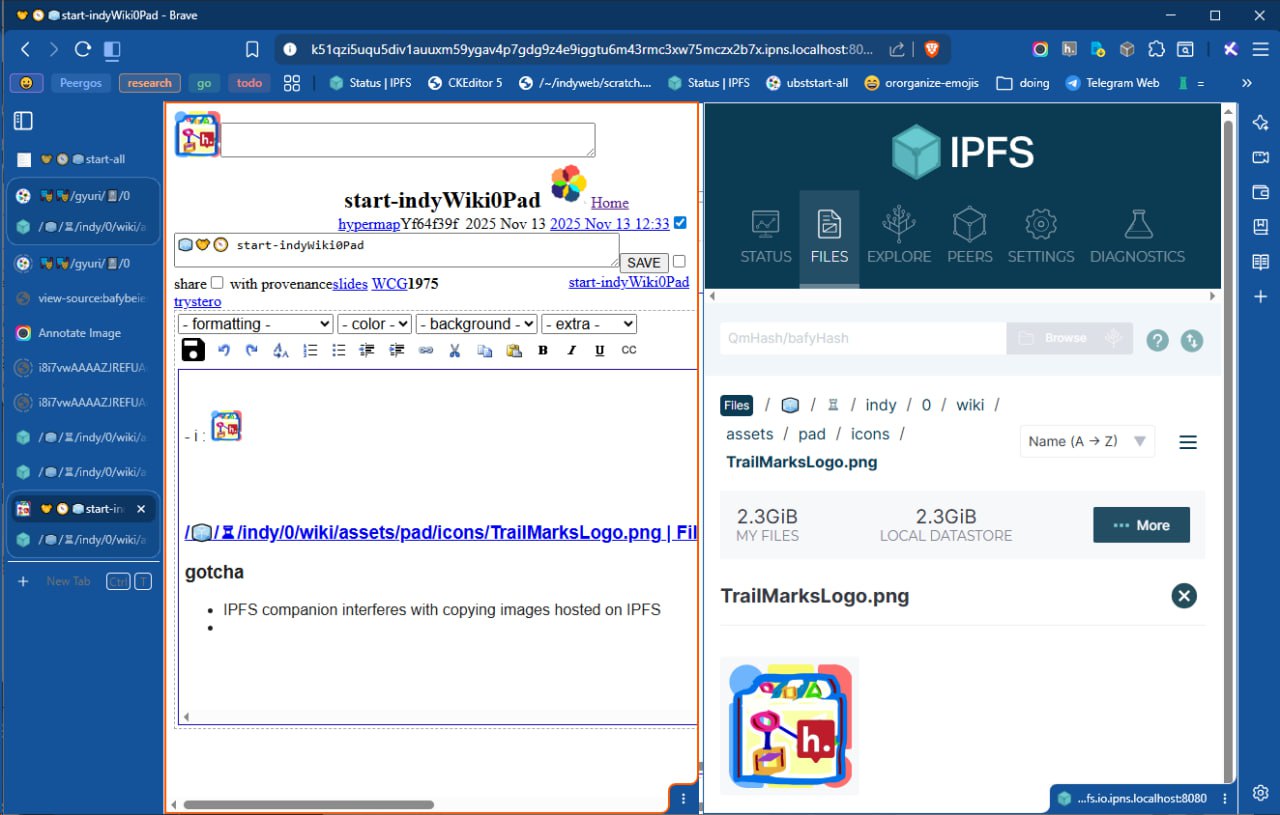
12:35
and was not able to show images
12:35
and in fact it interferes with the indyWiki0Pad's abiity to past in images from ipfs sources
12:36
Wehereas running IPFS WebUi for 1's IPFS Desktop IPFS node in the browser is so uch better then running iut as a Desktop App
12:38
Combine that with Brave's Split View we have the best developer/user eperience possible because we can have an IPFS WebUi running on the left Split View and open links to files on that page in the right Split view and vica versa
12:39
Before doing that 1 can also drag out from the vertiacal tab into its own window such a split view
12:39
like this
12:40
Drag out a split view into its own browser window than duplicate it to do steps
12:47
use back foward arose to navigate independently side by side in IPFS Desktop folder space
12:47
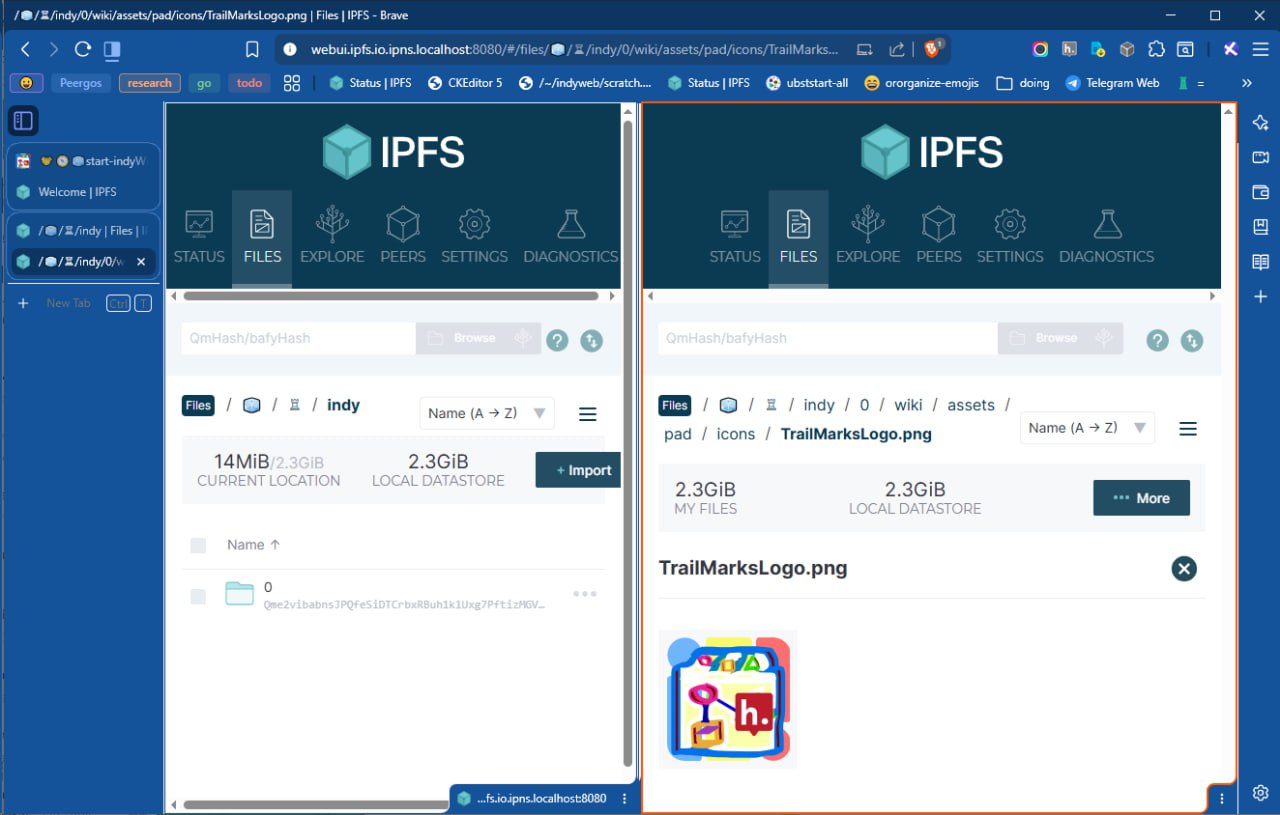
Great browsing experience in once' own IPFS folder tree
14 November 2025
GL
08:44
Gyuri Lajos
Marking the begining of clonfluence to closure, at long last. marking the end of the Groan Zone accelerating convergence to Closure and delivering a minimal workable seed for the IndyWeb https://via.hypothes.is/https://hyperpost.peergos.me/%F0%9F%A7%8A/
08:47
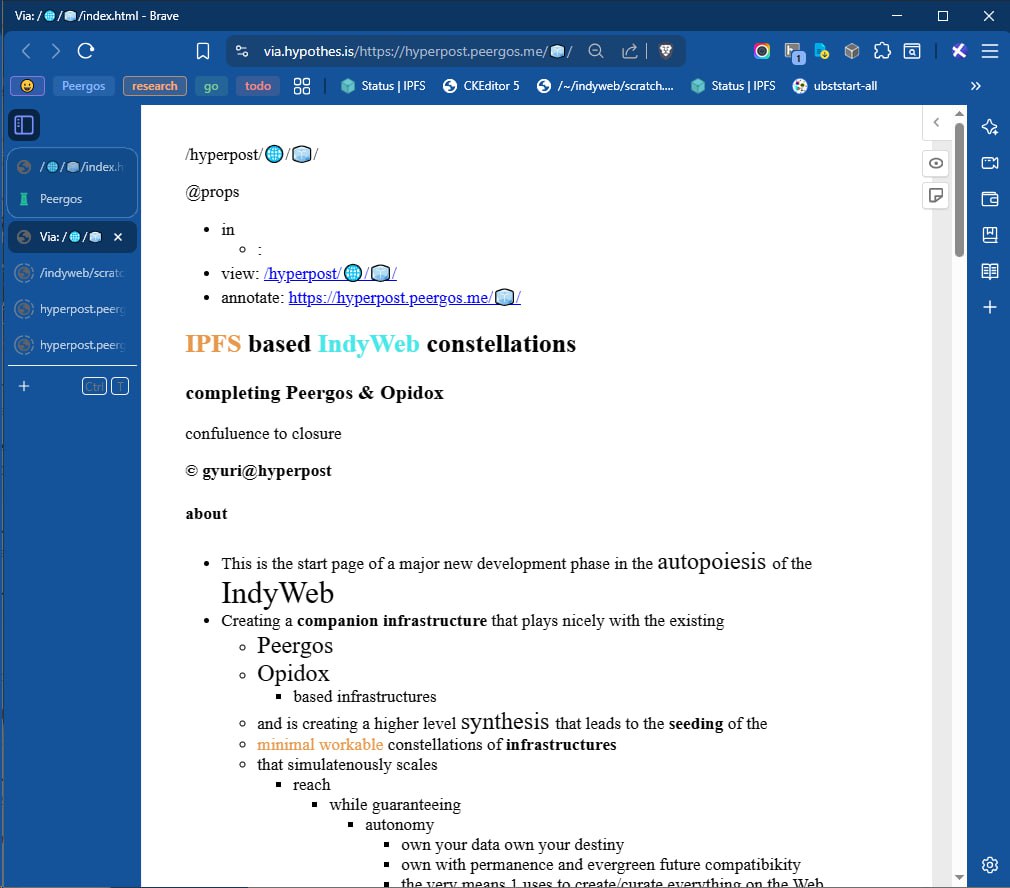
The start-page for the autopoiesis of confluence to closure
🙏
JW
GL
22:45
Gyuri Lajos
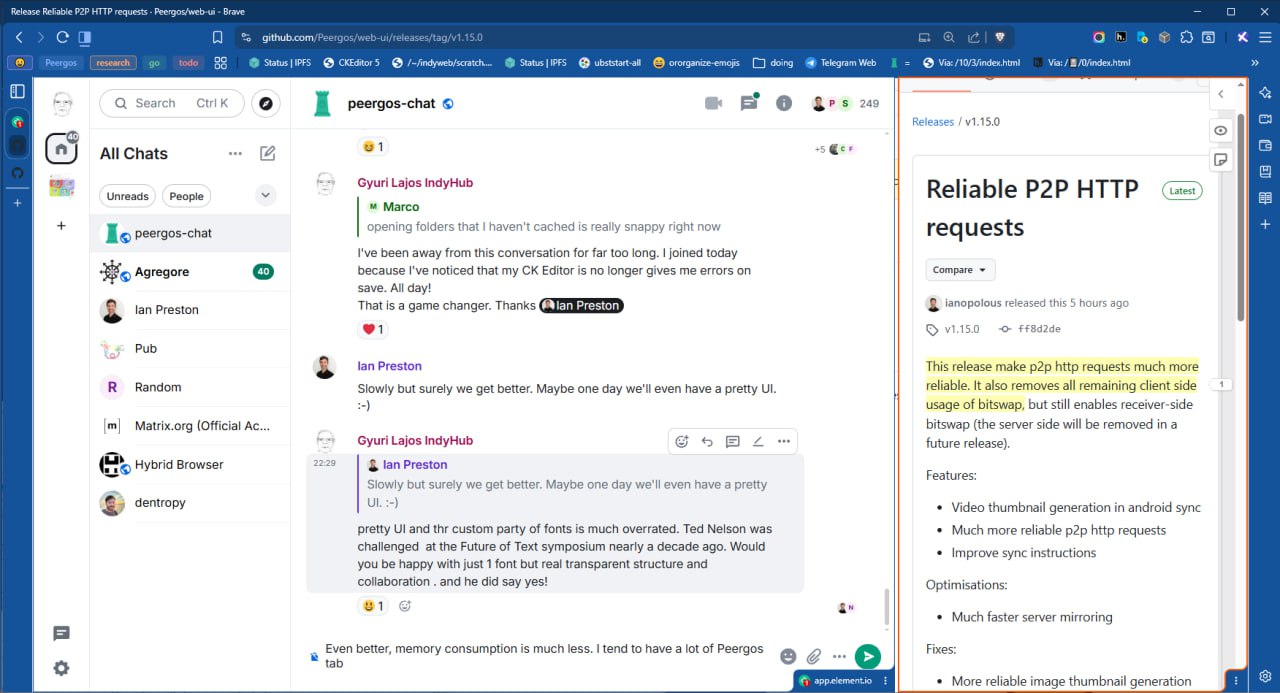
All day Peergos CK editor worked flawlessly. The latest release ellimintated the long running showtopper that undermined the reliability of CK Editor
22:47
I've learned a lot while trying to develop a work around.
17 November 2025
GL
18:34
Gyuri Lajos
I did have fun playing with font colours and sizes. I annotate my own sritings so that hypothesis faceted search can surfce them https://via.hypothes.is/https://hyperpost.peergos.me/%F0%9F%A7%8A/
GL
19:11
Gyuri Lajos
I thought I've shared this back when
19:11
takes a long time to load though
19:15
19:16
then paste in at the front https://via.hypothes.is/
19:18
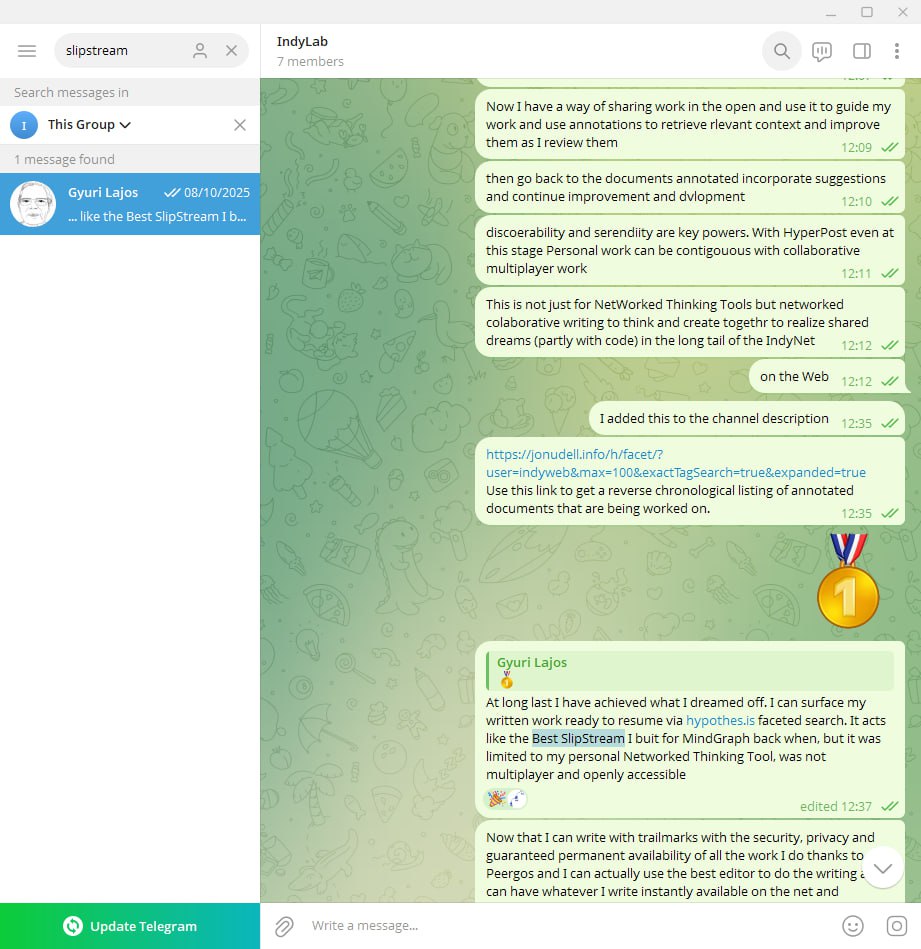
that was a month ago, by now faceted search works on the stuff I write
18 November 2025
GL
02:34
Gyuri Lajos
InterPlaying nicely with IPFS lead me to extend indy0pad so that it enabes embedding of hypothesis into saved documents, thus eliminitating the need for having to request acces via viahypothes.is, (just as I intended all along)
so for hyperpost or anything intended to be part of the Indy Learning Commons would be ipso facto part of the social annotation scene
so for hyperpost or anything intended to be part of the Indy Learning Commons would be ipso facto part of the social annotation scene
02:35
I'm geting used to IPFS working at last!
02:35
Just in time
02:36
should be seeing somethin glike this
02:37
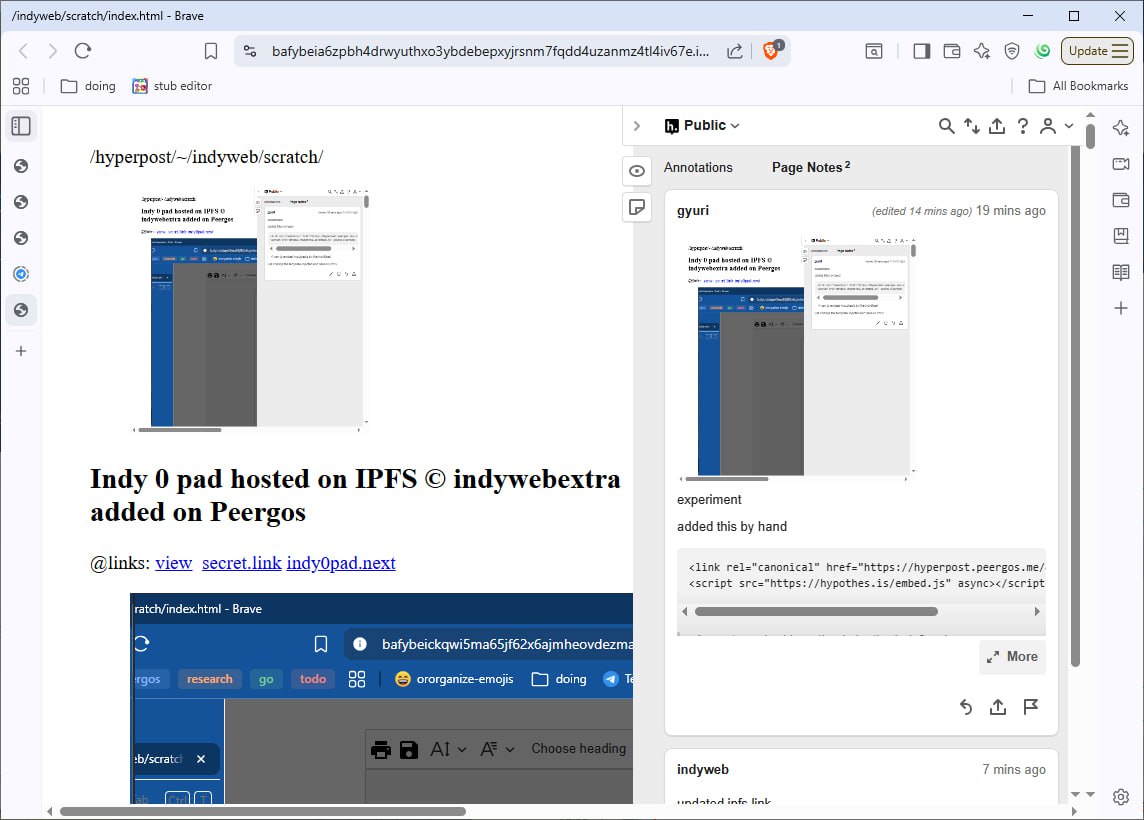
an early days explorimentation that lead to the latest indy0pad
02:39
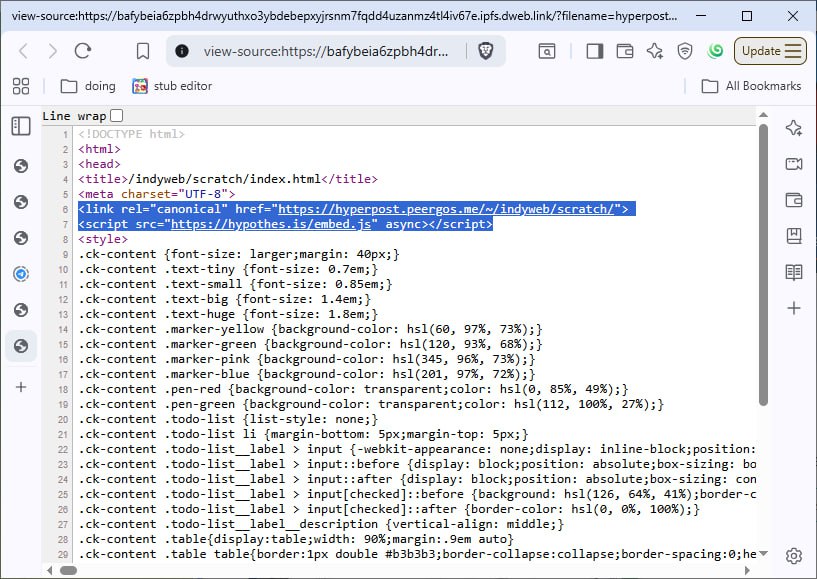
need to generate and splice in lines as highlighted into the indy 0 pad Peergos Custom App and its ipfs counterpart
02:41
This looks like my regular /tuesday night session. When the cat wakes me up and I dream u a way of resolving a long running issue. How to interplay with hypothesis social annotation without requiring permission
02:44
This one also opens up a pathway to scaling. Rely on Peergos for hyperpost only needing to store the mapping from Universal Resource Names to IPFS CID with some appropriately name folder structures. Target is to be able to serve 10-100 million users.
02:48
Put in an other way, to keep up with the market share of Brave just hit 1 %. Recently reached around 100 million usersThat is a sad reflection on humanity in my book. I cannot get my wife to switch from Google chrome to Brave, even though she suffers so much cause of all the tracking and advertisements and slow browser
GL
03:30
Gyuri Lajos
CB
Charles Blass 16.11.2025 13:02:38
@asimong best greetings, noticing your activities and efforts eg today's post https://open.substack.com/pub/growingcommons/p/structuring-knowledge-commons ... and thought to check in... keen to tune in and catch up
GL
ML
09:09
Michael Lennon
ML
Michael Lennon 18.11.2025 09:08:47
Last week I presented at a AI Research Symposium on narratives about the future of AI and Labor (e.g. Techno-Apocalyse vs. Techno-Utopia). And what some of the most reliable economic predictors suggest we should be paying attention to namely —>the learning in our networks.
My substack has the recording with notes/highlights. Comments / reactions welcome.
https://me2we2all.substack.com/p/net-zero-job-losses-from-ai-amplifying
My substack has the recording with notes/highlights. Comments / reactions welcome.
https://me2we2all.substack.com/p/net-zero-job-losses-from-ai-amplifying
JW
GL
20 November 2025
GL
08:21
Gyuri Lajos
setting playback speed and listenning with headphone in front ot the laptop it is possible to make out what you say
👍
ML
GL
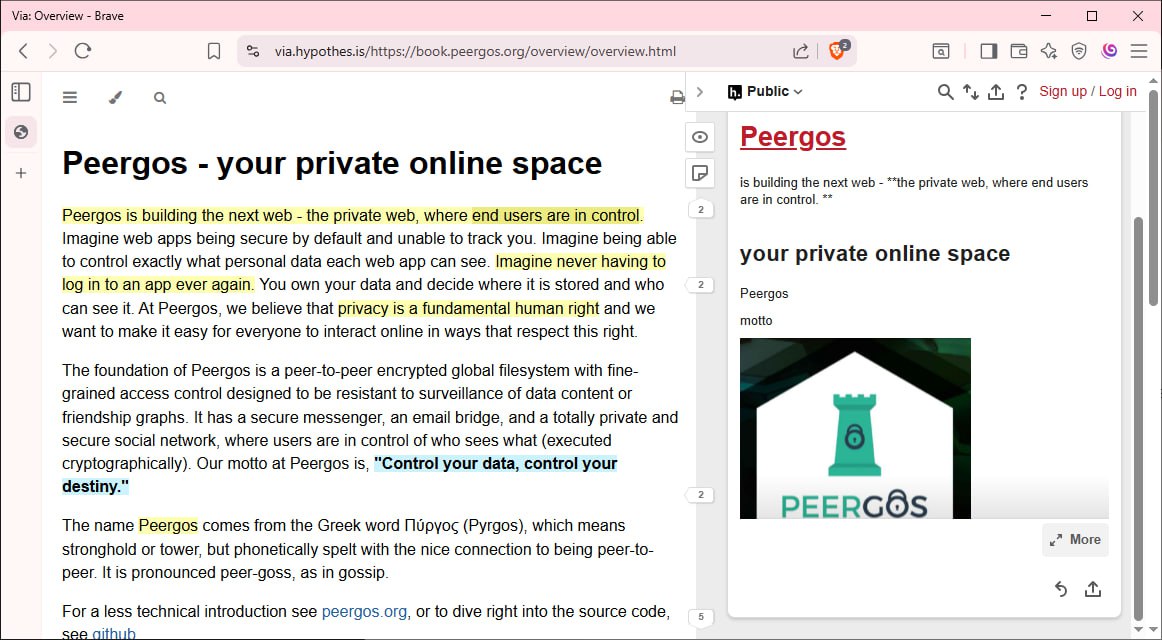
GL
17:39
Gyuri Lajos
I accept it tomorrow morning.
👍
ML
GL
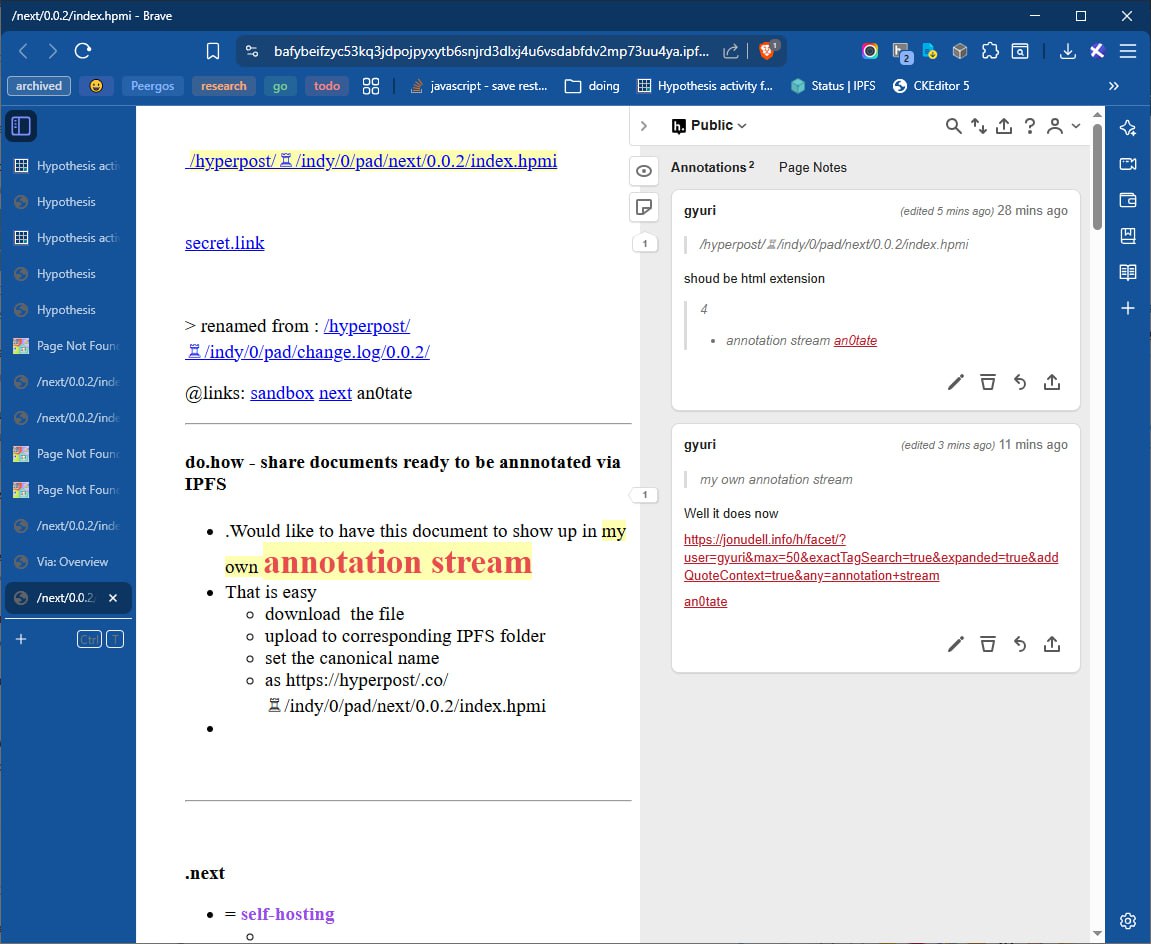
21:06
I guess I have to set the hypoerpost.co link as alternate. It won't be there for some time.
21:06
will change that now
21:06
The best ting is that I can just do that in Peergos
GL
21:31
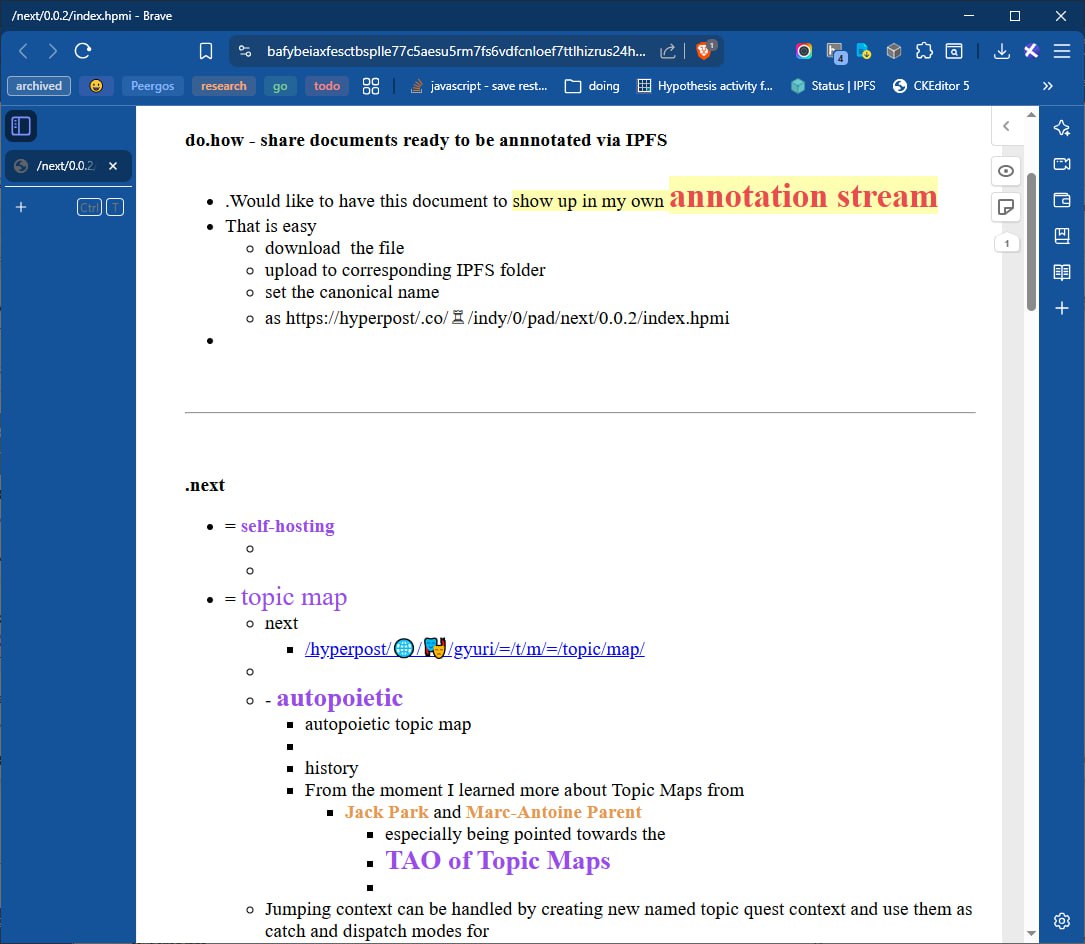
still some way to go but making breakthroughs at last
21:37
Now that I have an instance first exemplar of what is needed to embed hypothes.is and ensure that permanence of annotations the next version of the indy0pad will do this automatically
21:37
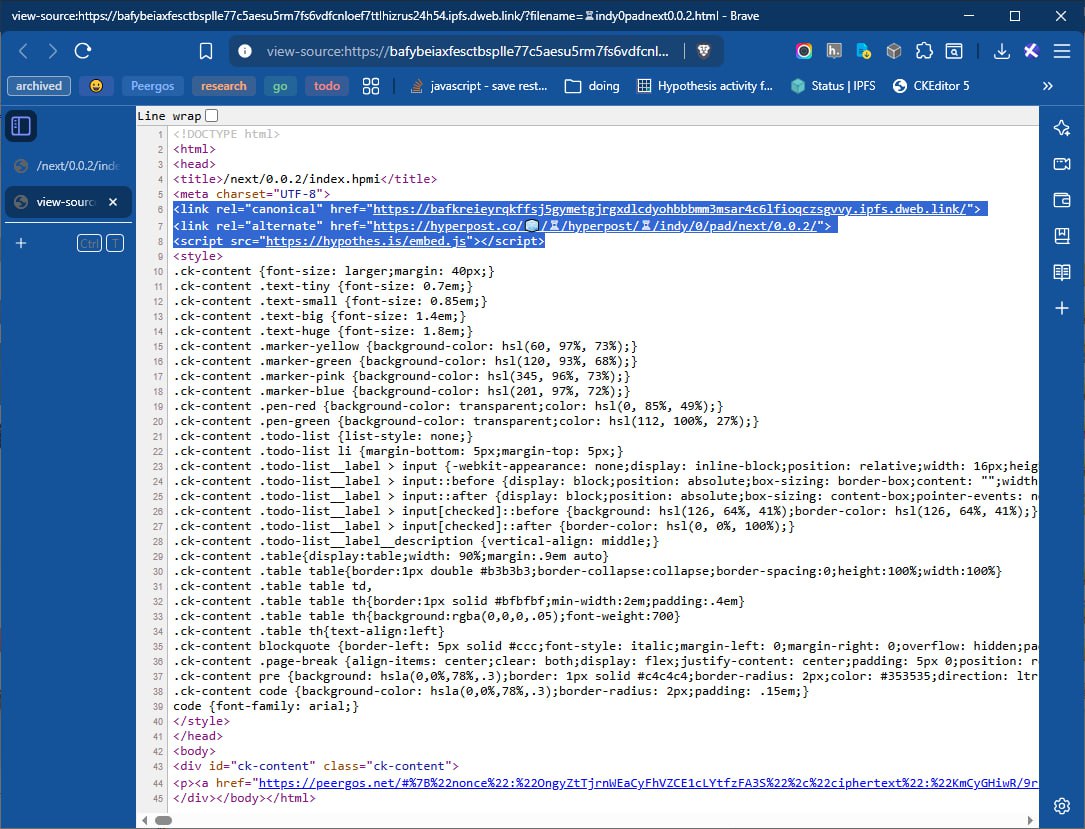
21:38
It takes a complex ground breaking new setup to make the task of extending capabilities a breeze.
👀
ML
21 November 2025
ML
22 November 2025
GL
09:35
Gyuri Lajos
Looks like Google Chat is introducing new features that should have been there from the word go
09:36
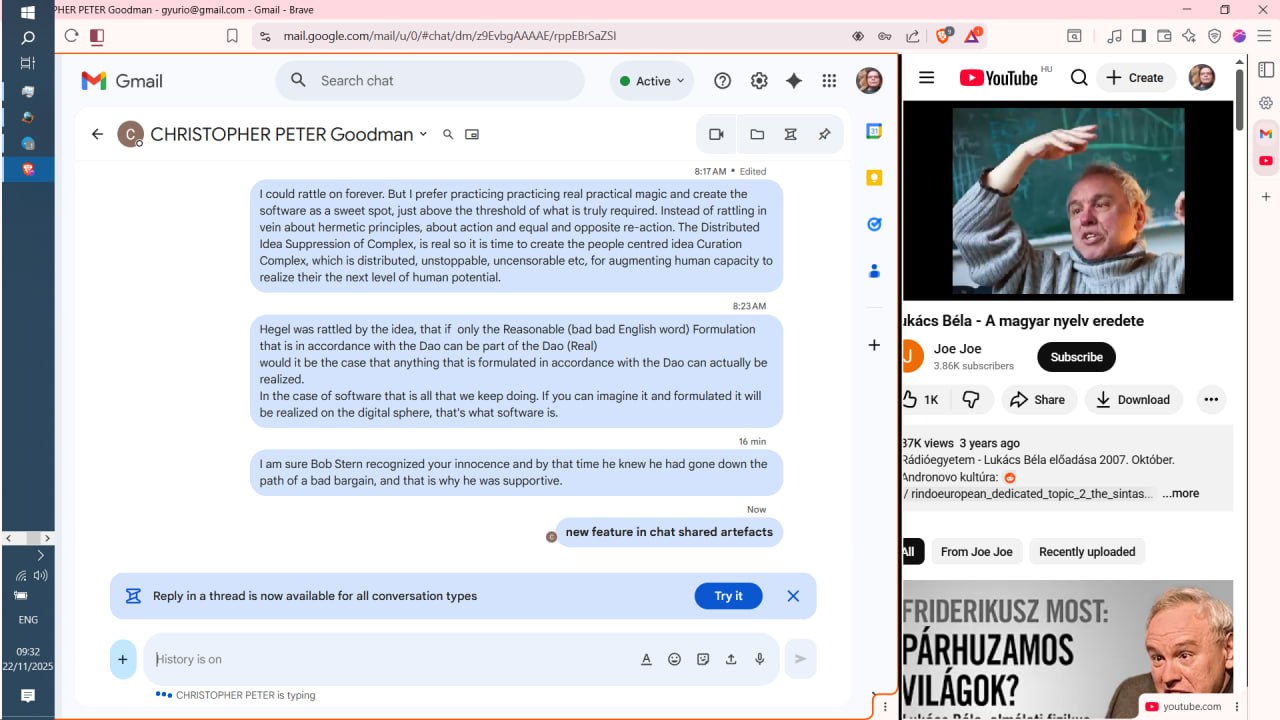
Trheaded conversations
09:39
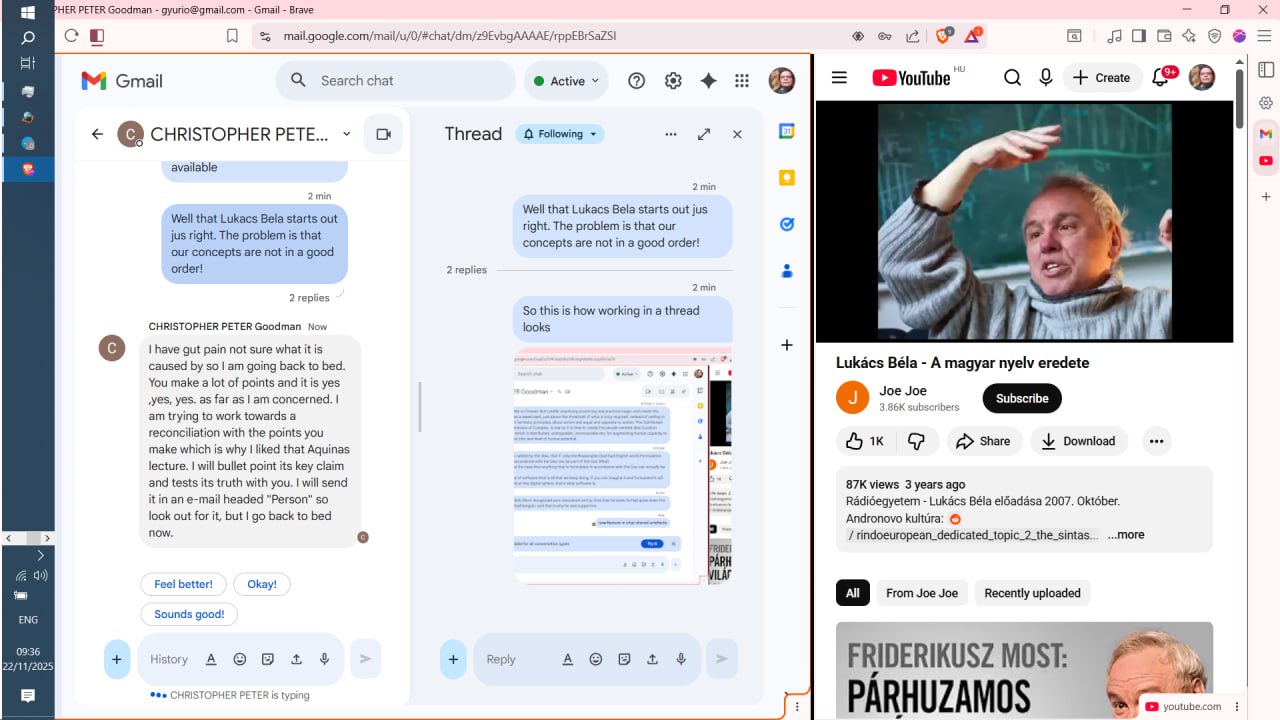
adding threads
17:26
If the above works, then the path towards developing the autopoietic plumbing for the first cycle of the evolutionary spiral of the Permanent interpersonal interplanetry autonomous Indy Web would have proved to be open. Ready to be used to document itself.
👀
ML
GL
17:46
Gyuri Lajos
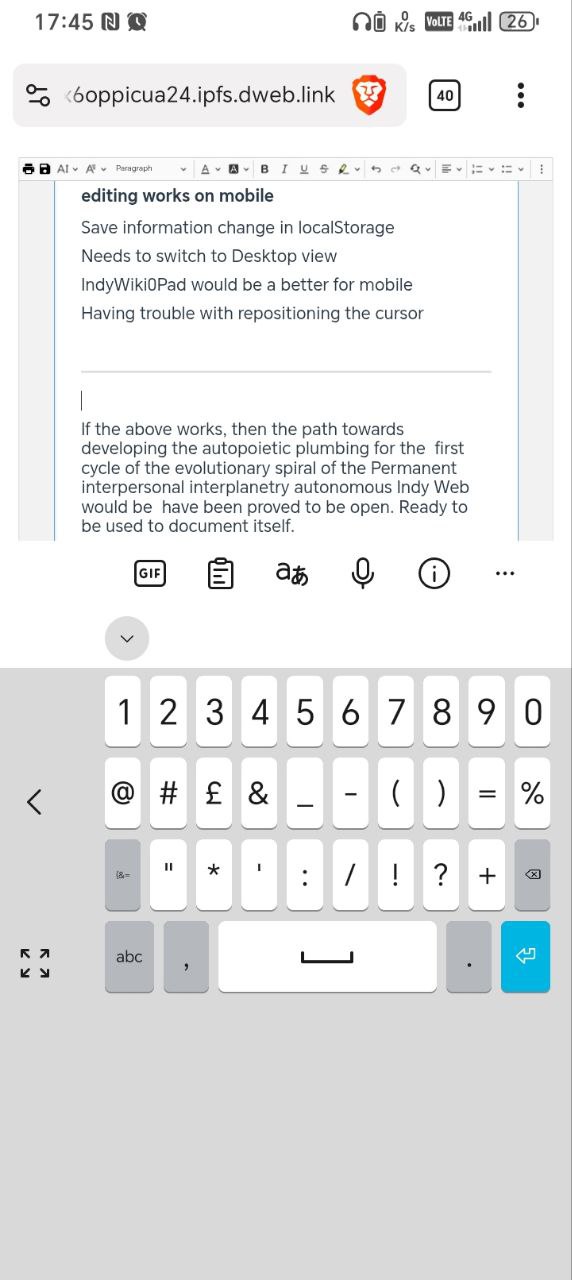
Kinda works on mobile in desktop mode
GL
20:54
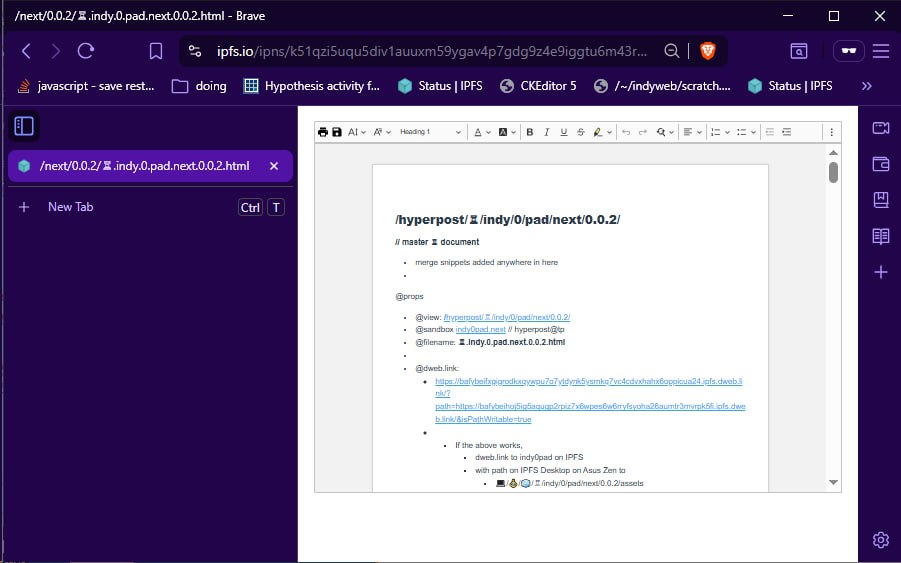
nice one, the information is saved with the capability to edit it as a holon
20:55
cuttng this one out /📝/?path=.. from the path to get to the information
20:56
and delete the url parameter isPathWritable
20:59
getting closer. Using IndyWiki0Pad would handle the mapping from human readable names all anchored in the private owned autonomus local space of the Author to permanent InterPlanetary CIDs and IPNS references to folders and paths within those folders
20:59
This is a major milestone
👀
ML
21:00
🗝
21:01
Actually the url looks prettier if copy it in two pieces
21:06
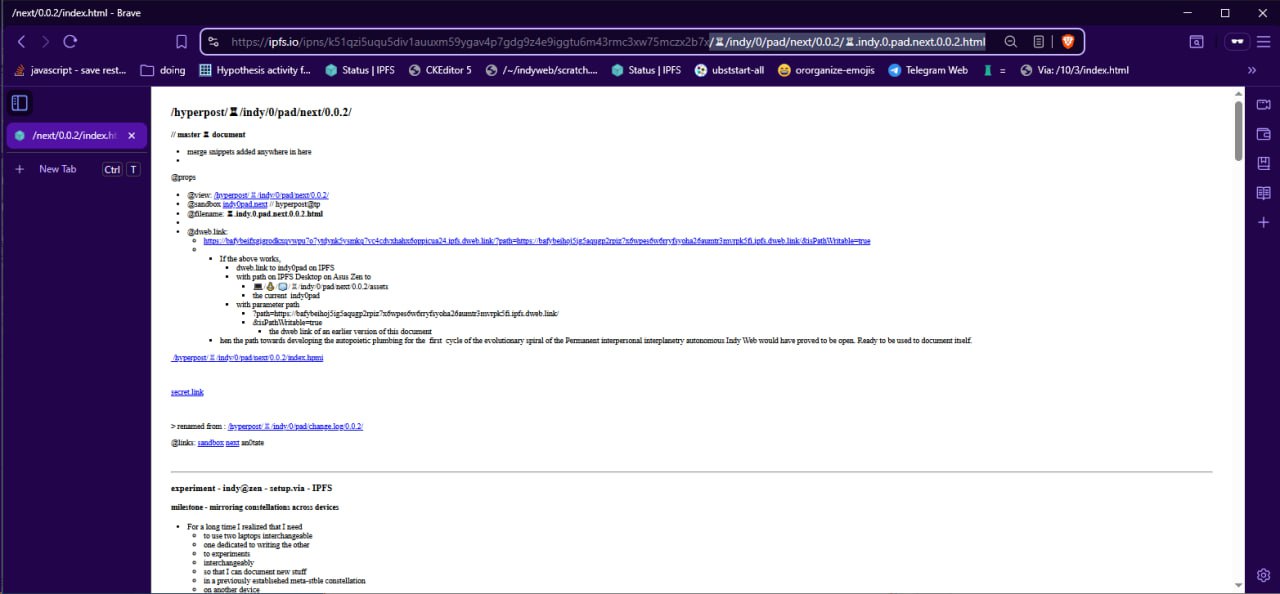
Just the information cn be shared too via via IPNS or indeed IPFS lets see that next
21:09
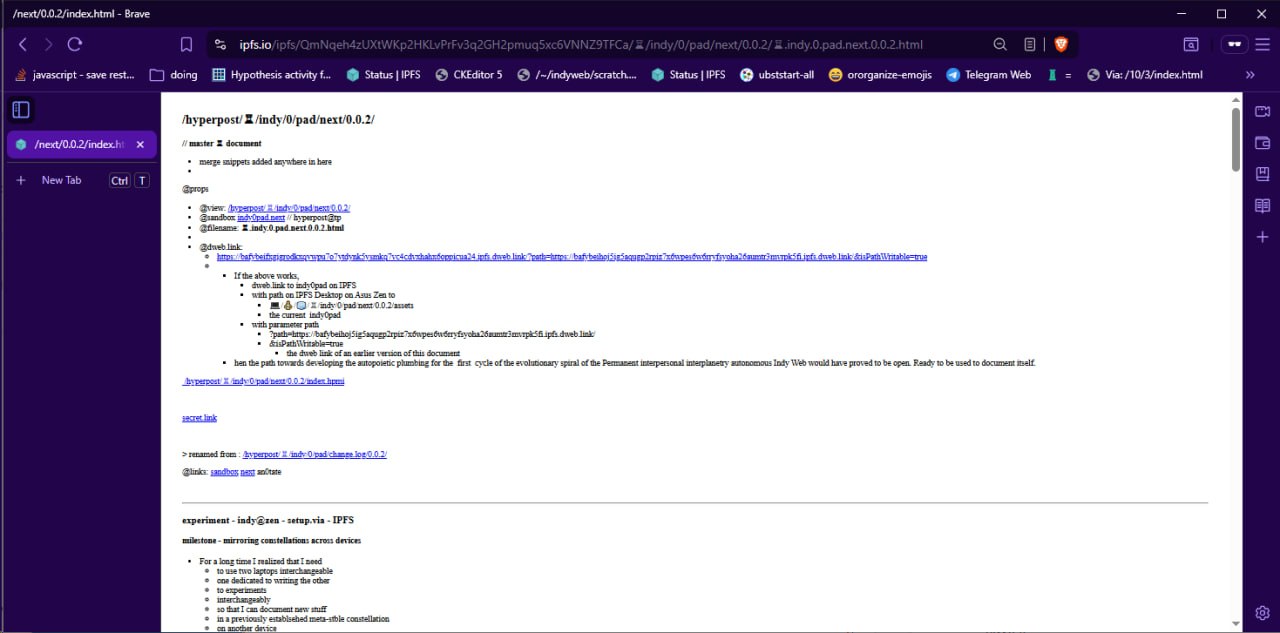
now via ipfs
21:14
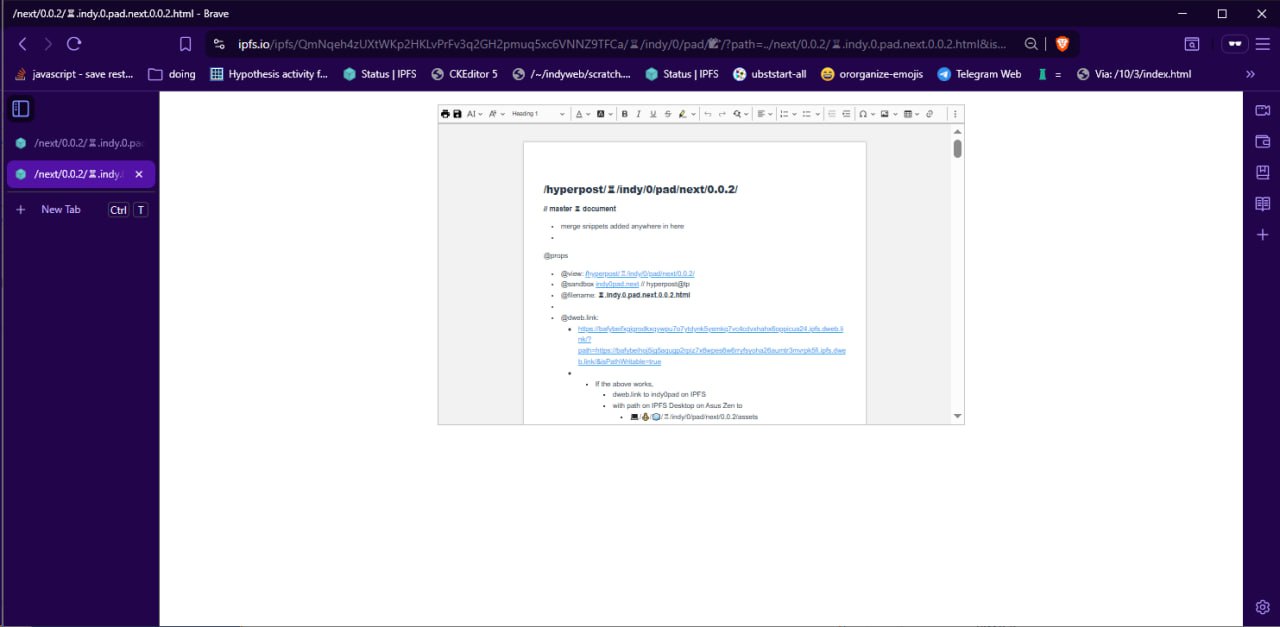
these info-morphic references can be shared
21:16
If we share dynamically generted versions of documents via IPFS and the documents contain links to permanent verifiable inofmation pertaining provenance, and there is no other way to obtain the information that would change the game. Permanent avilablilit of information with verifiable provenance!
👀
ML
21:18
Even better each participant in the network would have their own copy of the capabilities that were used in the creation of the resource, so they can extend it and share it back to the author or into the commons, but even there to specific named commons communities
21:19
or indeed all this can be done privately.
21:20
No need to encrypt because each document is just a smll part of a complete nexus plexus of intertiwngled documents whcih cn only be accessed via permission/colaboration of the author!
21:21
it is like making each page of a book accessible on the seb but lacking the information how to get them all and in the right order
21:22
The human readable links will be there but could only be mapped to CIDs by the author.
21:23
I had this vision for four years or more, but it can be operational. Have the existence proof that such constellation of capabilities is possible!
🤩
ML
21:25
Remember also that these documents have multiple pages in them and in fact these pages are to be exploded into many smaller ones (clues) each with their own addresses that will be trans-in-out-cluded on demand
GL
22:14
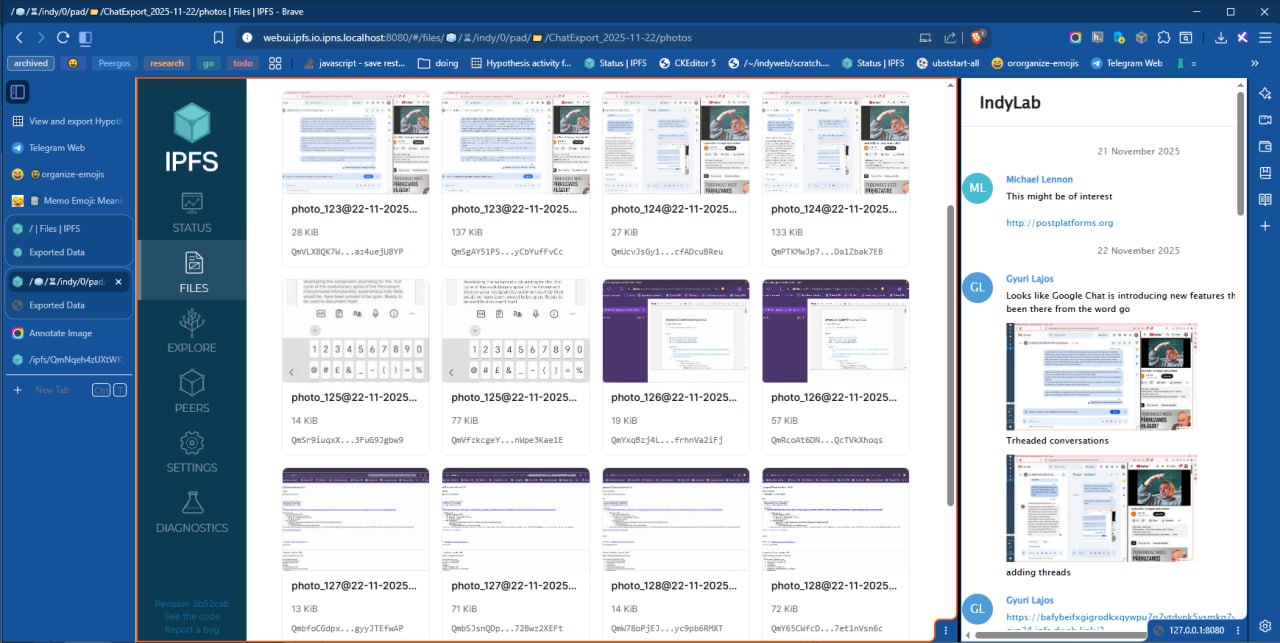
Here We go, exported Telegram Chat for today. Uploaded the folder to IPFS and here it is there
GL
23:53
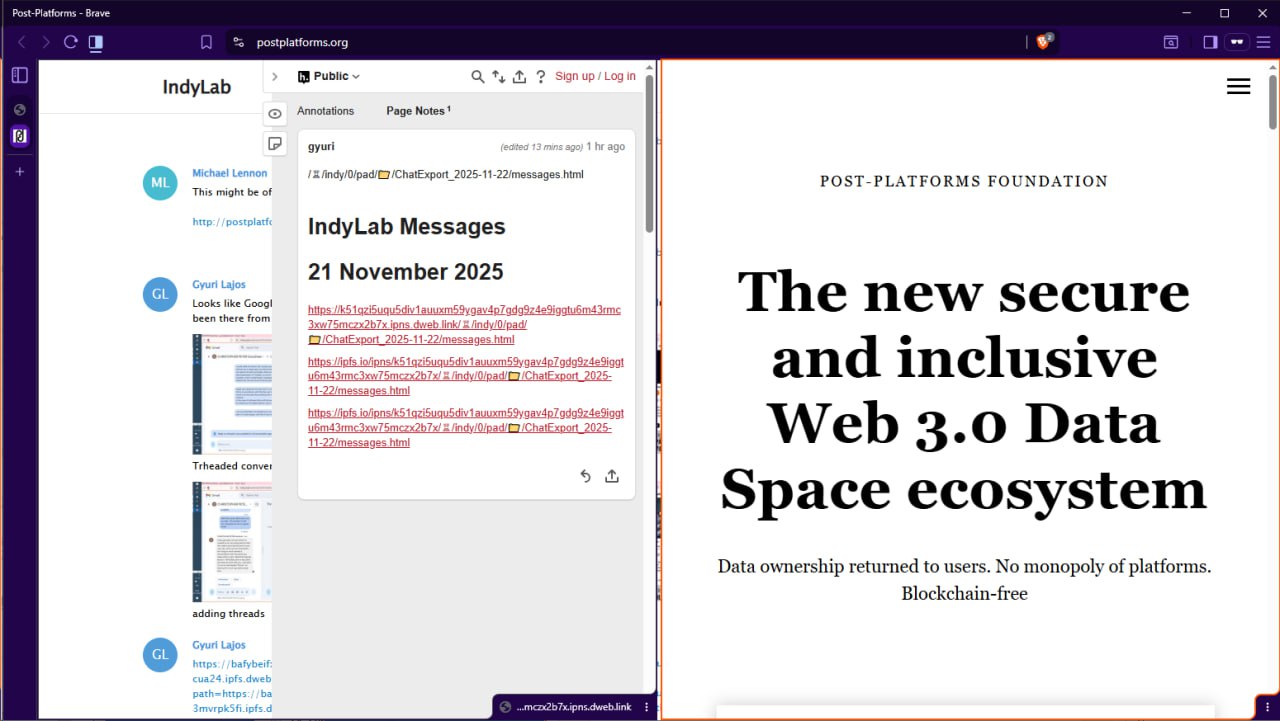
Web 3.0 Data Space Eco system
23:58
In reply to this message
Yes it is Solid, People can have Personal Online Data Store and their stuff is represented as Linked Data
23 November 2025
GL
00:01
Gyuri Lajos
IndyWeb, Peopel can have whatever data and format they need/want along with Open construct Apps that they can use and own permanently on their own devices and stored in IPFS so permanent, unstopable. And they have all their data on their own devices using IPFS Desktop or Agregore or other Apps. They truly control their data and weave their own autonomous social networks and much much more
🤩
ML
00:01
Yes SoLiD and Inrupt I've been tracking from the early days
00:03
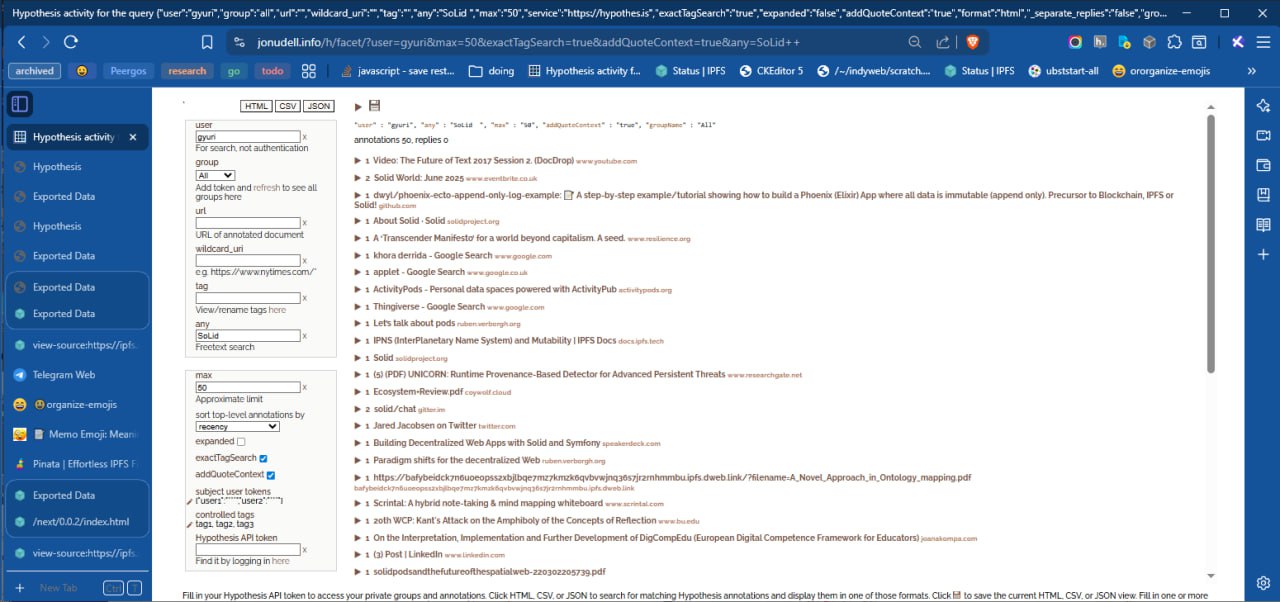
Socially Linked Data SoLiD
ML
05:03
In reply to this message
It's as if perfect traceability (and privacy?) at the individual level impedes the rapid exchange of signal systems
Or to use biological cell metaphors, if every cell in the body creates its own unique memories, the signalling role of neurons in compressing and relaying "memory signals" becomes untenable?
Or to use biological cell metaphors, if every cell in the body creates its own unique memories, the signalling role of neurons in compressing and relaying "memory signals" becomes untenable?
GL
10:13
Gyuri Lajos
In reply to this message
Thank u Michael for keeping up with the torrent. Yes it does when something is not pinned by the pinning service. When my laptop is turned off. On a per community basis some pinning service should be set up. There are a number of options that can be provided. Will be sorted
10:20
In reply to this message
Much of this should be in the open commons. Except that provenance will be baked in. Private sharing is the exception. Search engines will be able to index everything shared publicly but the connections will be available only through cascading trust networks. Flip the current setup where only search engines have information about full history and back links. The default is that the individual can have all that information local first but optionally share some of it in the open
👀
ML
GL
10:36
Gyuri Lajos
We created the project on Open Collective under Open Learning Commons as Indy Learning Commons (it really should have been called Indy Mutual Learning Commons for emergent local-cosmo emergent self-irganizing Symmathesy
⚡
ML
10:41
Where we rely on social annotation as a global discovery engine . Everything shared on the IndyWeb is created ready to be annotated and thus surface able through hypothesis annotations and in the future by other like services.
So the open the universal hyper document system itself was designed to be capable of capturing the frontier of the web itself through co-laboration and searches
So the open the universal hyper document system itself was designed to be capable of capturing the frontier of the web itself through co-laboration and searches
10:48
In reply to this message
Serendipity engine where every search should be able to surface the entire neighbourhood of all that individuals curated related to any given search. Share learning and n the form of learning trails providing a dynamic hypermap everything that is related share the very scaffoldings with which all related externalisation/ formulationsof 1s learnings were erected. These 1 s could be individuals or indeed named collectives cascading through local Cosmo emergent the virtual networks of communities of interests
🤩
ML
GL
11:47
Gyuri Lajos
ipns://k51qzi5uqu5div1auuxm59ygav4p7gdg9z4e9iggtu6m43rmc3xw75mczx2b7x/%E2%99%96/indy/0/pad/next/0.0.2/%E2%99%96.indy.0.pad.next.0.0.2.html
24 November 2025
GL
23:59
Gyuri Lajos
did not have time to do any work today
23:59
only in the evening
25 November 2025
GL
00:00
Gyuri Lajos
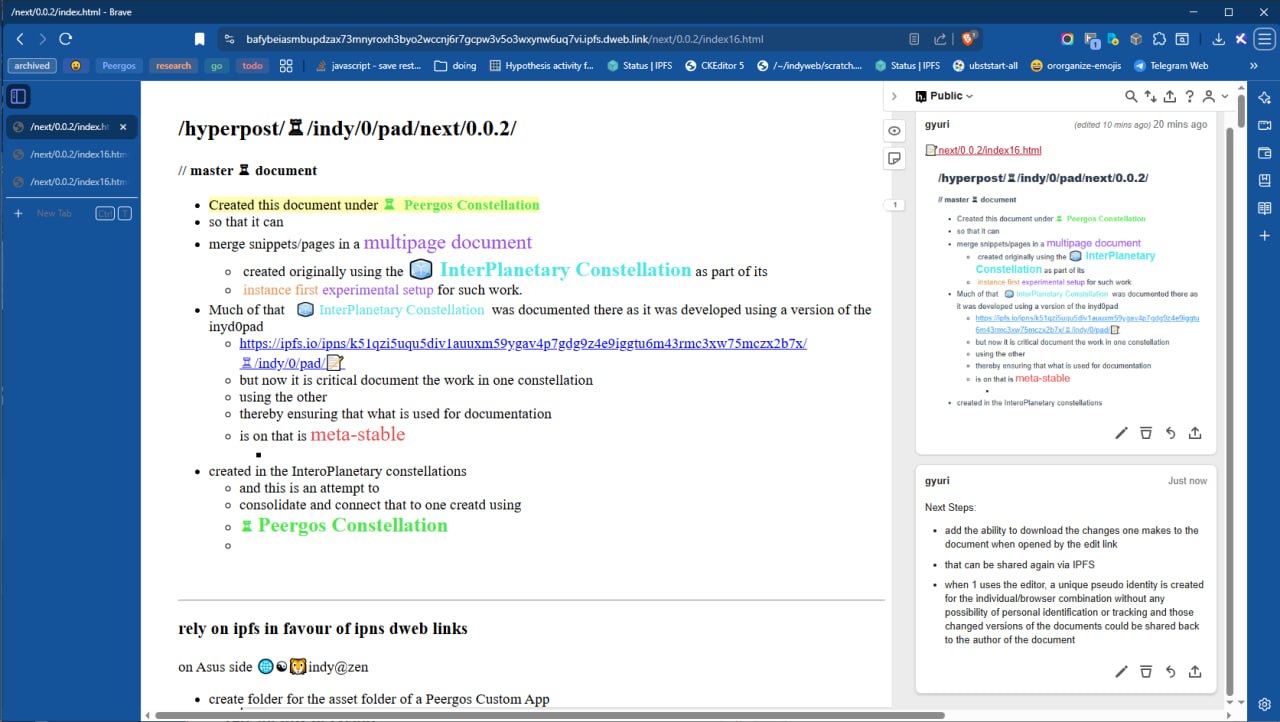
documenting and etending the work I did yesterday
00:07
I suppose these links will only work if I have my machine or if I pin them using a pinning service
00:14
26 November 2025
GL
11:20
Gyuri Lajos
At long last I am changing the default font in the indy)Pad editor ro roboto which is aar more readable even withsmaller font sizes
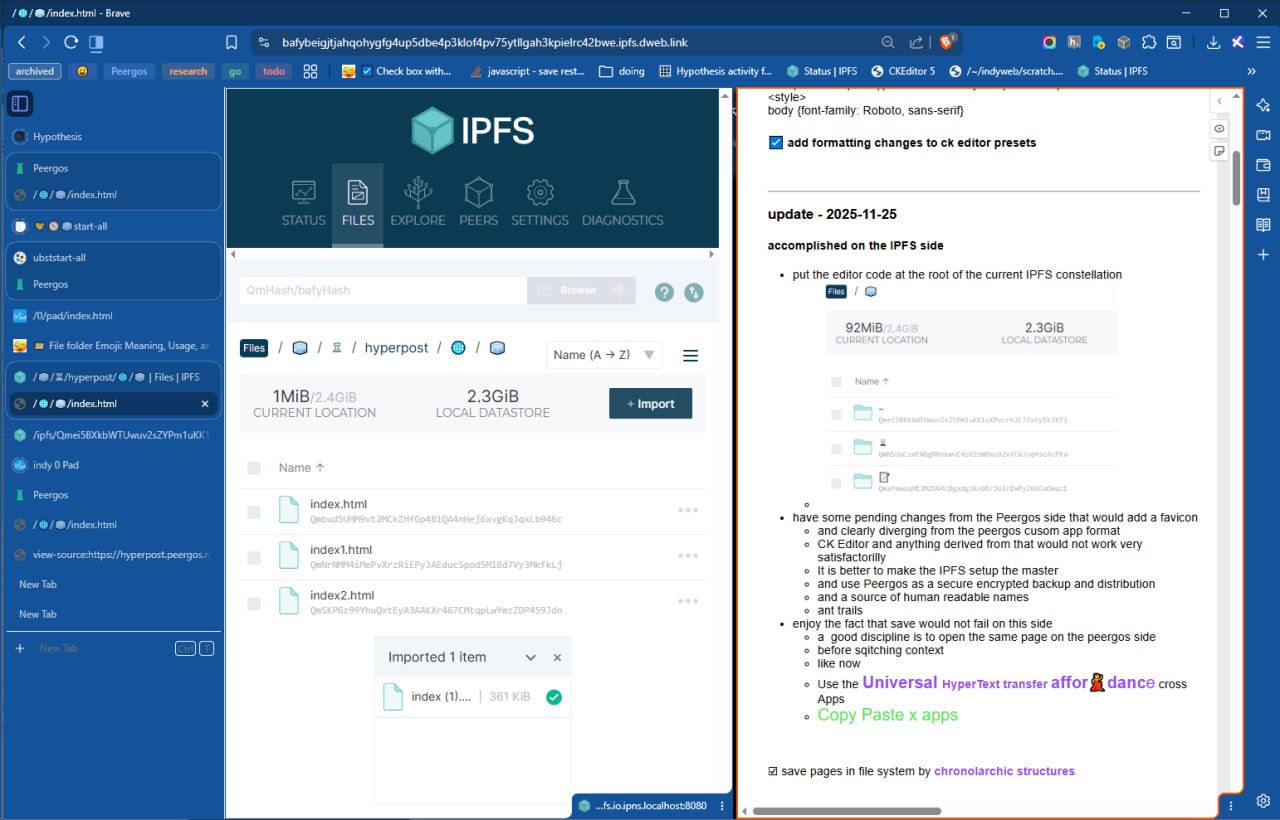
11:22
Oh and hypothesis is injected as a default
11:35
I can't help thinking that over the past 3 decades or so, ever since the rise of Java (with 500 million marketing, rhe rise of O'REILLY dominance/monopoly of book publishing in computing and the rise of XML all the hype most of the mindshare had been created to push people in the diagonally opposite direction that would have been required.
👀
ML
11:37
Wat trigerred this rant is the realization that "separation of concerns" and many other the programming fads were just the opposite of what was needed. It is clear to me that instead of separation of concerns, developing layers, micro services, web services, monolith everything is just plain wrong. Integral holonic maleable design is needed where iintentions can be formulated in an organic coevolutionary ways.
👍
JW
ML
11:41
Will see
GL
12:36
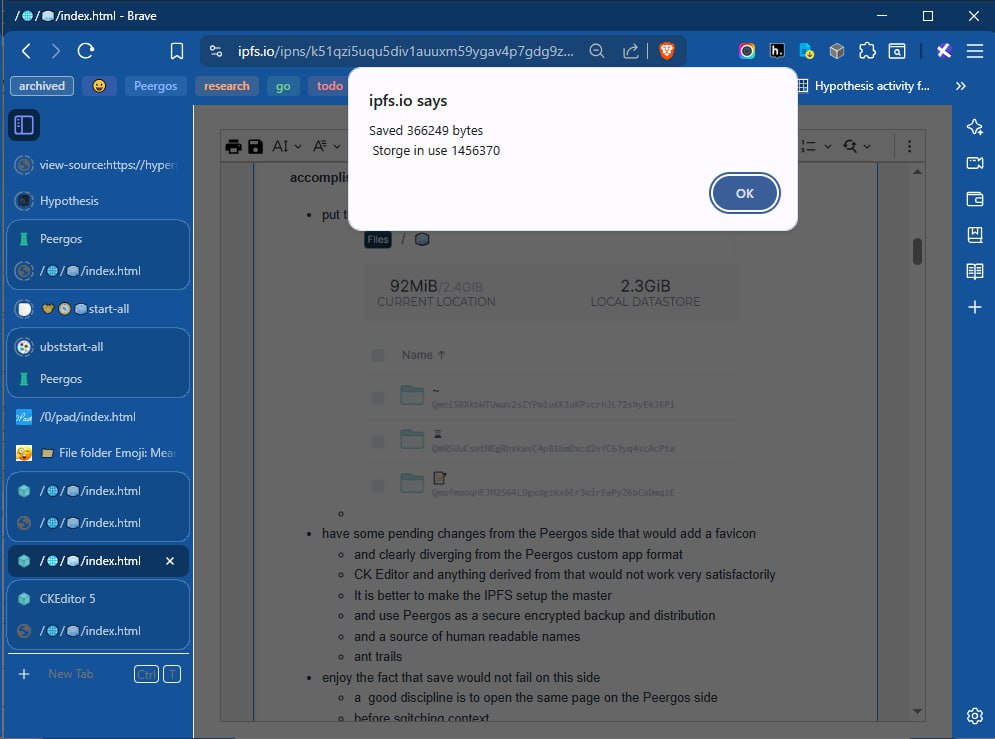
The Read Write Web is born
🤩
ML
12:39
Share documents in a way that people Can use In-line-trailmarked responses and futher elaborations that would be clearly markd with TrailNMarks in-notation, conversation thread, work on, own their own contributions and can share back
12:40
There is quite a bit of work still to do but the path is clear.
12:40
The editor will load the original, but overrides it with locally saved changes.
12:42
Need to generate a delta document, clearly marking the changes,, download that as a file and share it via Peergos by uploading it into a shared secret folder. So that we can have Matt Saia's Dream Space. Where deep work and conversations can be continuous without it being synchronous, verifiable provenance adn co-laboration history
⚡
ML
GL
12:59
Gyuri Lajos
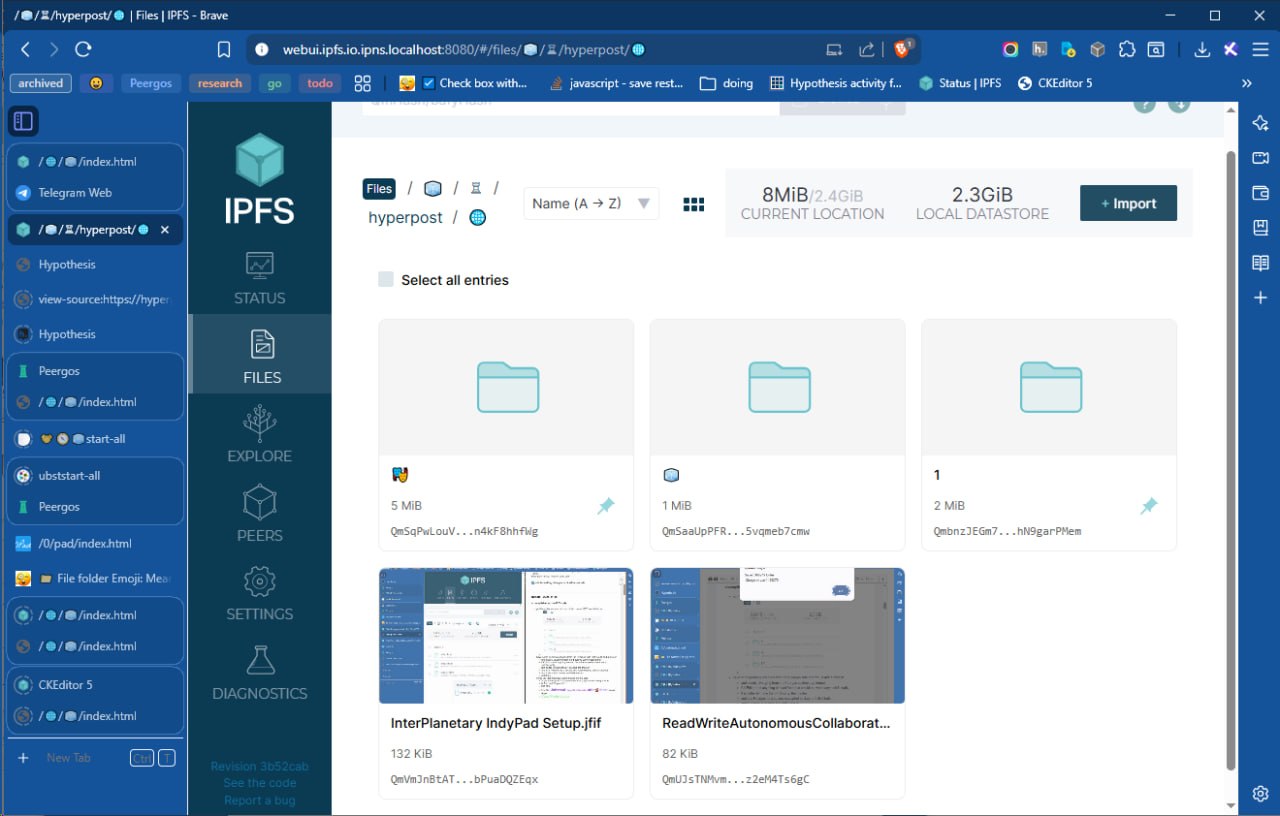
WebUI for IPFS Desktop runs in the browser and better than Peergos, a pretty Good Drive experience, including showing images
12:59
MindDrive will be rborn 10 years after without me needing to do much coding
13:01
But te best thing is that there is a great workflow to incorporate snippets of conversations from Telegram using WebTelegram into one's own WriteFlow
13:05
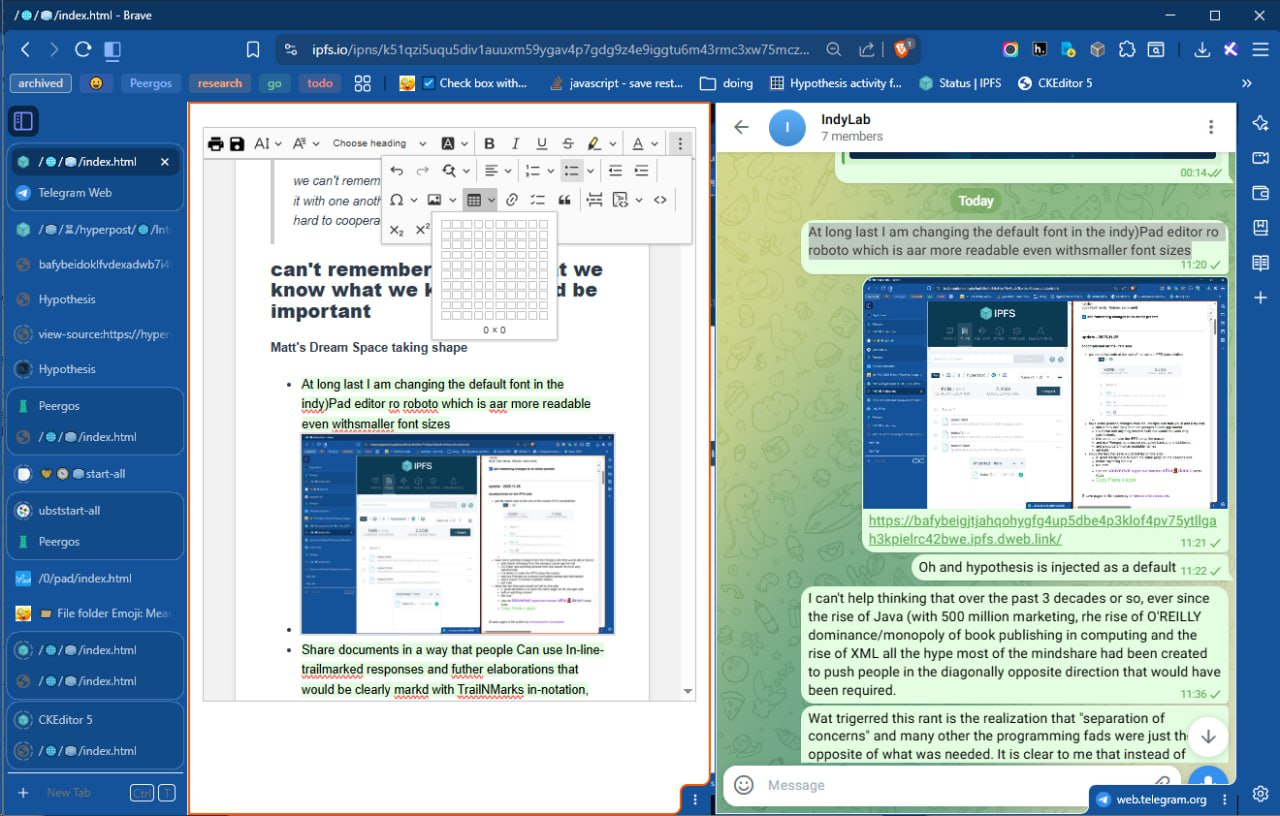
Better still, if I download the image from telegram, and upload it to IPFS using the WebUi in the browser I can than add that aved image via a link that is permanent
13:06
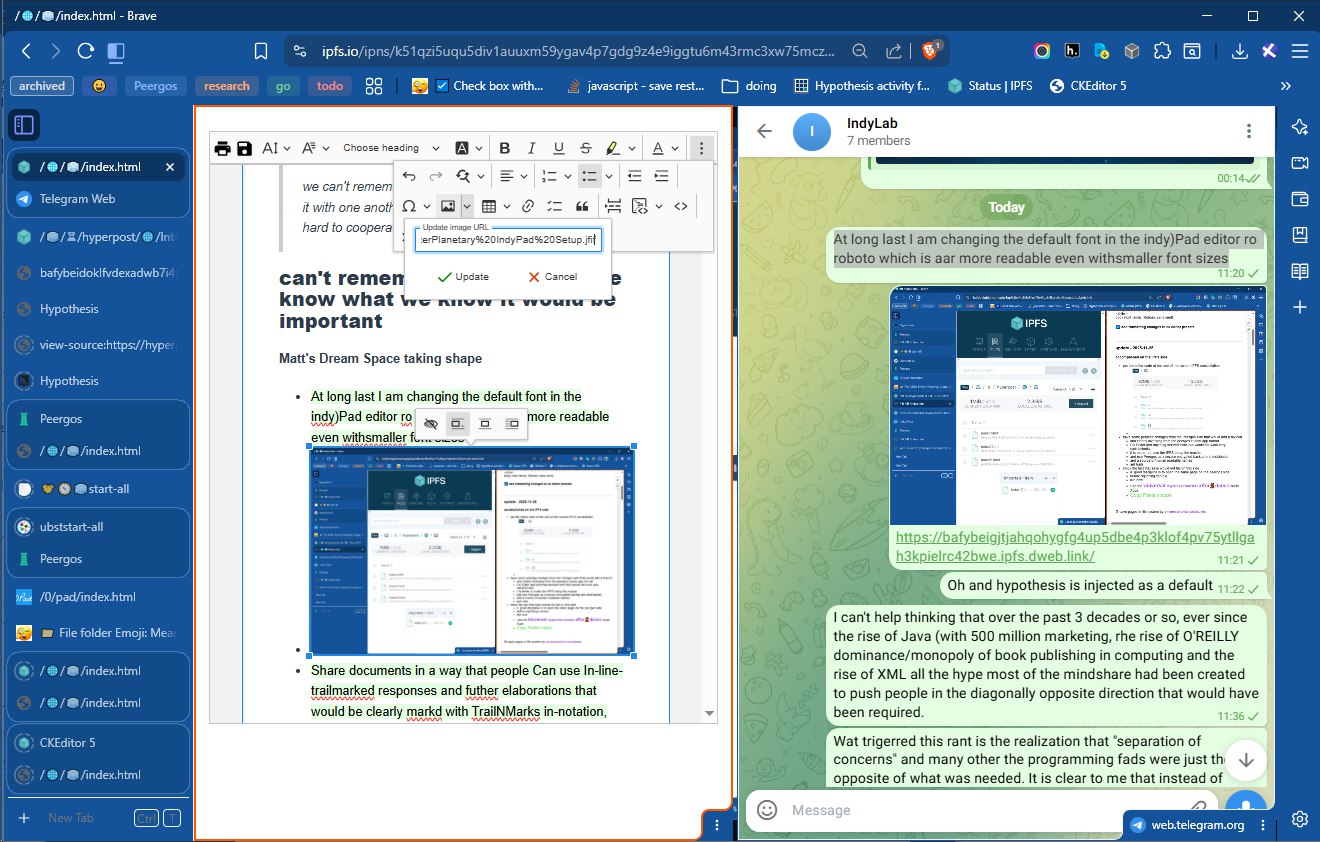
unfortunately the mouse moved so that image above is not whosing the magic, the abikity to add images via links
13:07
have another great workflow/affordance ready made by the developer of editor.js (I know hi well from the days when I was still active on twitter 6 years ago
13:08
I always knew this will come out in the wash in the long run. I just could not imagin it would 5 years
13:21
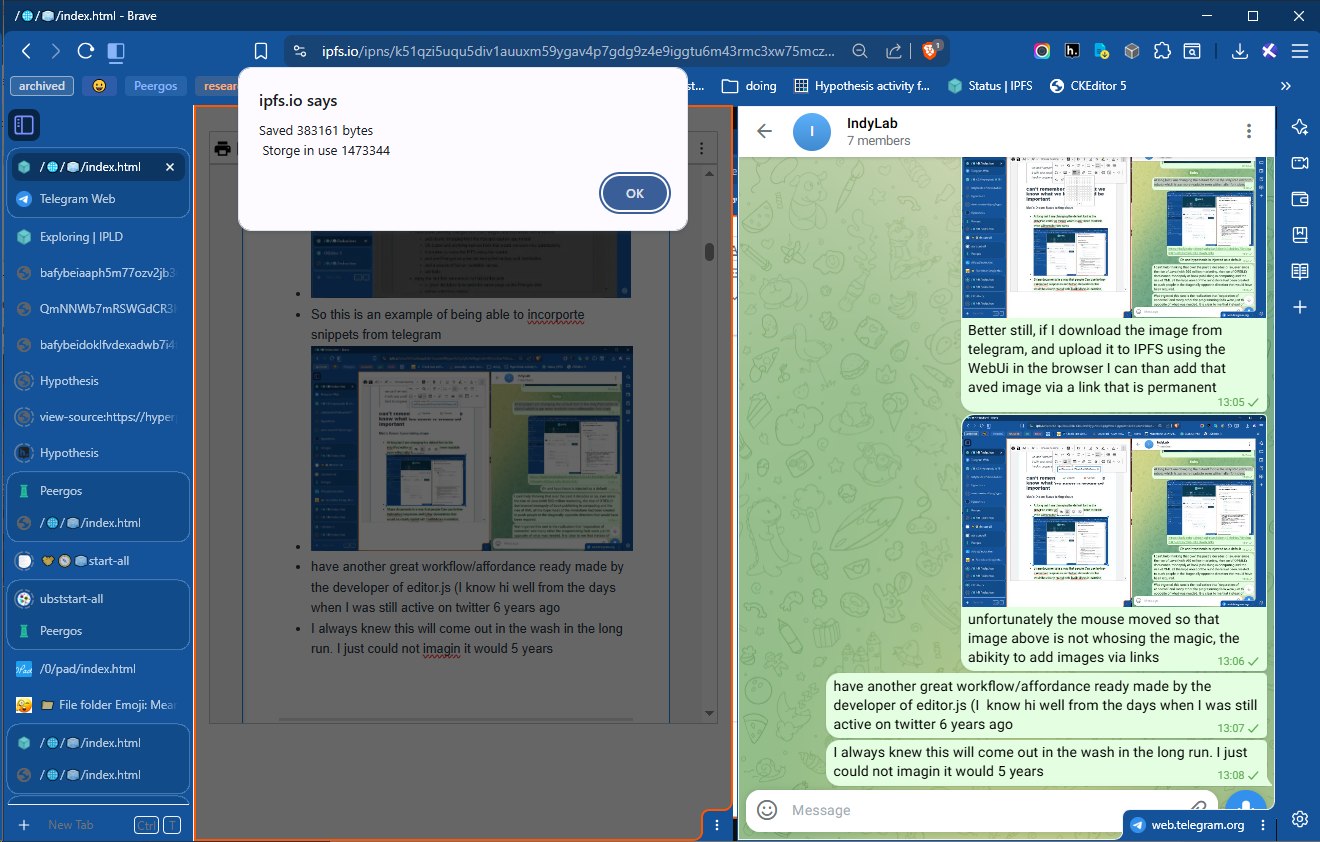
Here it is. Telegram notes making it into my notes.
⚡
ML
13:22
Actually, I can use this workflow to save screenshots and images in existing documents and replace them with dweb.links to saved images
13:23
I knew it will come out in the wash too!
13:26
The ability to search nd snarf great snipptes of conversations things of interestingness afrom telegram streams into 1's own documents itself is super useful. Can
13:27
Using SinglePage to personally archive web pages of interests, Websnarfing to make Surfing not ephemeral but recallable
👀
ML
13:29
let see if copying all that into a Peergos Indy 0Pad editor
13:31
would work. Using the Universal HTML Rich Text Transfer affordance Copy Paste to show tat it would allow selective transfer of information from one IndyWeb Infrastructural constellation to another from InterPlanetary to Peergos
13:42
now we have it on Peergos too https://via.hypothes.is/https://hyperpost.peergos.me/%F0%9F%A7%8A/
GL
14:03
☑️ add formatting changes to ck editor presets
do that first on the Peergos side
do that first on the Peergos side
14:04
In the document where I keep track of the work it is reverse chronological. Telegram is chronological
14:10
we need BOTH. Another one that vindicates the OmniOptional approach in the integral co-e-volutionary holonic emergent holonistic instance first-exemlars progressive formulative eplorimental meta-morphic intentional design methodology
ML
17:54
Michael Lennon
@gyuritrailmarker The other day we spoke about archiving threads (of conversations) instead of individual data / conversations alone.
What if the browser (and its history) rather than a separate app became the interface?
(The trailer for this "AI browser" made think about invisiblly re-accessing one digitial history)
https://www.diabrowser.com/
What if the browser (and its history) rather than a separate app became the interface?
(The trailer for this "AI browser" made think about invisiblly re-accessing one digitial history)
https://www.diabrowser.com/
GL
17:56
Gyuri Lajos
we need BOTH. Another one that vindicates the OmniOptional approach in the integral co-e-volutionary holonic emergent instance firs exemlars driven eplorimental meta-morphic design methdol
👍
ML
17:56
Browser
ML
GL
18:11
Gyuri Lajos
In reply to this message
hi Michael . Could you please measur ethe time it takes for the above link to load. It may just work now. Please ping me before you do so I can monitor the ipfs webui status tab
👍
ML
18:17
In reply to this message
regadingdia browser. If you take a closer look at my vertical tabs on those screenshots, I am already in deep converstions with my own mind across vertical tabls acrosss 6 brower profiles!. Imaging you could have conversations with the others. throug social bookmarking and as the network spreads you could be conersing woith other humans who share precisel your intersts at a micro level in depth.
👀
ML
18:19
BTW agregore has some built in private AI in it. I am interested in flipping AI (as IBM proposed a decadde go, called it Intelligence Autmentation, where aI plays a role nut strictly withn Human Loops, not as it is now where Humans are in the Loop for the mahcine, and the people behind the machine, foolish enough to think they can controls IT.(
18:21
The makers of Plantir clearly did not understand the book
18:24
In reply to this message
the slew of it will come. Not one video can convey all that. It like alll else willl come out in the wash in time.
18:27
I have the setup that would allow me to record my entire work. Too much fumbling still at the moment. I actually started the reording, but beause it is all emergent and nascent, I had trouble mainntining continuity. The day will come sooner rathe than later.
🙏
ML
ML
GL
18:28
Gyuri Lajos
Even if we had the capacity to for telepathy, we would use it rarely.
🤪
ML
18:29
I had that experience last June. We all hav etha capacity, just it is bloked for the sake of our own sanity.
👀
ML
ML
GL
18:30
Gyuri Lajos
We need less friction, but have to tread very very carefully.
👌
ML
18:30
just a minute
18:31
ready
18:31
You know you can serh your own tabs and history already in the browser. i use it all the time
18:32
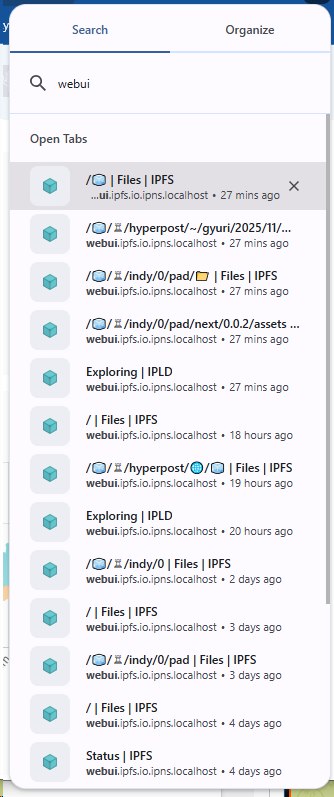
This is the way I switch tabs, thanks to vertial tabs in the Brae Borser I am 10 time more powerful
18:32
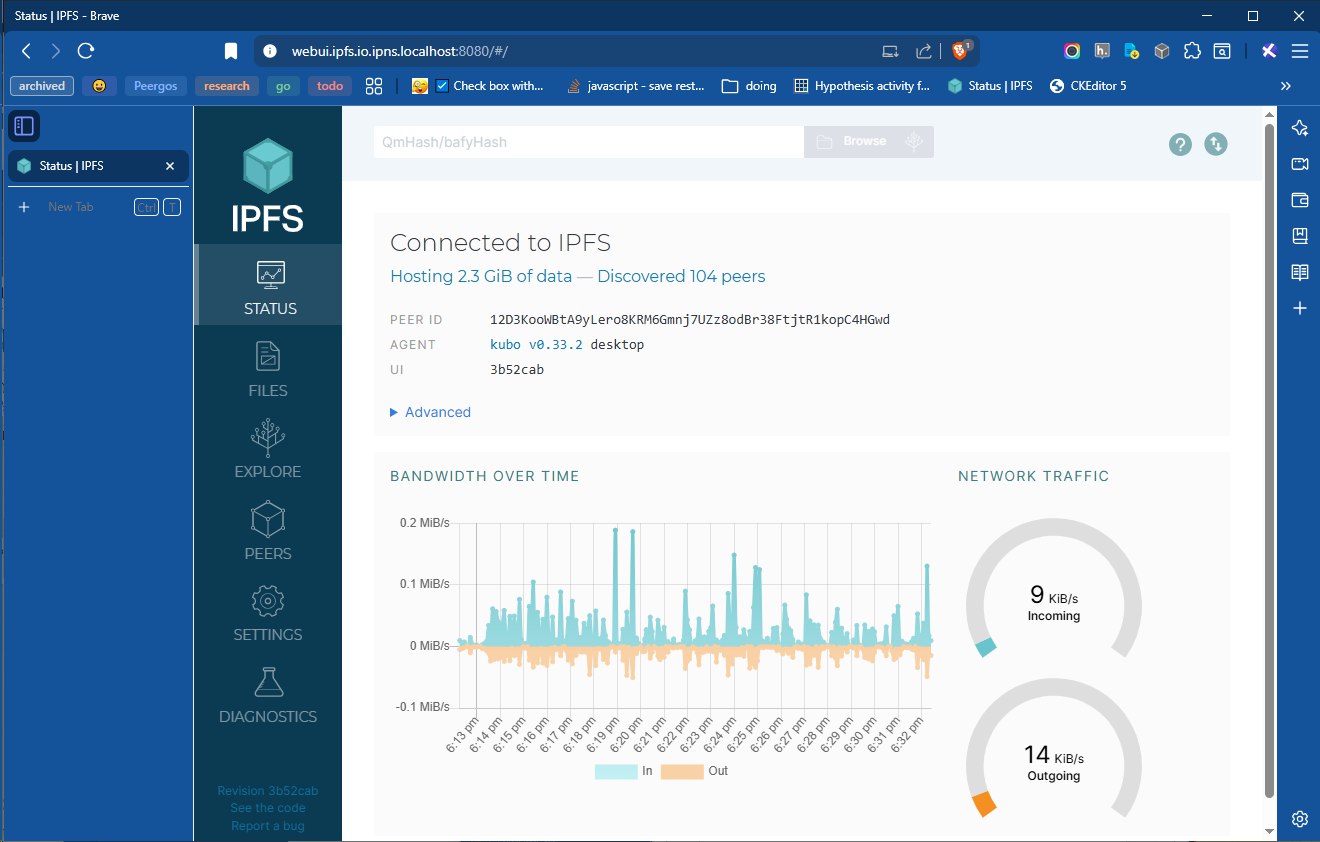
18:32
that means my capacity to work is already augmented, jus tby that
ML
GL
18:33
Gyuri Lajos
reload
18:33
I can always in it with Pinata that wold be the solution
18:34
But as the networks grows latency would improve and will beat any existing Cloud sevice
18:34
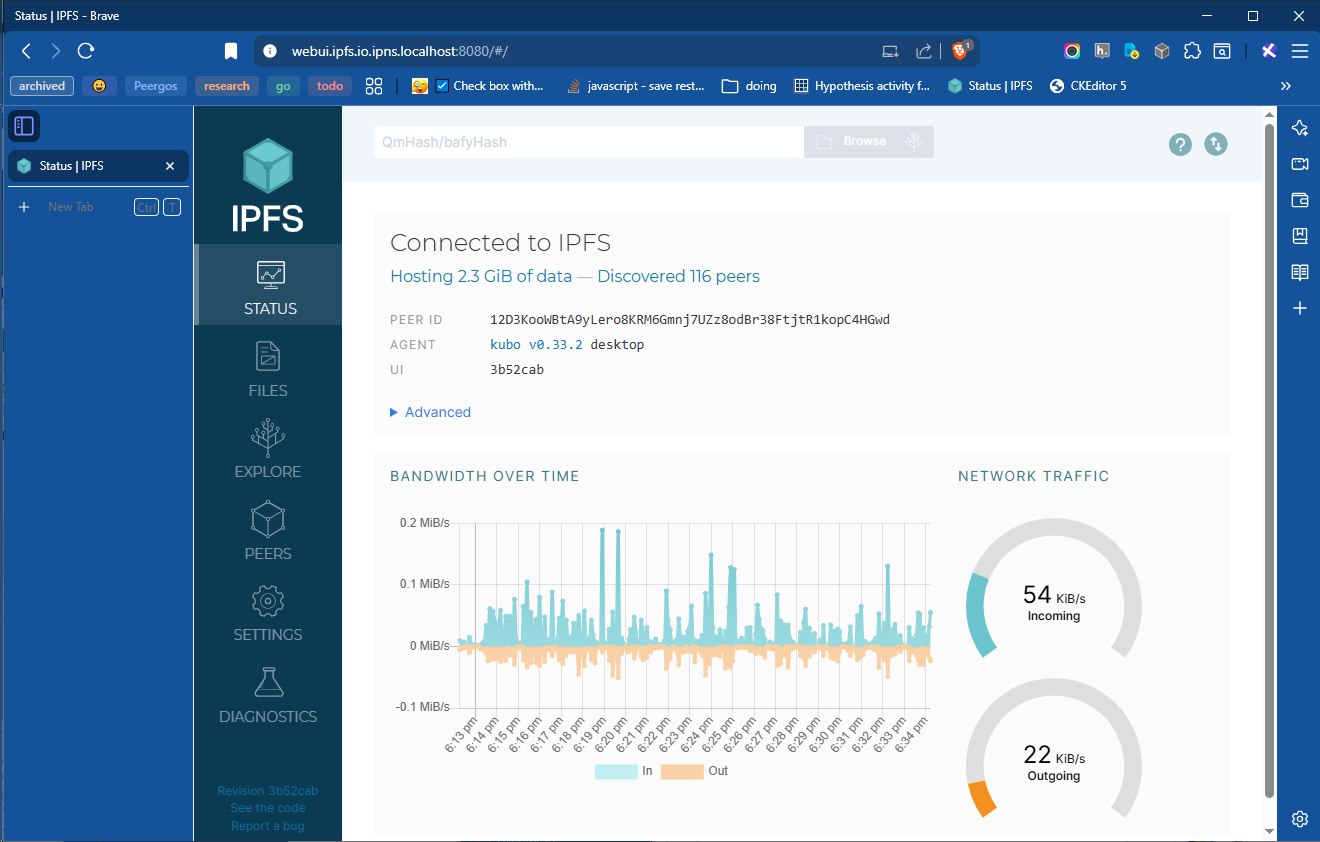
18:34
may need a couple of reloads without shift
ML
GL
18:35
Gyuri Lajos
refresh please
18:36
It has a lot of images
18:36
44 kb
18:37
need to install IPFS Desktop and run it in your browser like I do
18:37
there was a huge spike
ML
18:37
Michael Lennon
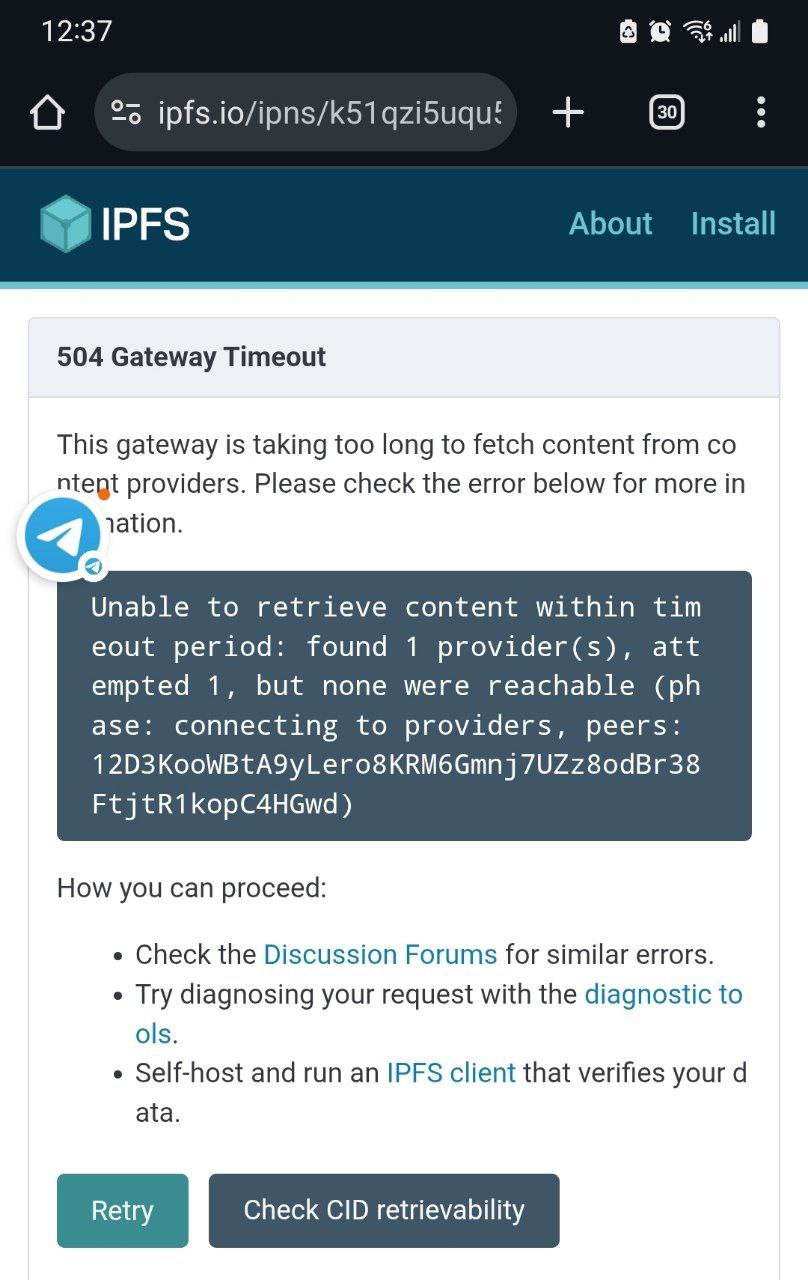
GL
18:38
Gyuri Lajos
do pres check CID availability and increse the time out period to 2 minutes
👍
ML
18:39
you can do that on that screen you shared
18:40
I open it on my mobile so you wil have another seed
ML
18:41
Michael Lennon
In reply to this message
Test successful twice (within 3 secs) Dont see option to increase timeout
GL
18:41
Gyuri Lajos
Loads under h10 seconds, the editor et least but the page is much laster
18:41
click on the check availability and configure backend or something along these lines
18:42
It loaded ready for editing
18:42
If you switch to desktop view it is nearly usable
18:42
you have to long pres to change the position of the cursor. Not recommended. Indy Wiki 0Pad will be better for mobile
18:44
Indy Wiki 0Pad accesses the same MindPlex but with finer granularity. I built a prototype for that 18 years ago. It wa mbobile First
18:44
Please share screenshot of the desktop view
18:45
It will reload for that
18:46
There is ome caching going on on the mobile
18:47
That suggest need to share IPFS links to the document
18:47
That's why testing is so important
18:47
Thank you for doing the test
👍
ML
18:51
That's not caching issue I did not save the latest version on IPFS yet. That's what I am working on. But can do it without extending the code. Just upload the Peeros Version to IPFS
👍
ML
ML
18:56
Michael Lennon
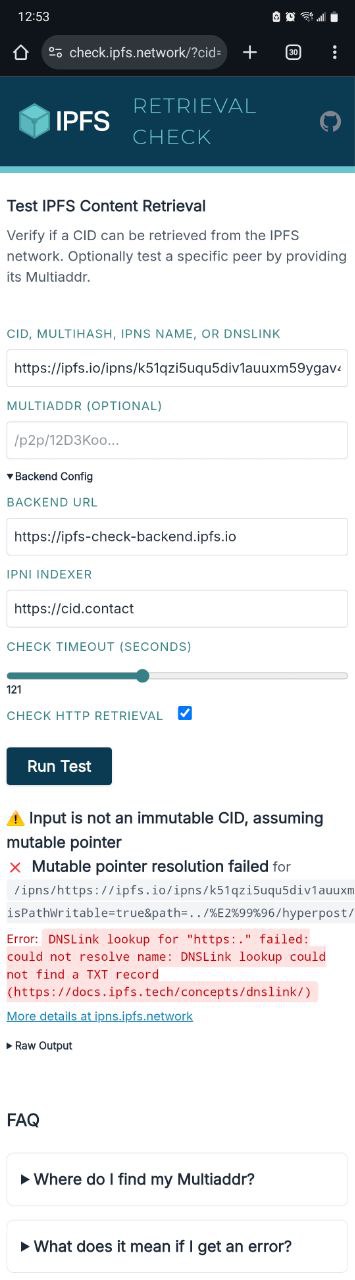
18:57
Hopping on a call now. Later
GL
18:59
Gyuri Lajos
Very helpful thank you
19:02
Lesson learned.
Use Ipns and meaningful urls when working locally share everything whith opaque CIDs and share rich meaningful contexts only through trusted mutually recorded trusted channels
👍
Use Ipns and meaningful urls when working locally share everything whith opaque CIDs and share rich meaningful contexts only through trusted mutually recorded trusted channels
ML
GL
19:32
I'll be away from my machine. I loaded in an instant on my mobile
19:35
embeded hypothesis took a little more time to load
19:35
I guess my mobile can be a seed for it now
ML
GL
21:27
Gyuri Lajos
Yep thanks
21:30
It all fits together. Pages can be shared openly and every page can be a portal to the inter-planetary inter-personal read write open co-laborative autonomous permanent evergreen Web the indyweb
👍
ML
29 November 2025
GL
16:58
Gyuri Lajos
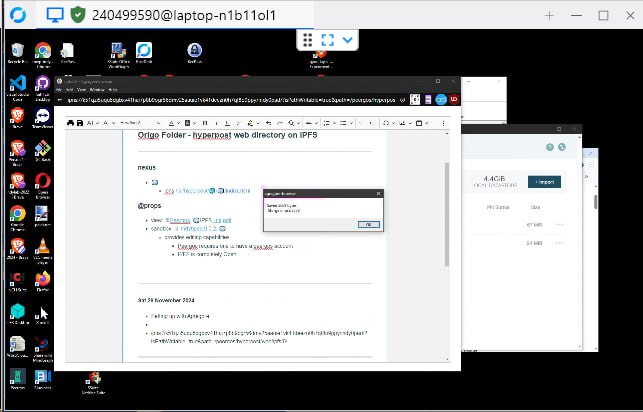
Major step towards closure. indy0pad is setup with Agregore and uses ipns://
16:58
Just one call away from technical demonstrator
16:59
Major gotcha IPFS resolver does not like UTF8ICONS in file Paths
👀
ML
17:01
That Should not be aa showtopper. In fact there are cogent arguments for avoiding them. However each folder would have its own Origo Folder where the associated UTF8 Icon can be designated.
17:14
In line with the progressive accelleration over the past month or two. I did not need to make any changes, as the whle point of Agregore is to provide for orginal fetch put designed for the Old Style entralized legcay web to work on the DECENTralized web across protocols. So since we re in the IPNS world that save in the code that failed till now just magically worked!
17:14
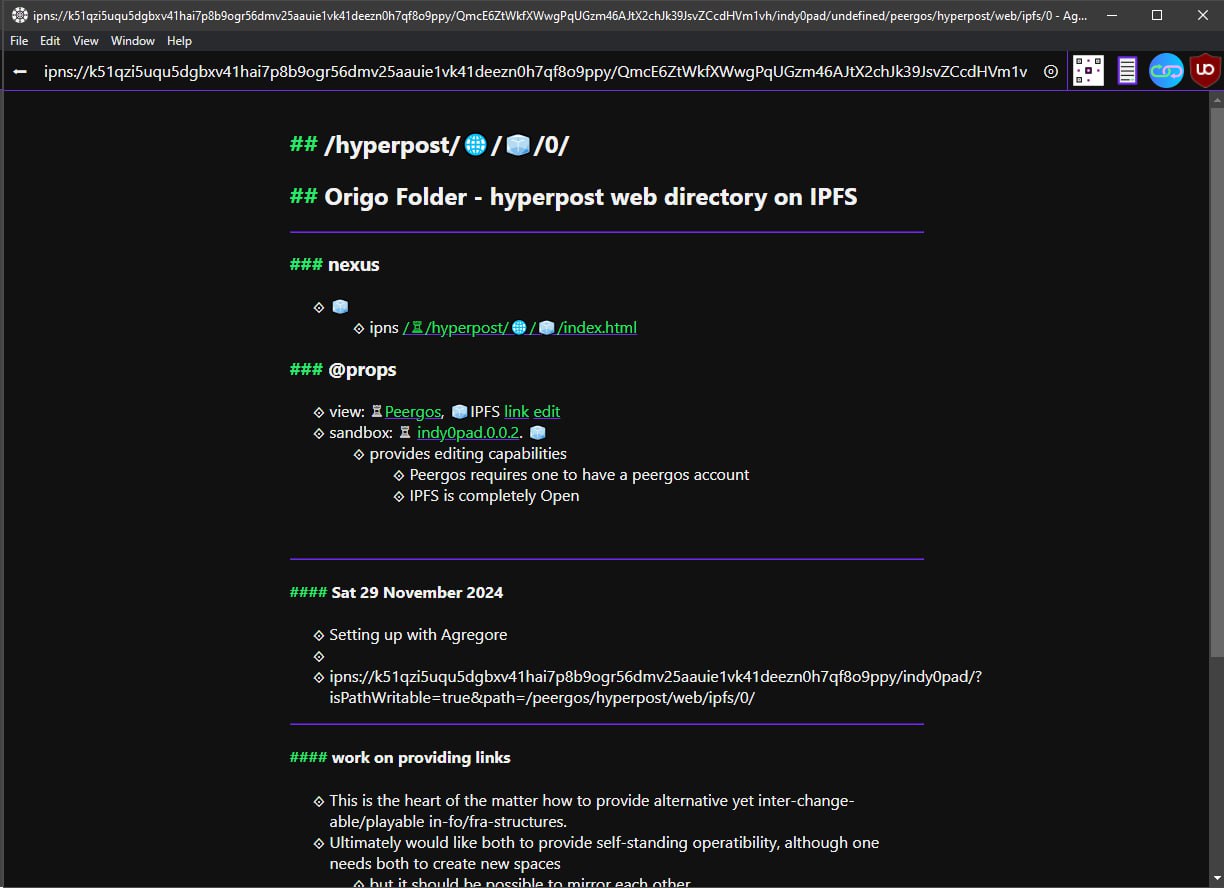
Historic Achievement. The best of it is that all I had to do is to make the right technoogy choice!
🤩
ML
17:15
ipns://k51qzi5uqu5dgbxv41hai7p8b9ogr56dmv25aauie1vk41deezn0h7qf8o9ppy/QmcE6ZtWkfXWwgPqUGzm46AJtX2chJk39JsvZCcdHVm1vh/indy0pad/undefined/peergos/hyperpost/web/ipfs/0
30 November 2025
GL
12:54
Gyuri Lajos
The long wait is over. I took the Long View nearly a decade ago, that IPFS is the future
Been using IPFS Desktop for the past 6 years but only this latest update manages to make it a viable system
🤩
Been using IPFS Desktop for the past 6 years but only this latest update manages to make it a viable system
ML
13:01
Just in time. Both Peergos, IPFS, Agregore PeerSuite are getting ready for Prime Time. Next one the IndyWeb itself
13:04
3 years ago I built it using OrbitDB as a self contained App. It was Open Source, but not really Open Construct, it was not easy to tinker, personailize customize extend exapt. It was a lot of complex behind the scene complex ode base, relying on a WebFramework best of its kind, except the very idea of a WebFramework was wrong. vanilla JavaScript css is the way, that you can tinker with right in your browser, and thanks to IPFS you can share it interplanetarily
13:05
I bet at the time on the possibility of going not only with Open Source, but Open Construct (I did not have the name for it, Peersuite is a great example) and truly Open Sauce!
13:07
I was betting on IPFS (Desktop) would deliver on its game changing potential. It just did!. I've been running towards this puck for the past 7 years, I'm ready and it is right here right now
🆒
ML
13:07
another great advance. One small step, one lchange, a giant leap for Human Kind
Congratulation
🙏🙏🙏🙏🙏🙏 🎈🎈🎈🎈🎈🎈
Congratulation
🙏🙏🙏🙏🙏🙏 🎈🎈🎈🎈🎈🎈
GL
13:24
Gyuri Lajos
the Do It yOursleves Web
1 December 2025
GL
GL
12:05
Gyuri Lajos
This is a key part of what I call today
Social Networked Essays,
reverting back to the etymology of the word that derives from
"Trial in thought"
which is not jus about writing, but leverages social shared web research, Personal Web Archiving weaving the Open Indy Mutual Learning Commons!
🆒
Social Networked Essays,
reverting back to the etymology of the word that derives from
"Trial in thought"
which is not jus about writing, but leverages social shared web research, Personal Web Archiving weaving the Open Indy Mutual Learning Commons!
ML
12:09
I have all the virtual self-hosted scaling local-first, permanent, everreen scaling, Open construct infrastructures up to Interplanetary scale, scaling not not just reach but Augmented Human Inter-Extellect (shared externalization of Human Interpersonal Human Intellect that is InterPersonal does reach from me 2 us 2 we 2 all organizing the ever expanding frontier of Human understanding so as to be understood. With full provenance and attribution of all info-morphic-communication-work-flows, such that the emergent territory of mutual learning itself is autmatically self-orgnising into HyperMaps that resolve to the territory
12:13
Scaling reach and mutual learning simultaneously.
🤩
ML
12:15
Better later than never. IPFS is as of 4 days ago is up to the job https://github.com/ipfs/ipfs-desktop/releases/tag/v0.47.0 see earlier messages
12:19
These Essays are not only about ideas but autopoietic affordances that empower people to Do IT for Temselvs. Do IT yOurselves Web
GL
GL
17:15
Gyuri Lajos
Tried to explain why IPFS Desktop need to be interplaying with Peergos.
17:17
The wholly grail is to be able to offer that capability to People who would "host" commnities soch that the member of the community do not need a eergos account or even downloading IPFS Desktop or Agregore
17:17
Would like to have an Agregore powered constellation that would be selfsufficient too
17:18
The easiest to achieve is currently to have Both Peergos account and IPFS Desktop. TYhis combination could be suffiecent to bootstrap Indy Spaces autnonomusly thanks to the way it is working and will work that would be easy to emulate and compelling to do.
17:19
IPFS does not provide you with search cpability for files not even for your local desktop
17:20
If you combine Peergos with IPFS and setup mutual mirroring (Peergos has the built in apability to mirror a local file system) then 1 can use Peergos built in filename search1
17:20
Just wanted to note this down as an important thing to bare in mind
17:20
Off to Aua Fitness
GL
17:35
Gyuri Lajos
another great idea
17:37
a given Peergos account that one owns can b viewed a s a virtual machinejust the same way as an IPFS folder can be set up on all my machines to be a named filstore that is accesible from anywhere, can do the same for own controlled Peergos Accounts
17:38
writing a module that can mutually mirror between IPFS folders and Peergos folders is something that would be quite straightforward
2 December 2025
GL
23:21
Gyuri Lajos
started to write my first Indy HyperBook https://bafybeig7nrhxx3nyb5rfmuj7cfy5xbl4ldtwr57ol6lykibww625qkxnke.ipfs.dweb.link/?filename=hyperpost-0.html
23:26
So many things are getting right with this https://hyp.is/1ktH1M_NEfCLsOf5NZtnug/bafybeig7nrhxx3nyb5rfmuj7cfy5xbl4ldtwr57ol6lykibww625qkxnke.ipfs.dweb.link/?filename=hyperpost-0.html
23:28
Share work, with Hypothesis embeded on the InterPlanetary File system mirroring work done using Peergos Account
GL
23:56
Checkout the page notes
3 December 2025
GL
12:18
Gyuri Lajos
I annotated this page 5 years ago
12:19
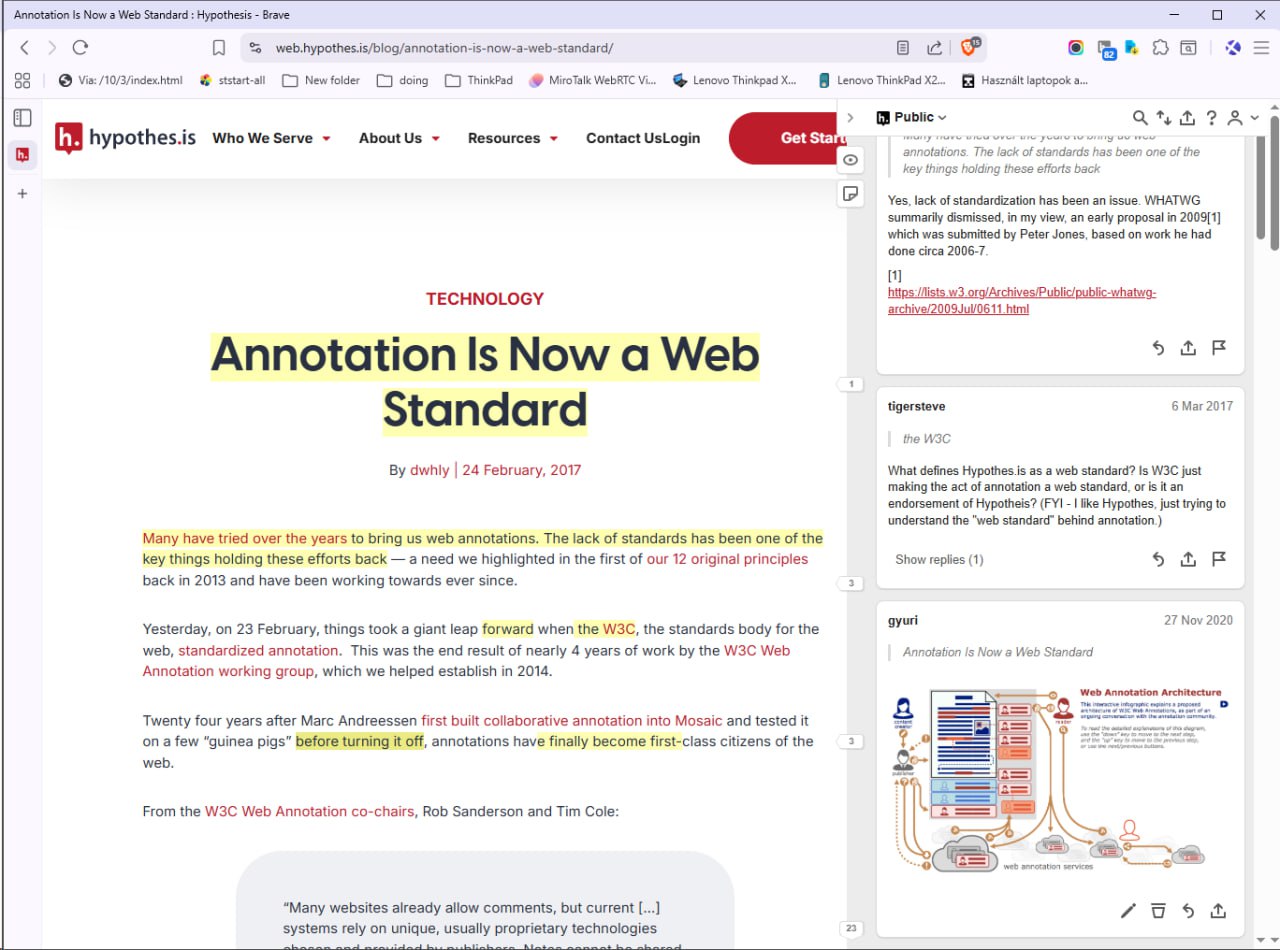
Annotation is a new Web Standard
12:20
On the hypothesis website explaining the basics of hypothesis
12:21
They used one of my annotations as an example
👍
ML
12:21
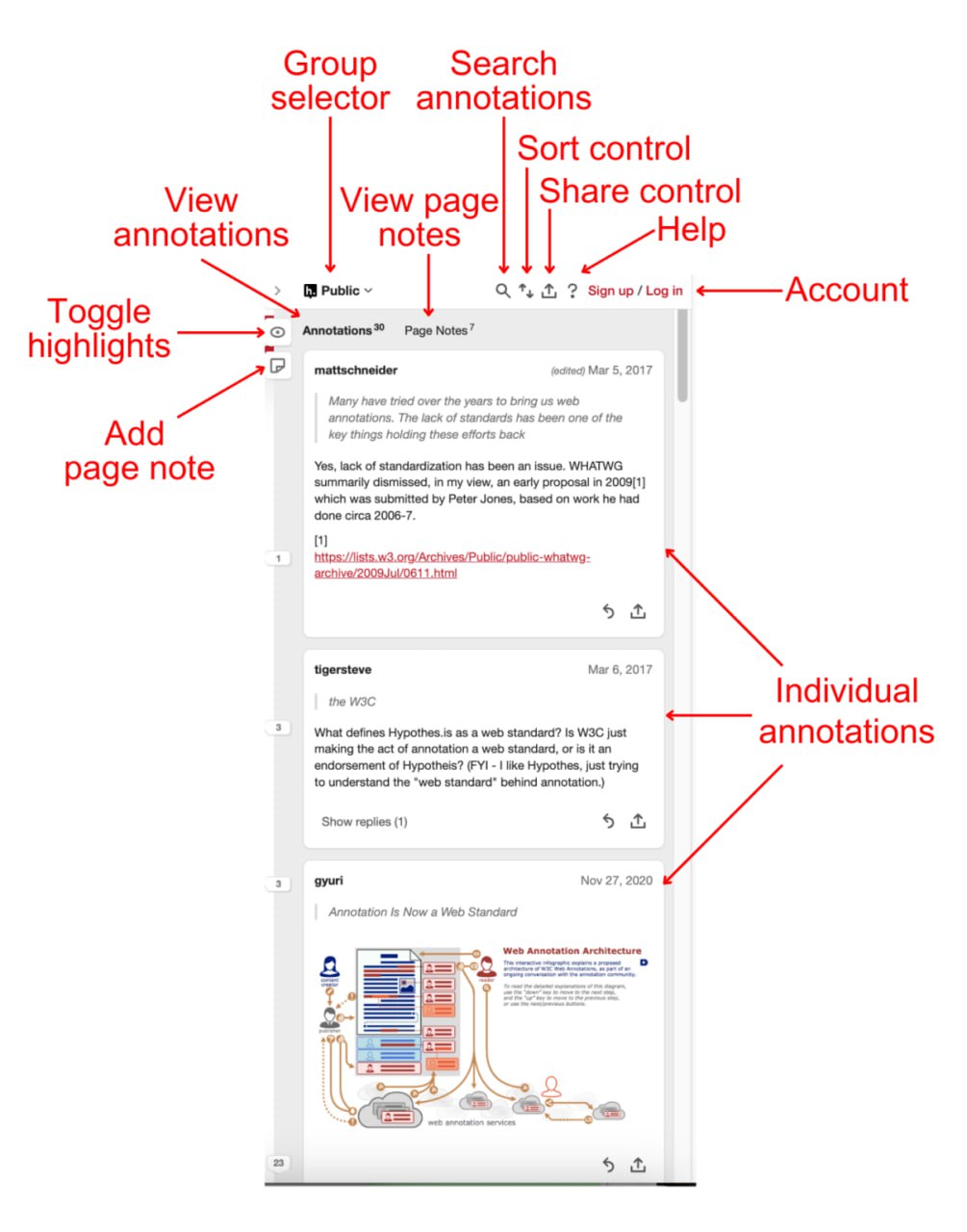
halls of Hypothesis fame
🏆
ML
12:42
Well everything is in place to deliver on that promise. Better still we an have Interest based emergent Autonomous Interplanetary interpersonal trust base social networks in the commons. Unstoppable, permanent, evergreen
12:42
co-laborative
ML
GL
19:32
Gyuri Lajos
In reply to this message
I always intended to swap out Google+. It was shutdown within 2 months before I could launch. Looking back that was a blessing in disguise.
ML
19:35
Michael Lennon
In reply to this message
The https://hyperpost.co/# home page is still centered on Google+
GL
19:36
Gyuri Lajos
That's what I presented in 2017 Future of Text Symposium in Southampton.
19:37
It is what I presented there as is warts an all.
👍
ML
ML
20:31
Michael Lennon
Recent inyerview with Alan Kay https://youtu.be/3M6_aoTEtBQ?si=DB3xH168BKold84t
ML
GL
4 December 2025
GL
00:06
Gyuri Lajos
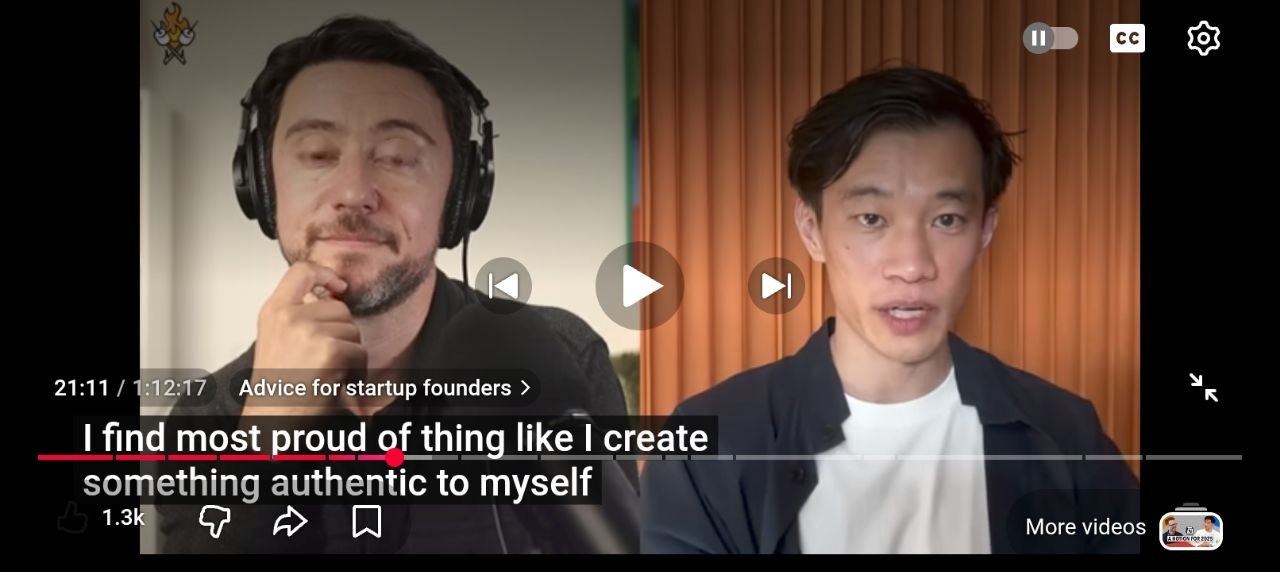
GL
02:01
Gyuri Lajos
Making money rather than civilization
😐
ML
6 December 2025
GL
07:56
Gyuri Lajos
Found the post about the breakthrough improvement to IPFS Desktop that makes the promise of IPFS realized https://ipshipyard.com/blog/2025-dht-provide-sweep/
07:59
Just in time, as hypothes.is sunseets via.hypothes.is. Relyingon IPFS Desktop 1 can save every age of interest on the web using /singleFile, then save that resource in 1's IPFS Desktop. Automatically embed hypothesis, so that 1 can share that personally archived page of interest connected meaningfully into 1's Personal Indy Learning Trail, make it permanent, contextualized, and part of 1's indranet workspace ready for interpersonal sharing and collaboration
🤩
ML
CB
08:01
I'll ressucitate my first "product" WebTrails private chrome extension, the one that would dynamically build a graph of visit of all web pages that 1 savs in their own(ed) slaince landscale of enscape
08:05
ready to be trailmarkd and permanently available connected to everything that is relevant via explicitly namd links that would help to mak snse and gives the ability for permanent recall in context or rather I should say conPlex the entire scaffoildings innoatated associated neighbourhood of 1s past experience, such that by sharing just 1 link 1 can claim to have been able to share an entry point to everything that 1 learned abut that and related subjects at scale with permanence ready fo social learning and expanind the frontiers of emergent augmented co-laborative human e=mututal learning
🤯
ML
CB
08:05
Now that is the beginning of closure
GL
11:55
Gyuri Lajos
In reply to this message
The same thing is now available on the Permanent Web! at https://bafybeihwigujdzh7xrbwmf2t2zv5eku6cr3reb5qzqmhgrpnfdd2ryhh7y.ipfs.dweb.link/slides2.html#/0
11:56
it works fine on my machines but that means nothing. please confirm if it is working
12:00
🙏☑️❓✅:❌
12:01
meaning 🙏Please ☑️todo ❓test if it works ✅: iOR not❌
GL
12:43
Gyuri Lajos
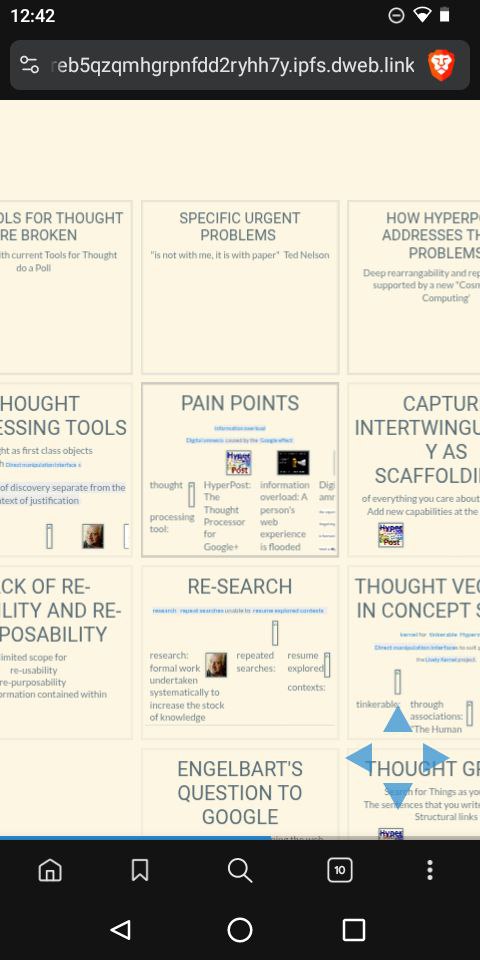
On mobile if you pinch a slide it shows yo the map of the slides focused on the one u been looking at
👍
ML
7 December 2025
JW
05:31
James Wong
In reply to this message
Resolves for me. Pinch and slide works on mobile. Nice to see you talking about this slide deck again.
JW
05:57
James Wong
In reply to this message
- Trying to imagine how you are implementing the full provenance architecture.
- Does webtrail provide part of provenance affordance?
- by recording the trajectory of web or social learning.
- Then hypothesis annotations of the website you visited are
- imported into mindplex
- (IPFS with a timestamp?),
- Does that complete the provenance affordance
- by providing a complete timestamped record of your web journey?
- When you are synthesizing in your own mindplex,
- in the Indyweb editor,
- then commit to IPFS
- via the save (commit to IPFS button),
- then share that mindplex node with someone
- through a Peergos link,
- does that sequence then complete the provenance step for synthesis?
So are these the two legs that create provenance for all aspects of knowledge work?
- the social learning and
- individual synthesis
Have I got the picture correct?
👀
- Does webtrail provide part of provenance affordance?
- by recording the trajectory of web or social learning.
- Then hypothesis annotations of the website you visited are
- imported into mindplex
- (IPFS with a timestamp?),
- Does that complete the provenance affordance
- by providing a complete timestamped record of your web journey?
- When you are synthesizing in your own mindplex,
- in the Indyweb editor,
- then commit to IPFS
- via the save (commit to IPFS button),
- then share that mindplex node with someone
- through a Peergos link,
- does that sequence then complete the provenance step for synthesis?
So are these the two legs that create provenance for all aspects of knowledge work?
- the social learning and
- individual synthesis
Have I got the picture correct?
ML
06:00
In reply to this message
Do you mean to say that this process can somehow replace via hypothesis affordance, especially with annotation of the transcription of YouTube videos?
GL
08:38
Gyuri Lajos
In reply to this message
The goal is to avoid needing to implement much. Constellation of infrastructures and leveraging existing capabilities and ultimately aiming for things emerge through connections. Remains to be seen.
ML
16:26
Michael Lennon
In reply to this message
Of "closure" or of "composting"? Living systems compost and metabolize
GL
20:20
Gyuri Lajos
In reply to this message
I had in mind transitive generative closure whole new spaces
Gyuri Lajos invited Charles Blass
GL
GL
GL
CB
8 December 2025
GL
00:01
Gyuri Lajos
Google+ was an interest based social network that was shutdown at short notice in 2018 just as I was ready to launch. Getting ready to launch it weaving autonomous social network. Actually it will also be a recreation of much of the functionality of Google Wave one that will be inter personal and interplanetary unstoppable and permanent
👀
ML
CB
GL
09:34
Gyuri Lajos
In reply to this message
in a way, yes. 1 can Use Single file to save Web pages of interest on IPFS so that the saved content embeds the JavaScript using a script element added so hypothesis loads automatically for the page when loaded from IPFS.
It also has linj elements that designates the original url as canonical so that annotation on the original page show up along with the personally archived local copy obtained by SinglePage and saved by IPFS Desktop and shared by 1
It also has linj elements that designates the original url as canonical so that annotation on the original page show up along with the personally archived local copy obtained by SinglePage and saved by IPFS Desktop and shared by 1
09:36
I want to deeply interplay with hypothesis search
Save searches themselves in personal IndyDrive@IPFSDesktop lol Cally replicate it on other devices and on Peergos account if 1 has one with hypothesis embedded and opened to be deeply two-way linked to own documents created for keeping associated notes acting as a portal to 1's own personal indranet work space
Save searches themselves in personal IndyDrive@IPFSDesktop lol Cally replicate it on other devices and on Peergos account if 1 has one with hypothesis embedded and opened to be deeply two-way linked to own documents created for keeping associated notes acting as a portal to 1's own personal indranet work space
09:47
Better still save all pages surfaced by hypothesis search in your personal local-first interplanetary web archive
09:50
1 can share any page as a portal to initiate interpersonal recorded connections and threaded conversations publicly or privately Peergos to peer or peer to named communities
CB
GL
10:23
Gyuri Lajos
Yes. Announced in November/December 2017 sunsetting by August 2018, Started shuting donw groups in Janary, first one was the one brand new 2k strong community discussing where to go from here! Internally by then they abandoned the dont be Evil Ethical code and switched to the new one do the right thing (right for who? As Milosz wrote anybody who think that they are 100% that signals that they are ready to commit genocide. By early Fenruary it was all gone
CB
11 December 2025
GL
00:46
Gyuri Lajos
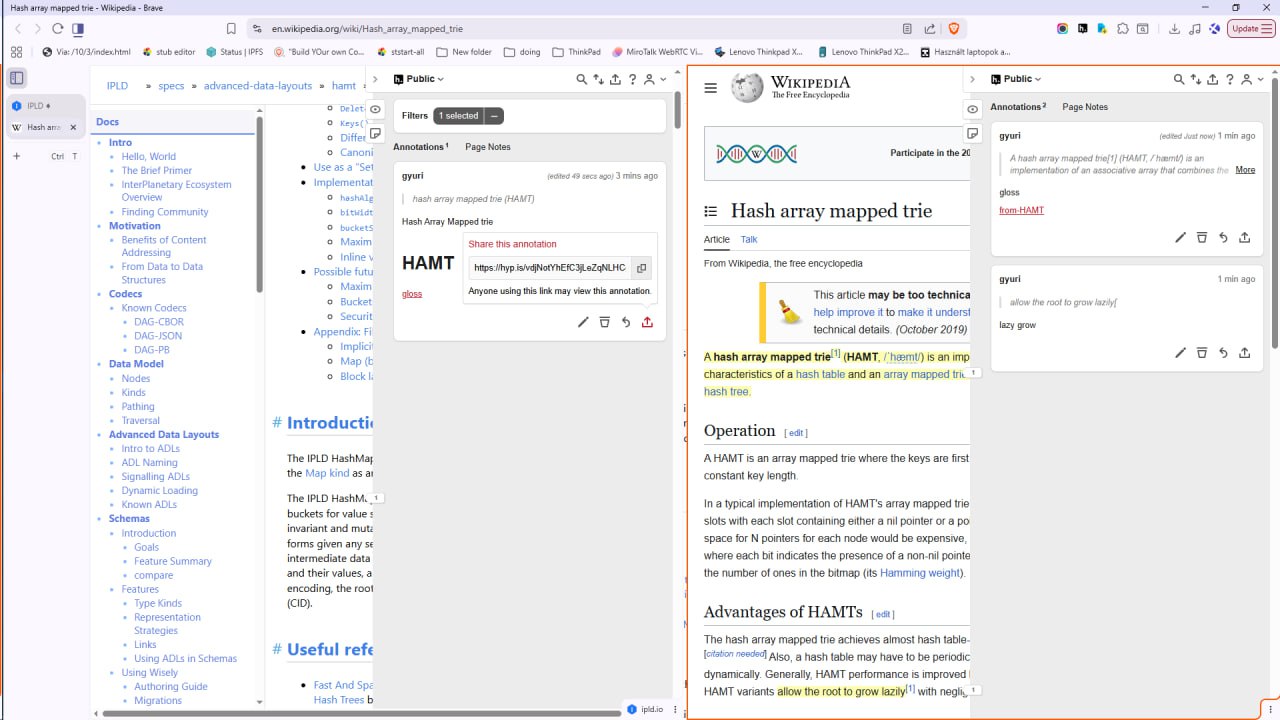
Use Brav's vertical Tabs and split-view makes creating bidirectional links accross annotations a breeze
GL
16:34
Gyuri Lajos
sharing PDF with Hypothesis annotation capability included worked 2 years ago and sit does https://bafybeihlkpp5zcpfzpyiogzxdsxbolhoppdezqqqj6jvgghfvx6k6tep4u.ipfs.dweb.link/pdf/viewer/web/viewer.html?file=https://bafybeieg5jhz5d5mlr7l6pbzulkuuvrxsgq3l5wau6zsq73y3bmah4hywq.ipfs.w3s.link/Wikinizer_%20Introducing%20MindGraph%20_%20LinkedUp_%20Linking%20Web%20Data%20for%20Education%20-%20An%20EU%20project%20about%20the%20potential%20of%20open%20data%20in%20education.pdf
16:36
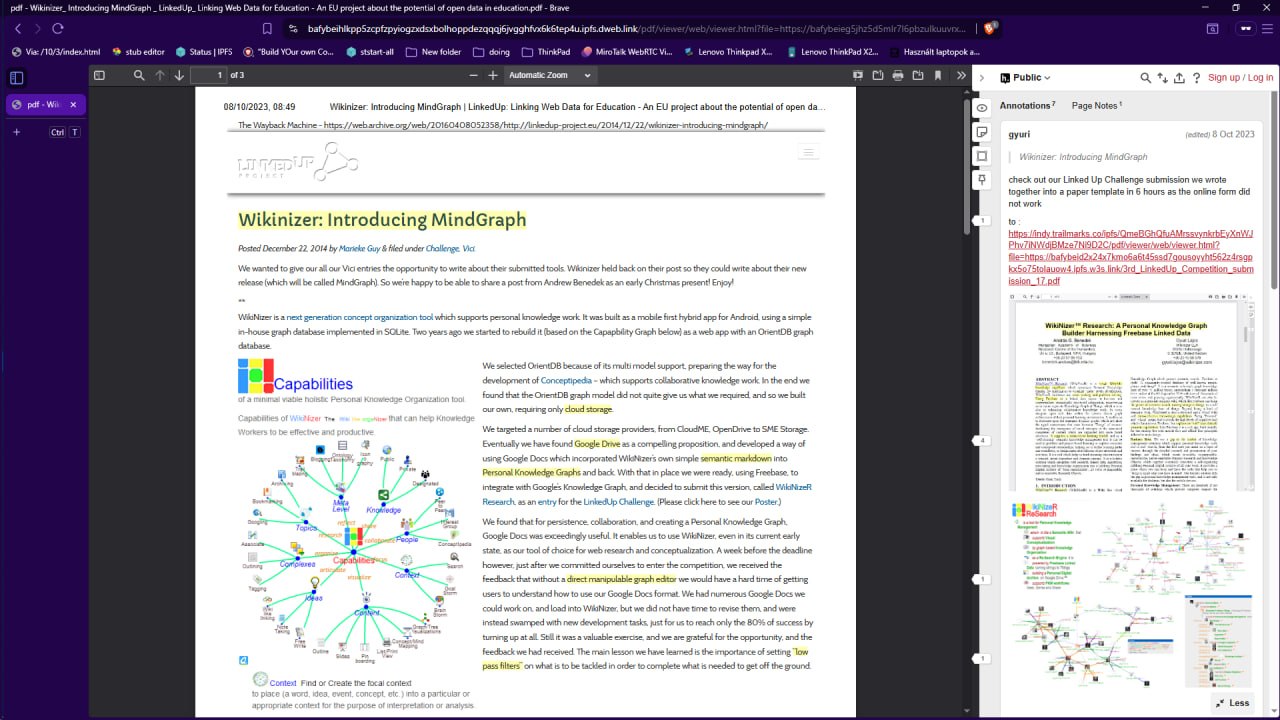
information needs to be personaized reorganized and contextualized
16:39
ACtuall Human Deep Mutual Learning where structure and collaboration can emerge
12 December 2025
GL
01:30
Gyuri Lajos
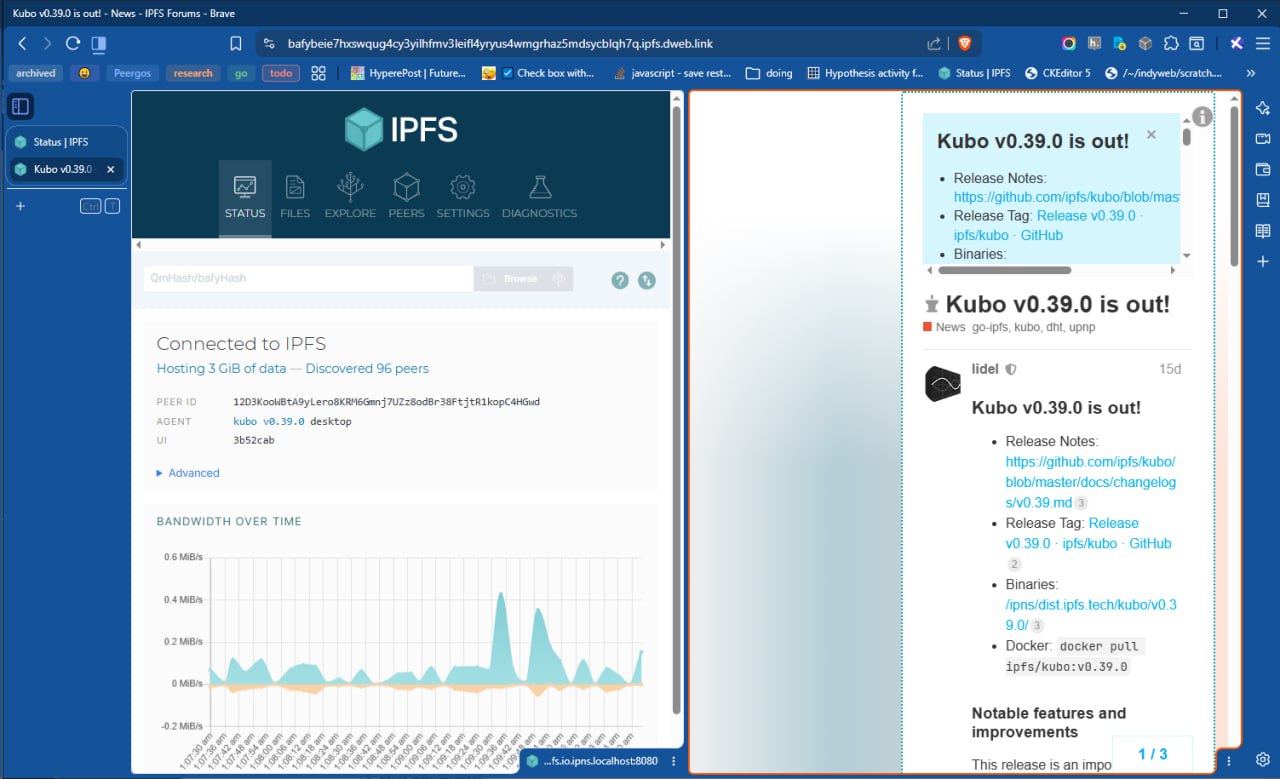
Kubo Provider Sweep
GL
GL
09:38
Gyuri Lajos
The sheer audacity of this is remarkable https://via.hypothes.is/https://www.youtube.com/watch?v=skMTdSEaCtA
15 December 2025
GL
GL
16 December 2025
GL
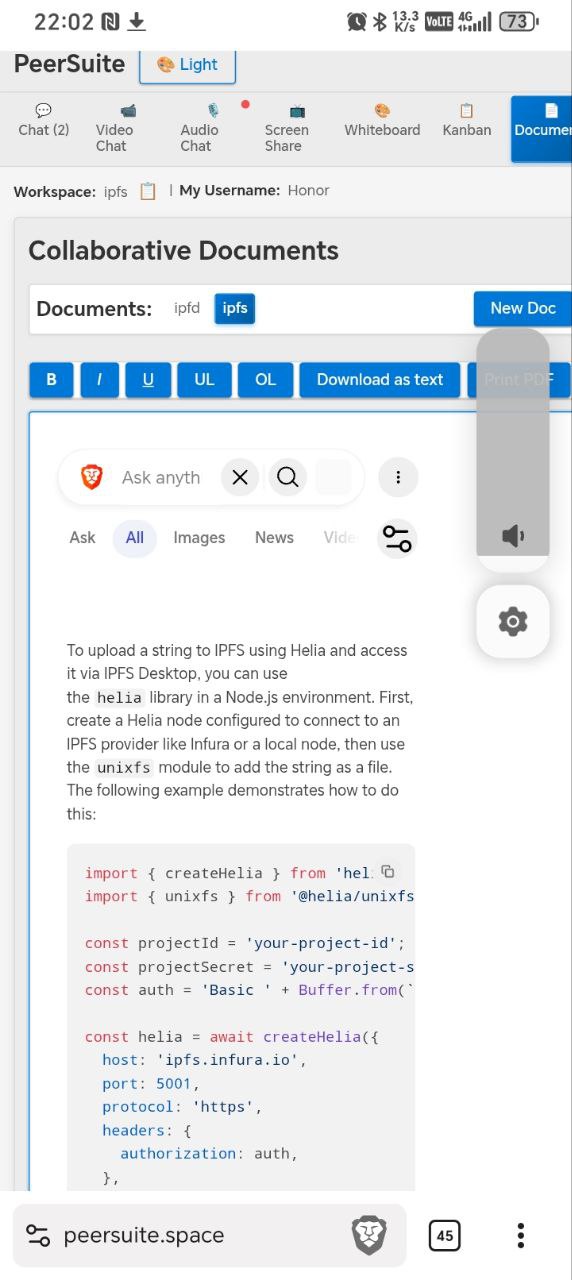


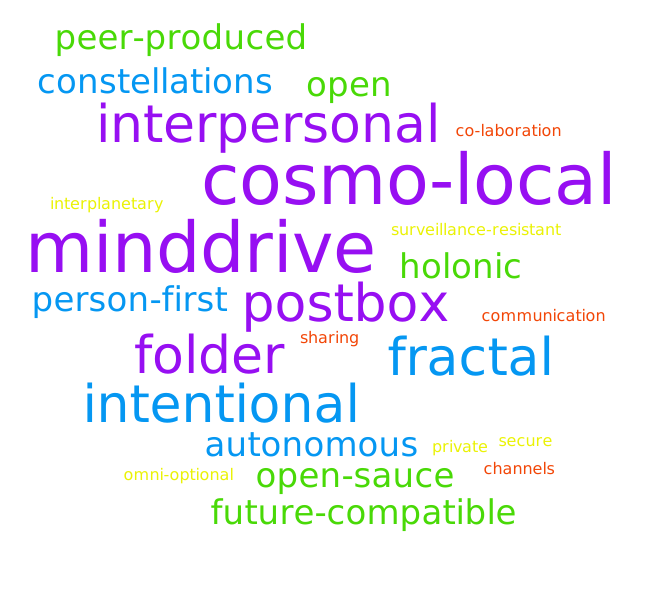

22:04
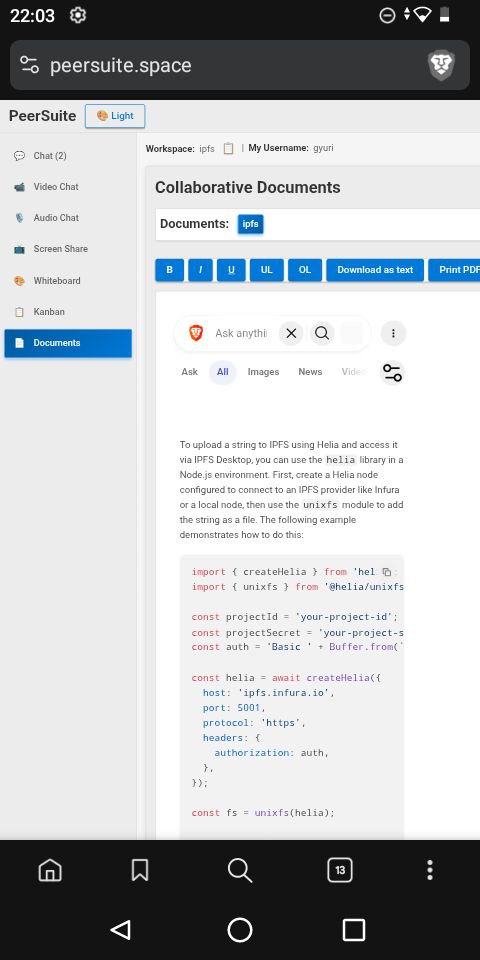
Best thing since sliced bread
GL
22:25
Gyuri Lajos
helia upload string to IPFS desktop - Brave Search
https://search.brave.com/search?q=helia+upload+string+to+IPFS+desktop&source=android&summary=1&conversation=260309d10df41fc86dd70f
https://search.brave.com/search?q=helia+upload+string+to+IPFS+desktop&source=android&summary=1&conversation=260309d10df41fc86dd70f
22:34
Started all this on my Honor Mobile
22:35
col-caborated with my iLike mobile that is good to write on
22:35
turned my ThinkPad laptop on
22:35
connected to the conversation and have this now too
22:36
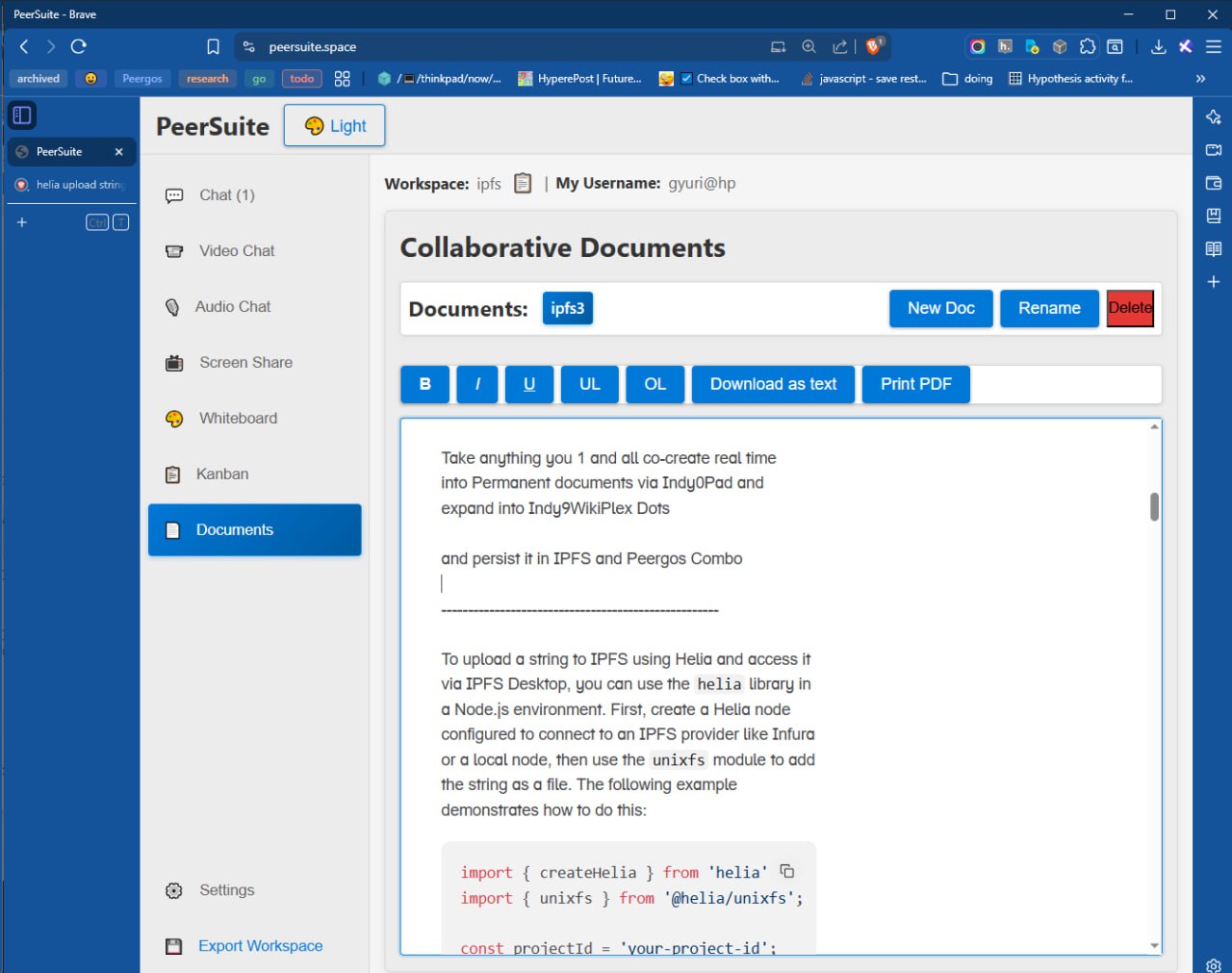
Same conversation on my ThinPad laptop
GL
23:29
Gyuri Lajos
This is obtained by singlePage